Camborne, Cornwall – Trevithick’s Town, Tin Mining Heritage & Things to Do
Camborne
Cornwall Online | West Cornwall Towns and Villages | Camborne | Redruth | Gwennap | Portreath | Godrevy | Gwithian | Hayle | St Ives | St Agnes
On This Page
- Holidays in Camborne
- Best Time to Visit
- Town Centre & Trelowarren Street
- Richard Trevithick & the Puffing Devil
- Mining Heritage
- Camborne School of Mines
- Carn Brea & the Great Flat Lode
- Tehidy & the North Coast
- Beaches near Camborne
- History of Camborne
- Key Buildings
- Notable People
- Things to Do
- Events & Trevithick Day
- Places near Camborne
- Visitor Information
- Stay & Explore
- Family Holidays & Short Breaks
- Frequently Asked Questions
Camborne at a Glance
Former mining town in west Cornwall, between Redruth and Hayle, in the Cornwall and West Devon Mining Landscape World Heritage Site. Home of the engineer Richard Trevithick and the Puffing Devil (1801), Dolcoath – ‘the Queen of Cornish Mines’ – and the Camborne School of Mines (1888). Main shopping street Trelowarren Street; railway station on the main line to London. Name from the Cornish Cambron, ‘crooked hill’. Population 23,831 (parish, 2021 census).
Trevithick Day
Camborne’s big day is Trevithick Day, held on the last Saturday in April. The streets close to traffic and fill with steam engines, bands, stalls and the Bal Maidens and Miners dance, with a working replica of the Puffing Devil.
HOLIDAYS IN CAMBORNE
Camborne is a proud, down-to-earth Cornish town in the heart of west Cornwall’s old mining country, midway between Redruth and Hayle and just three miles from the cliffs of the north coast. It is not a seaside resort, but it is the place to understand what made Cornwall rich – and a handy, good-value base for exploring the whole of the west of the county.
In the 18th and 19th centuries Camborne and its neighbour Redruth sat at the centre of one of the richest copper and tin mining districts in the world. Scores of engine houses stood around the town, and the great mine of Dolcoath, ‘the Queen of Cornish Mines’, was the deepest in Cornwall. The landscape of engine houses, chimneys and old mine tips is now part of the Cornwall and West Devon Mining Landscape World Heritage Site.
This is also the town of Richard Trevithick, the engineer who drove the first steam road vehicle up Camborne Hill on Christmas Eve 1801. His statue stands outside the old library on Trevenson Street, and every April the town celebrates him with Trevithick Day, one of the biggest free street festivals in Cornwall. Camborne was home, too, to the world-famous Camborne School of Mines, the Holman rock-drill works and William Bickford’s safety fuse factory at Tuckingmill.
Today the centre of town, around Trelowarren Street, Commercial Square and Cross Street, has independent shops, cafés and pubs, and has recently been smartened up with new paving, seating and crossings. Just outside, the wooded paths of Tehidy Country Park, the Great Flat Lode Trail around Carn Brea and the dramatic cliffs at Hell’s Mouth are ideal for walking and cycling.
Camborne has its own station on the main line from London Paddington, and the beaches of Gwithian and Godrevy, Portreath, St Ives Bay and Mount’s Bay are all within about half an hour by road – so it suits walkers, cyclists, heritage lovers and families looking for a central, affordable place to stay.
For somewhere to stay, see Camborne holiday cottages and holidays and short breaks in Camborne.
Best Time to Visit Camborne
Spring is the town’s liveliest season, with bluebells in Tehidy Woods and Trevithick Day on the last Saturday in April. Summer is the time for the north coast beaches, the Great Flat Lode Trail and mining heritage tours. Autumn brings quiet woodland walks and good-value breaks, and from late November Christmas in Camborne lights up the town centre with the lights switch-on and a children’s lantern parade.
Because most of the mining sites and trails are outdoors and free, Camborne is a good choice outside the main summer season – but check opening times for the museums and engine houses, which keep shorter hours in winter.
↑ Back to topCAMBORNE TOWN CENTRE – TRELOWARREN STREET & COMMERCIAL SQUARE
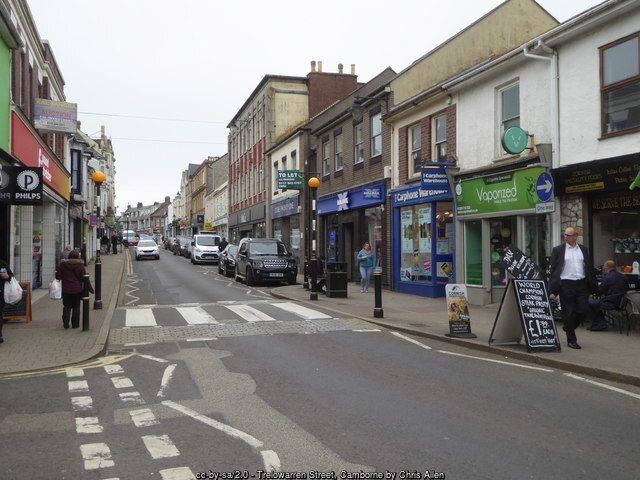
The heart of Camborne is Trelowarren Street, the main shopping street, which runs down from Commercial Square through the middle of the town. It is lined with a mix of national chains, independent shops, cafés, bakeries selling pasties and saffron buns, and the solid granite and stone buildings put up when the town was rich on mining.
At the top of the street, Commercial Square and Commercial Street form the old centre, with Tyacks Hotel, a former coaching inn, and the parish church of St Martin and St Meriadoc just round the corner in Church Street. Cross Street and Basset Road lead off towards Trevenson Street, where the Trevithick statue stands outside the Passmore Edwards library building of 1895.
Under the Camborne Town Deal, the town centre has been given new paving, seating, planting, lighting and safer crossings along Trelowarren Street and Fore Street, with the main works planned to finish in 2026. The big supermarkets are on the edge of the centre in Wesley Street and Church Street, and there is a retail park at Pool, towards Redruth.
↑ Back to topTown centre highlights
Trelowarren Street – the main shopping street
Commercial Square – the old centre and Trevithick Day main stage
Trevithick statue – Trevenson Street, unveiled 1932
St Martin & St Meriadoc – Grade I parish church
Tyacks Hotel – former coaching inn on Commercial Street
RICHARD TREVITHICK & THE PUFFING DEVIL
Richard Trevithick (1771–1833), ‘the Cornish Giant’, was born on 13 April 1771 at Tregajorran, in the neighbouring parish of Illogan, the son of a mine captain at Dolcoath. He grew up among the mines and engines of Camborne and became one of the great engineers of the Industrial Revolution.
Trevithick’s breakthrough was the high-pressure steam engine – small and powerful enough to be put on wheels. On Christmas Eve 1801 his road locomotive, the Puffing Devil, carried a group of men up Camborne Hill at Beacon – the first journey by a self-propelled steam vehicle carrying passengers, remembered in the Cornish song Going up Camborne Hill, coming down. In 1804 his locomotive at Penydarren in South Wales made the world’s first railway journey by steam, and his high-pressure engines and boilers went on to power mines across Cornwall and the world.
His bronze statue, by the sculptor L. S. Merrifield, stands on the pavement outside the Passmore Edwards library building in Trevenson Street, holding a model of his locomotive and looking up towards Camborne Hill. It was unveiled by Prince George on 17 May 1932 in front of thousands of people, and is Grade II listed.
The cottage at Penponds, just south-west of the town, where the Trevithick family lived, belongs to the National Trust and opens one afternoon a week in season for pre-booked visits. Trevithick died in poverty at Dartford in Kent in April 1833 – but Camborne has never forgotten him, and Trevithick Day each April is held in his honour.
↑ Back to top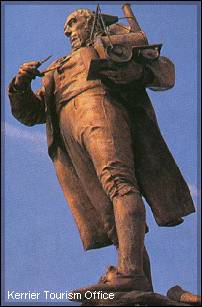
Trevithick in brief
Born: 13 April 1771, Tregajorran, Illogan
1801: the Puffing Devil climbs Camborne Hill
1804: first steam railway journey, Penydarren
Died: 22 April 1833, Dartford
Remembered: the statue (1932), Trevithick Cottage (National Trust) and Trevithick Day
CAMBORNE’S MINING HERITAGE – DOLCOATH, SOUTH CROFTY & THE ENGINEERS
Camborne was a small churchtown until the mining boom of the late 18th century transformed it. By the 19th century the district between Camborne and Redruth was covered with mines, engine houses, stamps and dressing floors, and the town’s foundries and workshops made machinery for mines all over the world.
Dolcoath – the Queen of Cornish Mines
Dolcoath (Cornish for ‘old ground’) lay on the eastern side of the town. First worked for copper, and then from the 1840s for tin, it became the largest and deepest mine in Cornwall – ‘as deep as Dolcoath’ was a Cornish saying for anything bottomless. Its Williams’ Shaft eventually reached about 3,300 feet (550 fathoms), and for much of the late 19th century it was the richest tin mine in Cornwall. The post-war slump in tin prices closed Dolcoath in 1921. Little survives on the site today, but the name lives on in Dolcoath Road.
South Crofty – reopening Cornwall’s tin mine
The steel headframe of South Crofty, between Camborne and Pool, is a local landmark. When it closed in 1998 it was the last working tin mine in Europe. Since then it has been brought back to life: Cornish Metals is refurbishing the shafts, pumping out the flooded workings and building a new processing plant, with first tin production targeted for 2028. It is a working industrial site and not open to visitors.
Holman’s, Bickford’s and the engineers
Camborne’s engineers made its name around the world. Holman Brothers, founded in 1801 as a boiler works, developed the famous Cornish Rock Drill in 1881; by 1896 more than a thousand were at work in the gold mines of South Africa alone, and Holman’s became Cornwall’s biggest engineering firm before merging into CompAir in 1968. At Tuckingmill, William Bickford patented the safety fuse in 1831, an invention that saved countless miners’ lives; fuse was made there for nearly 130 years, and the grand frontage of the later fuseworks still stands on Pendarves Street.
↑ Back to top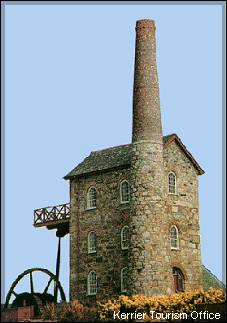
Mining sites to visit
King Edward Mine – mining museum and working tin mill, Troon
East Pool Mine (National Trust) – Taylor’s and Michell’s beam engines, Pool; pre-booked tours
Heartlands – Robinson’s Shaft, Pool; being taken on by the National Trust
Great Flat Lode Trail – engine houses around Carn Brea
Bickford’s fuseworks – Pendarves Street, Tuckingmill
CAMBORNE SCHOOL OF MINES
The Camborne School of Mines was founded in 1888, when Cornish mining was still among the most important in the world, to train mining engineers and mine captains. Its graduates went on to run mines on every continent, and ‘CSM’ became one of the best-known names in mining education. From 1897 students learned their practical skills underground at King Edward Mine near Troon, which remained the school’s training mine until 2005.
The school was based in the centre of Camborne for almost a century. In 1975 it moved to a new purpose-built campus at Trevenson, Pool, between Camborne and Redruth; it merged with the University of Exeter in 1993, and in 2004 moved to the university’s campus at Tremough – now the Penryn Campus – where it still teaches mining, geology and environmental science.
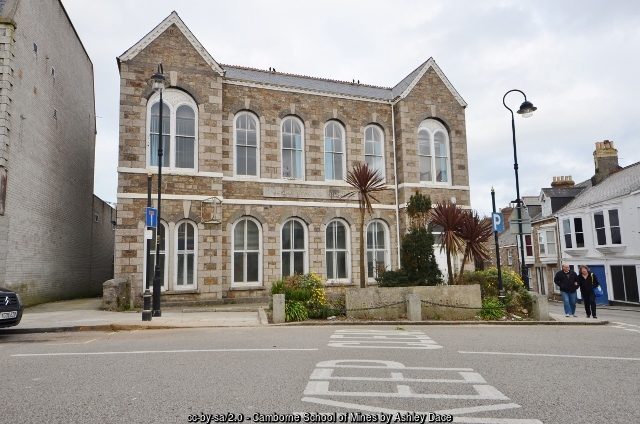
The handsome stone building in the photograph at the top of this page is the only one left of the original school in Camborne. The name lives on in the town, and every year CSM students still play the Royal School of Mines in London in the Bottle Match, one of the oldest varsity fixtures.
↑ Back to topCamborne School of Mines
Founded: 1888, in Camborne
Training mine: King Edward Mine, 1897–2005
1975: moved to Trevenson, Pool
1993: merged with the University of Exeter
2004: moved to Tremough, now Penryn Campus
CARN BREA, KING EDWARD MINE & THE GREAT FLAT LODE TRAIL
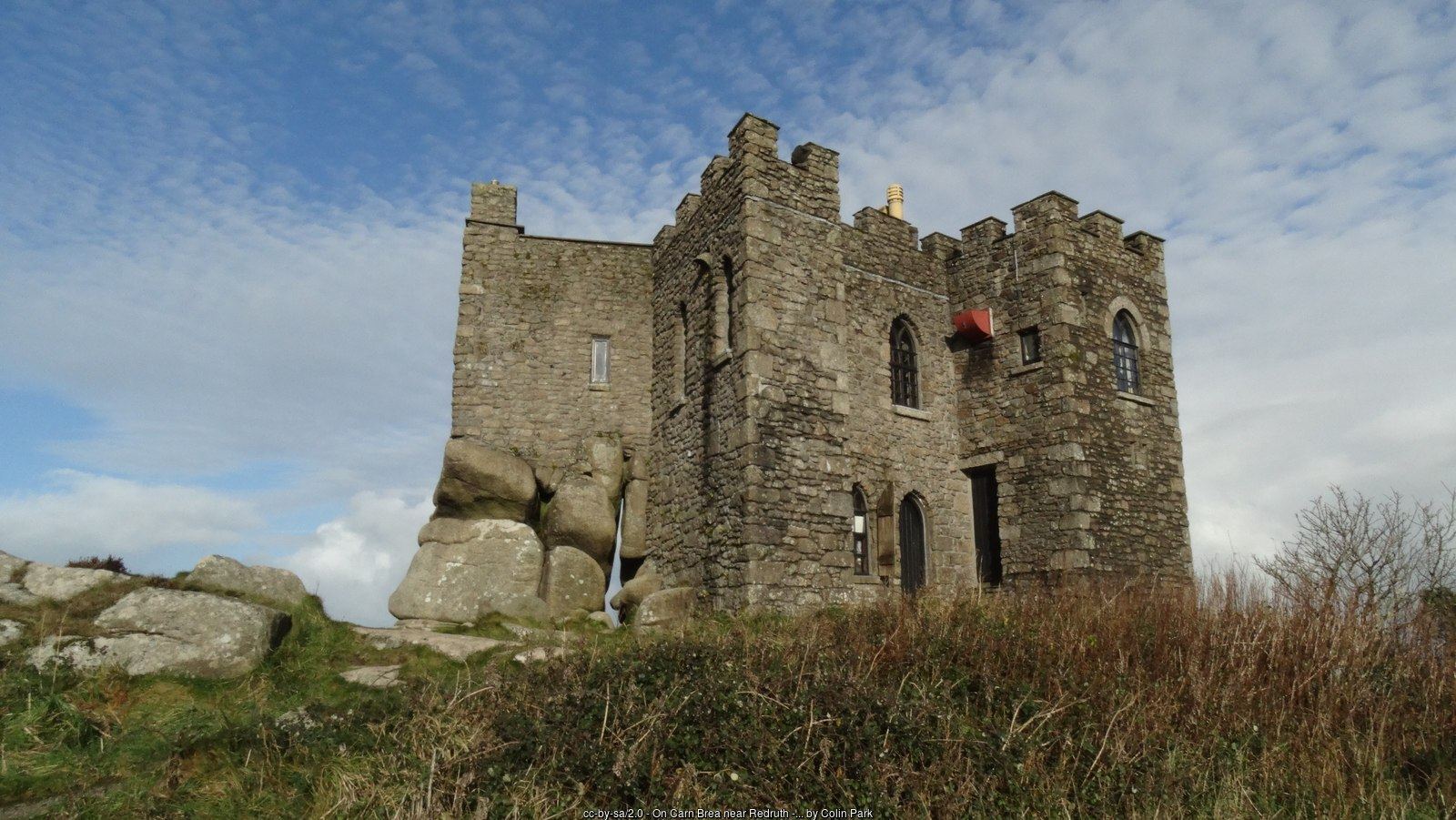
Between Camborne and Redruth rises the granite hill of Carn Brea, crowned by a Neolithic hilltop settlement, a little castle and the 90-foot Basset Monument, put up in 1836 in memory of Francis Basset, Lord de Dunstanville, of the Tehidy estate. The climb is short and the views stretch across the mining country to both coasts.
South of the hill, the Great Flat Lode Trail is a 7½-mile (12 km) circular route for walkers, cyclists and horse riders. It follows the old Basset Mines tramroad past one of the greatest concentrations of engine houses anywhere, from South Wheal Frances to Wheal Basset. It is part of Cornwall’s network of Mineral Tramways trails, linking with the Portreath Branchline and the Coast to Coast trail.
The best place to start is King Edward Mine at Troon, south of Camborne, which has free parking and a café. The mine museum tells the story of Cornish hard-rock mining, and volunteers demonstrate the restored tin mill with its stamps, round frames and shaking tables. Check opening days before you go – it is open on selected days in the season.
↑ Back to top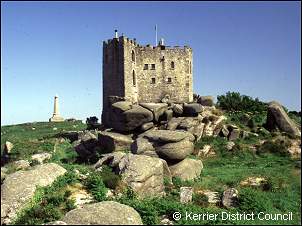
Great Flat Lode Trail
Length: about 7½ miles (12 km), circular
For: walkers, cyclists and horse riders
Start: King Edward Mine, Troon (free parking, café)
Also: parking at South Wheal Frances and Dolcoath
See: engine houses, Carn Brea, views of South Crofty
TEHIDY COUNTRY PARK, HELL’S MOUTH & THE NORTH COAST
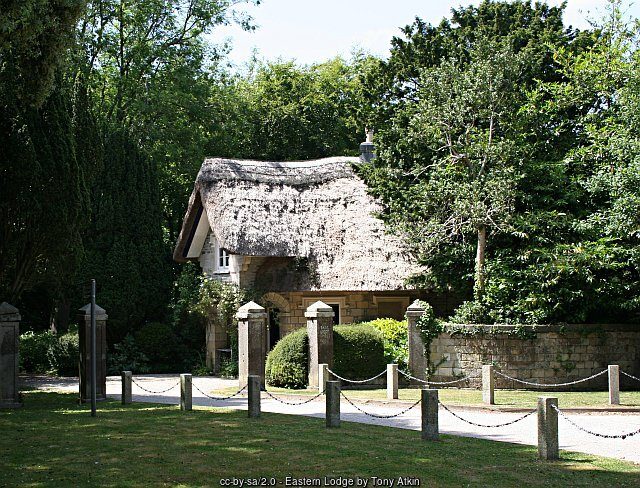
Two miles north of the town, Tehidy Country Park is the largest area of woodland in west Cornwall – around 250 acres of woods, lakes and streams with more than nine miles of paths. It was once the estate of the Basset family, who grew rich on the local mines; Cornwall County Council bought it in 1983. Today it is a favourite with families and dog walkers, with a café, picnic areas, bluebells in spring and easy trails for walking and cycling. The car parks at South Drive, East Lodge and North Cliffs are free.
Camborne’s parish runs right up to the north coast. From the North Cliffs, the South West Coast Path follows the high cliffs past Deadman’s Cove to Hell’s Mouth, a sheer-sided chasm where the sea crashes into the rocks far below, and on towards Godrevy, its lighthouse and the seals at Mutton Cove. In the other direction the path leads to Portreath, Camborne and Redruth’s old mining harbour.
- Tehidy Country Park – Cornwall Council
- Golf in Cornwall – Tehidy Park Golf Club is next to the country park
BEACHES NEAR CAMBORNE
Camborne is an inland town, but some of Cornwall’s best family beaches are only 15 to 20 minutes away by car. The great sweep of St Ives Bay, from Godrevy to Hayle, has three miles of golden sand backed by dunes, with surf, rock pools and RNLI lifeguards on the main beaches in summer. On the south coast, the beaches of Mount’s Bay and Praa Sands are within half an hour.
- Godrevy – National Trust beach facing Godrevy lighthouse, with surf and rock pools, about 5 miles away.
- Gwithian – long sandy beach and dunes, popular with surfers and families.
- Upton Towans, Mexico Towans and Hayle Towans – the dune-backed sands running towards Hayle.
- Portreath – a sandy cove and harbour about 4 miles north-east.
HISTORY OF CAMBORNE
The name Camborne comes from the Cornish Cambron, usually explained as ‘crooked hill’. There was a Christian settlement here long before the Normans: an inscribed altar stone of the 10th or 11th century is kept in the parish church. The church is dedicated to the Breton saint Meriadoc (Meriasek), with St Martin added in the 15th century, and the town features in Beunans Meriasek, ‘the Life of St Meriasek’, a Cornish-language miracle play written around 1500.
For centuries Camborne was a small churchtown in farming country, with the great houses of the Bassets at Tehidy and the Pendarves family at Pendarves nearby. Copper mining took off in the 18th century, and by the early 19th century the mines around Camborne and Redruth were among the richest in the world. The population grew fast, Methodism took a strong hold, and the town filled with chapels, foundries and engineering works, including Holman’s and Bickford’s fuse factory.
When copper ran out, the deep mines turned to tin, and Dolcoath flourished until the slump after the First World War. Many Camborne miners emigrated to South Africa, Australia and the Americas, taking Cornish engineering, rock drills and rugby with them. Through the 20th century the town lived on its engineering, the School of Mines and South Crofty, until the mine closed in 1998.
In 2006 the old mining landscape became part of the Cornwall and West Devon Mining Landscape World Heritage Site. Today Camborne is a busy working town, with a regenerated town centre and South Crofty preparing to produce tin again.
↑ Back to topCamborne timeline
10th–11th century – inscribed altar stone, now in the church
Late 15th century – parish church largely rebuilt
c.1500 – Beunans Meriasek miracle play
1766 – engineer Arthur Woolf baptised at Camborne
1771 – Richard Trevithick born at Tregajorran
1801 – Puffing Devil climbs Camborne Hill; Holman’s founded
1831 – Bickford patents the safety fuse
1843 – railway station opens
1881 – Holman’s Cornish Rock Drill
1888 – Camborne School of Mines founded
1895 – Passmore Edwards library opens
1921 – Dolcoath closes
1932 – Trevithick statue unveiled
1984 – first Trevithick Day
1998 – South Crofty closes
2004 – School of Mines moves to Penryn
2006 – World Heritage Site status
2028 – South Crofty targets first tin
KEY BUILDINGS IN CAMBORNE
- Church of St Martin and St Meriadoc, Church Street – Grade I listed granite parish church, mostly late 15th century, restored and enlarged in 1878; it holds the early medieval altar stone and memorials to the Pendarves family.
- Trevithick statue, Trevenson Street – bronze by L. S. Merrifield on a granite plinth, unveiled by Prince George in 1932; Grade II listed.
- Passmore Edwards Free Library, Trevenson Street – opened in 1895, one of the many libraries given to Cornwall by the Cornish-born philanthropist John Passmore Edwards.
- Camborne School of Mines – the stone building that is the last survivor of the original school in the town (pictured at the top of the page).
- Bickford Smith fuseworks, Pendarves Street, Tuckingmill – listed frontage of 1910 with a plaque to William Bickford and the safety fuse.
- Tyacks Hotel, Commercial Street – the town’s historic coaching inn.
NOTABLE PEOPLE OF CAMBORNE
- Richard Trevithick (1771–1833) – pioneer of high-pressure steam, born at Tregajorran on the edge of Camborne; his Puffing Devil climbed Camborne Hill in 1801 and his statue stands in Trevenson Street.
- Arthur Woolf (1766–1837) – engineer, baptised at Camborne, the son of a carpenter at Dolcoath; he invented the high-pressure compound steam engine.
- William Bickford (1774–1834) – a Devon-born currier who settled at Tuckingmill and in 1831 patented the miners’ safety fuse, made in Camborne for nearly 130 years.
- The Holman family – Nicholas Holman founded the family engineering works in 1801, and his descendants John and James Holman made the Cornish Rock Drill famous around the world.
THINGS TO DO IN CAMBORNE
Camborne’s attractions are mostly about its remarkable industrial past and the open country around it – and many of them are free. Families can spend a day in the woods at Tehidy or cycling the old mineral tramways, while heritage lovers will find more engine houses, museums and stories within a few miles than anywhere else in Cornwall.
- See the Trevithick statue and walk up Camborne Hill, the route of the Puffing Devil.
- Come for Trevithick Day on the last Saturday in April – steam engines, bands and dancing in the streets.
- Visit King Edward Mine and cycle or walk the Great Flat Lode Trail around Carn Brea.
- Climb Carn Brea for the views, the castle and the Basset Monument.
- Book a tour of the beam engines at East Pool Mine (National Trust) at Pool, and visit Trevithick Cottage at Penponds.
- Walk the woods and lakes of Tehidy Country Park, then follow the coast path to Hell’s Mouth.
- Spend a day on the beach at Godrevy or Gwithian, or take the train to St Ives or Penzance.
- Look for the Bickford fuseworks plaque at Tuckingmill and the old School of Mines building in town.
EVENTS IN CAMBORNE
Trevithick Day (last Saturday in April) – Camborne’s great free street festival, held since 1984 to celebrate Richard Trevithick and the town’s mining and engineering heritage. The main streets close to traffic and fill with traction engines and steam vehicles, a working replica of the Puffing Devil, stalls, choirs and brass bands. The day opens with a procession along Trelowarren Street, and Camborne Town Band leads the Bal Maidens and Miners dance in the morning and the Trevithick Day dance in the afternoon. It draws tens of thousands of visitors, and its volunteer organisers received the King’s Award for Voluntary Service in 2025.
Christmas in Camborne (late November and December) – the Christmas lights switch-on with a festive market and entertainment in the town square, and Camborne Town Council’s children’s lantern parade.
Camborne also has a strong musical tradition, with Camborne Town Band, one of Cornwall’s best-known brass bands, and the Holman-Climax Male Voice Choir. Nearby, Redruth holds Murdoch Day in early summer. Dates change each year – check before you travel.
↑ Back to topPLACES NEAR CAMBORNE
- Redruth – Camborne’s neighbour and the old capital of Cornish mining, about 3 miles east.
- Portreath – the mining harbour and beach on the north coast, about 4 miles away.
- Gwithian and Godrevy – dunes, surf and the lighthouse on St Ives Bay, about 5 miles west.
- Hayle – the harbour town and Hayle Towans, about 5 miles west.
- Gwennap – Gwennap Pit, where John Wesley preached to the miners, east of Redruth.
- St Ives and Penzance – a short journey west by train or car.
Camborne, west Cornwall – between Redruth and Hayle, with Tehidy and the north coast cliffs to the north.
VISITOR INFORMATION
Camborne is easy to reach. The A30 bypasses the town to the north, with junctions for Camborne West and Camborne East, and the A3047 runs through Tuckingmill and Pool to Redruth. The railway station is a short walk from Trelowarren Street, and buses link the town with Redruth, Truro, Hayle, Penzance, Helston and the north coast.
Parking & EV Charging
The main Cornwall Council car parks for the town centre are Rosewarne (TR14 8BE, about 94 spaces) and Rosewarne Extension on Rosewarne Road, close to Trelowarren Street and the station. There is limited free on-street parking at the top of Trelowarren Street, a small car park at the railway station, and a council car park at the Tuckingmill Pavilion. For the Great Flat Lode Trail, King Edward Mine at Troon has a large free car park, and the Tehidy Country Park car parks are free. Charges change – check the council website or the pay app.
Electric vehicle charging:
- Tesco Superstore, Wesley Street TR14 8DT – rapid charger (CCS)
- McDonald’s, Trevenson Road, Pool TR15 3PL – rapid charger
Public chargers change often – check the live map before you travel.
Train & Bus
Camborne station (Trevu Road, TR14 8SR) is on the Cornish main line, with Great Western Railway trains to Penzance, Truro, Plymouth and London Paddington, CrossCountry services, and the Night Riviera sleeper. Both platforms have step-free access, linked by a level crossing. Change at St Erth for St Ives. Local buses run to Redruth, Truro, Hayle, Penzance, Helston and Portreath. Check timetables before you travel.
Facilities & Supermarkets
The town centre has banks, a post office, chemists, public toilets and a good range of shops along Trelowarren Street and Cross Street. Supermarkets:
- Tesco Superstore – Wesley Street, Camborne TR14 8DT
- Aldi – Church Street, Camborne TR14 7DF
- Lidl – Illogan Highway, Pool TR15 3EE
- Tesco Extra – Station Road, Pool TR15 3QJ
Cafés, Pubs & Restaurants
Trelowarren Street, Cross Street and Commercial Square have cafés, bakeries and traditional pubs, and Tyacks Hotel on Commercial Street serves food in the town centre. Out of town there are cafés at Tehidy Country Park and King Edward Mine, and pub food at the inns in the surrounding villages. Do try a proper Cornish pasty – the miners’ lunch.
Health
Camborne Redruth Community Hospital, Barncoose, Redruth TR15 3ER, has a nurse-led Minor Injury Unit, open every day from 8am to 10pm, with free parking. The nearest A&E is the Royal Cornwall Hospital at Treliske, Truro. There are GP surgeries and pharmacies in the town. Call NHS 111 for urgent advice and 999 in an emergency.
Disabled Access
The recent town centre improvements added better crossings and seating along Trelowarren Street and Fore Street, though some streets slope. Camborne station has step-free access to both platforms. At Tehidy Country Park some of the main paths are firm and fairly level, and the Great Flat Lode Trail has long stretches of firm, gently graded track. Check access at the mining museums and engine houses before you go.
Vets & Dogs
Vets in Camborne: Medivet Camborne (Monument Vets), Trevithick Road, Camborne TR14 8LQ; and Lamorna House Veterinary Centre, East Hill, Tuckingmill TR14 8NQ. Tehidy Country Park and the Great Flat Lode Trail are popular dog walks – keep dogs on leads near livestock and on the cliffs. Check seasonal dog restrictions on the beaches.
National Trust & English Heritage
The National Trust looks after East Pool Mine at Pool (TR15 3NP), with Taylor’s and Michell’s engine houses, and Trevithick Cottage at Penponds – both open for pre-booked visits, so check before you go. The Trust is also taking on the running of Heartlands at Pool. Nearby, it cares for Godrevy and the north cliffs.
Attractions
King Edward Mine, East Pool Mine, Carn Brea and the Great Flat Lode Trail, Tehidy Country Park and the Trevithick statue, with the beaches of St Ives Bay, St Ives and Penzance all within easy reach.
STAY & EXPLORE IN CAMBORNE
Official Information
FAMILY HOLIDAYS & SHORT BREAKS IN CAMBORNE
Family holidays in Camborne put the whole of west Cornwall within easy reach – the sands and surf of Godrevy and Gwithian in one direction, St Michael’s Mount and Penzance in the other, and woods, cycle trails and real mines right on the doorstep. Children love the steam engines on Trevithick Day, the working tin mill at King Edward Mine and a day exploring Tehidy Woods.
Browse Camborne holiday cottages for self-catering homes in the town and the surrounding countryside, or holidays and short breaks in Camborne for every type of accommodation.
Short breaks in Camborne are good value all year – a spring weekend for Trevithick Day and the bluebells at Tehidy, an autumn break walking the mining trails, or a base for exploring west Cornwall by train. Booking direct with the owner means no agency fees.
↑ Back to topFREQUENTLY ASKED QUESTIONS ABOUT CAMBORNE
Camborne is a town in west Cornwall, about three miles west of Redruth, five miles east of Hayle and 13 miles west of Truro. It lies just south of the A30, with the north coast cliffs and Tehidy Country Park about two miles to the north.
Camborne is famous for tin and copper mining and for the engineer Richard Trevithick, whose Puffing Devil steam carriage climbed Camborne Hill on Christmas Eve 1801. It was home to Dolcoath, ‘the Queen of Cornish Mines’, the Camborne School of Mines, Holman’s rock drills and Bickford’s safety fuse, and it holds Trevithick Day every April.
Trevithick Day is held on the last Saturday in April. The town centre closes to traffic for a free festival of steam engines, a working replica of the Puffing Devil, stalls, brass bands and the Bal Maidens and Miners dance.
The bronze statue of Richard Trevithick stands on the pavement outside the Passmore Edwards library building in Trevenson Street, in the centre of Camborne. It was unveiled by Prince George on 17 May 1932.
No. The Camborne School of Mines was founded in the town in 1888, moved to Pool in 1975 and merged with the University of Exeter in 1993. Since 2004 it has been based at the university’s Penryn Campus near Falmouth. One building of the original school survives in Camborne.
South Crofty closed in 1998 but is being reopened by Cornish Metals, which is refurbishing the shafts, pumping out the old workings and building a processing plant, with first tin production targeted for 2028. It is a working industrial site and is not open to visitors.
The main Cornwall Council car parks for the town centre are Rosewarne and Rosewarne Extension on Rosewarne Road, TR14 8BE, close to Trelowarren Street and the station. There is limited free on-street parking at the top of Trelowarren Street, and King Edward Mine and Tehidy Country Park have free car parks.
Yes. Camborne station is on the main line between Penzance and London Paddington, with Great Western Railway and CrossCountry trains and the Night Riviera sleeper. The station is a short walk from the town centre.
Camborne is an inland town, but the beaches of St Ives Bay are about 15 minutes away by car – Godrevy, Gwithian and the Towans – and Portreath beach is about four miles to the north-east. Several have RNLI lifeguards in summer.