Gwennap, Cornwall – Gwennap Pit, John Wesley & the Copper Kingdom
Gwennap
Cornwall Online | West Cornwall Towns and Villages | Camborne | Redruth | Gwennap | Portreath | Godrevy | Gwithian | Hayle | St Ives | St Agnes
On This Page
Gwennap at a Glance
Village and parish in the hills east of Redruth, once the heart of the ‘Copper Kingdom’ – called the richest square mile in the Old World. Home of Gwennap Pit at Busveal, where John Wesley preached 18 times between 1762 and 1789, and the Grade I church of St Weneppa with its detached bell tower. Part of the Cornwall and West Devon Mining Landscape World Heritage Site. Population about 1,500 (parish, 2011).
Visiting Gwennap Pit
Where: Busveal, near St Day, Redruth TR16 5HH
Open: the pit is open daily all year, free
Visitor centre: in the adjoining Busveal Chapel, open in summer
Services: Sunday afternoons in July and August, and the Whitsun gathering
GWENNAP – GWENNAP PIT & THE COPPER KINGDOM
Gwennap is a quiet parish of small villages, lanes and old mine country in the hills just east of Redruth. Today it is green and peaceful, but two hundred years ago it was the busiest and richest mining district in Cornwall – the ‘Copper Kingdom’, said to be the richest square mile in the Old World – with dozens of engine houses, roaring stamps and thousands of miners.
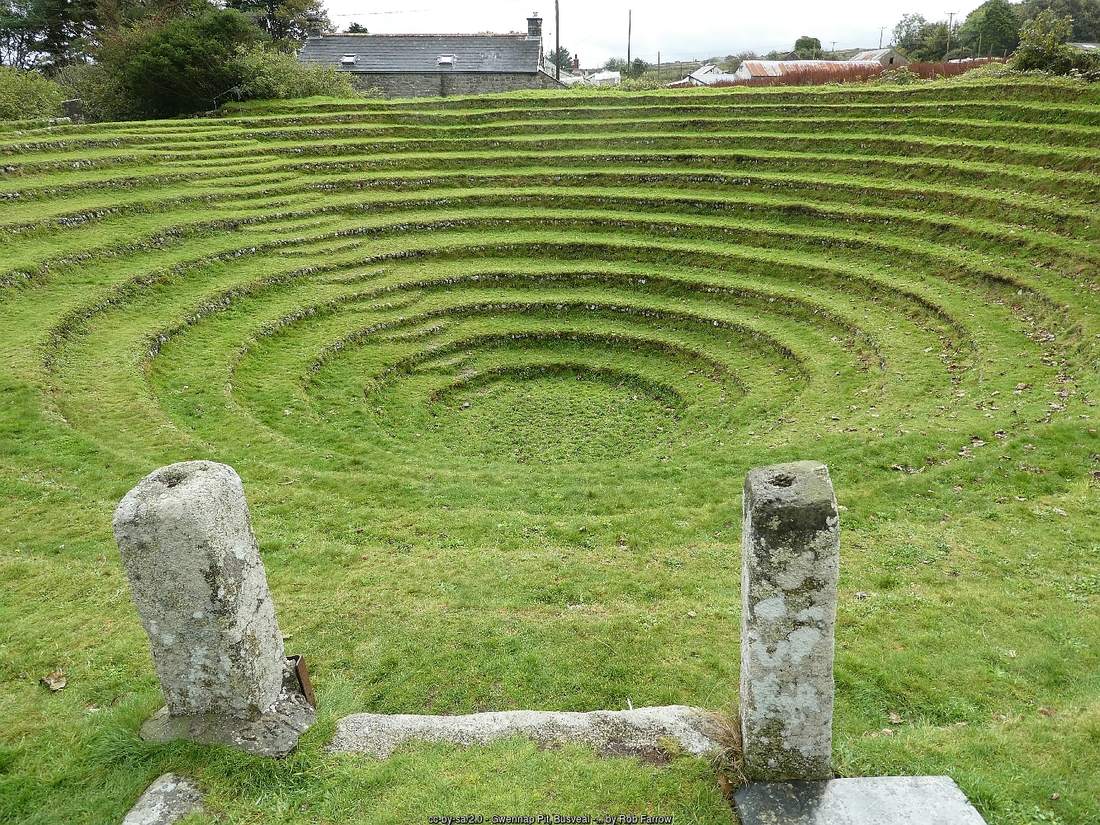
Those miners drew John Wesley, the founder of Methodism, to the parish again and again. Between 1762 and 1789 he preached eighteen times at Gwennap Pit, a hollow left by mining subsidence at the hamlet of Busveal, to crowds said to have numbered many thousands. In 1806 the pit was remodelled into the remarkable grassy amphitheatre you see today, and it is still a place of Methodist pilgrimage and worship – one of the most unusual and moving sights in Cornwall.
The village of Gwennap itself, in a wooded valley to the south-east, has the ancient church of St Weneppa, one of only four in Cornwall with a detached bell tower. Around the parish are the remains of the great copper mines, the Coast to Coast trail through the Poldice valley, and the woodland gardens and nursery at Burncoose.
Gwennap is an easy trip from Redruth, two or three miles away, and fits well into a day exploring Cornwall’s mining heritage, with Camborne, Carn Brea and the north coast close by. For somewhere to stay, see Redruth holiday cottages and holidays and short breaks in Redruth.
↑ Back to topGWENNAP PIT – JOHN WESLEY’S PREACHING PLACE
Gwennap Pit is not actually in Gwennap village but nearly two miles to the north-west, at the hamlet of Busveal, between Redruth and St Day. The hollow was caused by mining subsidence in the mid-18th century, and before Wesley’s time it is said to have been used for Cornish wrestling.
On 6 September 1762 John Wesley came to preach to the tin and copper miners of Gwennap. The wind was so strong that he could not make himself heard, so the crowd walked to the sheltered hollow nearby, and Wesley preached from its side. He was struck by its acoustics and returned again and again – eighteen times between 1762 and his last visit in 1789, when he was in his eighties. The crowds were enormous; one figure claimed for 1773 is 32,000 people. Wesley himself called the sight of the people gathered in the pit ‘the most magnificent spectacle this side of heaven’.
After Wesley’s death, a group of local men – the mining engineer Richard Michell and four mine captains – agreed in 1806 to reconstruct the pit in his memory. They gave it its regular circular shape, with thirteen rings of turf seating, and the first service in the new amphitheatre was held in 1807. A pair of granite posts on one side marks the preaching place, and there are steps halfway up the tiers on the north and south sides.
Gwennap Pit is a Grade II* listed monument and part of the World Heritage Site. It is open to visitors all year, free of charge. The little Busveal Chapel of 1836 next door houses a visitor centre with pictures and exhibition panels, open in the summer. Open-air services are still held on Sunday afternoons in July and August, and the pit has long been the scene of a great Whitsun gathering.
↑ Back to topGwennap Pit facts
Formed: by mining subsidence, mid-18th century
Wesley’s first sermon: 6 September 1762
Wesley’s visits: 18, the last in 1789
Remodelled: 1806, by Richard Michell and four mine captains
Seating: 13 rings of turf terraces
Listed: Grade II*
Next door: Busveal Chapel (1836) and visitor centre
ST WENEPPA’S CHURCH & GWENNAP VILLAGE
The village of Gwennap lies in a sheltered valley south-east of Redruth, gathered around its parish church. The church of St Weneppa (also spelt Wenappa) is thought to stand on the site of an early Celtic monastery. The present building is Grade I listed: it was rebuilt in the 15th century, in three phases, as the mining population grew, keeping some walling of the 13th and 14th centuries, and was restored and extended between 1862 and the 1890s. Its list of vicars goes back to the early 13th century.
The church’s most striking feature is its detached bell tower, standing on its own about twenty yards up the slope to the south of the church. It probably dates from the 15th century, perhaps on older foundations, and was probably built apart to give it a higher position at lower cost. Gwennap is one of only four churches in Cornwall with a separate tower. The tower still holds six bells, rung for services, and the large, wildlife-friendly churchyard is full of fine chest tombs of local mining families. The church is usually open daily from Easter to October.
↑ Back to top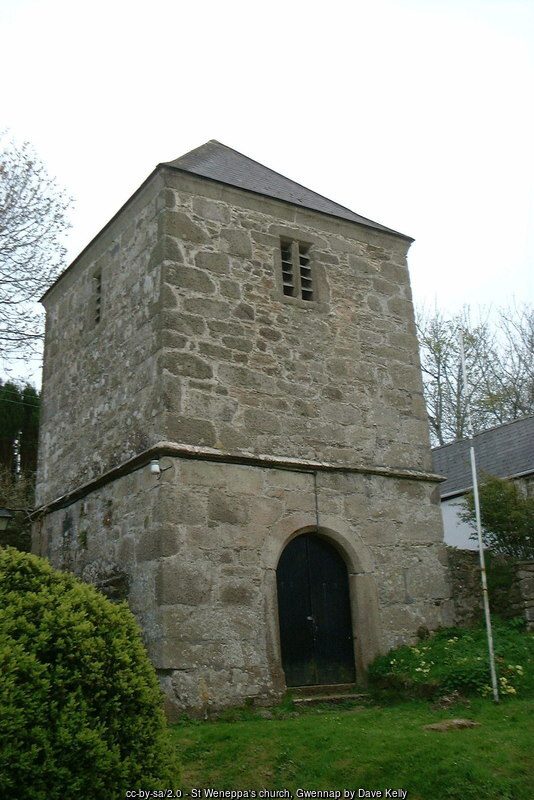
THE COPPER KINGDOM – GWENNAP’S MINES
In the 18th and early 19th centuries the parish of Gwennap was the richest copper-mining district in Cornwall, and was called the ‘richest square mile in the Old World’. Great mines such as Poldice, Consolidated Mines, United Mines and Tresavean employed thousands of men, women and children. Consolidated Mines alone had nineteen engine houses, and between 1819 and 1840 it raised nearly 300,000 tons of copper ore, with the Camborne engineer Arthur Woolf in charge of its engines.
Deep mining here was only possible because of the Great County Adit, begun in 1748 by John Williams of Scorrier, the manager of Poldice. This network of drainage tunnels eventually stretched for around 40 miles and drained more than a hundred mines, carrying their water out to the Carnon valley near Twelveheads and on down to the Fal at Devoran. It still drains the old workings today.
When copper prices collapsed in the 1860s, the mines closed or merged and many miners emigrated. The landscape they left – spoil heaps, engine houses, chimneys and tramways, now softened by heather and woodland – forms part of the Gwennap Mining District of the World Heritage Site. The best way to see it is on the Coast to Coast trail, an 11-mile, mostly traffic-free route along old mineral tramways from Portreath to Devoran, which runs through the Poldice valley; there is bike hire along the way.
↑ Back to topThe Copper Kingdom
Great mines: Poldice, Consolidated, United, Tresavean
Great County Adit: begun 1748, around 40 miles of tunnels
Consolidated Mines: nearly 300,000 tons of ore, 1819–40
Decline: copper prices collapse in the 1860s
Today: Gwennap Mining District of the World Heritage Site
BURNCOOSE GARDENS & NURSERY
Just south of Gwennap village, Burncoose is the oldest part of the Caerhays estate of the Williams family, who settled here in 1715 and made their fortune in mining. Its 30-acre woodland garden is at its best in spring, with camellias, rhododendrons and magnolias, followed by hydrangeas in summer, and it is open with the nursery, free of charge, with dogs welcome on leads. Burncoose Nurseries is one of the country’s best-known plant nurseries and has won many RHS Chelsea gold medals.
↑ Back to topHISTORY OF GWENNAP
Gwennap takes its name from St Weneppa, to whom the church is dedicated; its Cornish name is Lannwenep, the church enclosure of Weneppa. The church was given to the chapter of Exeter Cathedral in the early 13th century, and for centuries the parish was a farming community, with tin streaming in the valleys.
Everything changed in the 18th century. Once the Great County Adit had drained the deep copper lodes, the mines of Gwennap grew into the richest in the world, and the population rose rapidly. John Wesley found eager congregations among the miners, and Methodism became the heart of local life. The parish then took in the busy mining villages of St Day and Carharrack as well as Gwennap itself.
The copper boom ended in the 1860s, and many Gwennap families emigrated to the mines of America, Australia and South Africa; among those born in the parish was John Verran, who became Premier of South Australia. St Day and Carharrack later became parishes of their own, and today Gwennap is a quiet rural parish whose mining landscape is part of the World Heritage Site.
↑ Back to topGwennap timeline
13th century – church given to the chapter of Exeter
15th century – church rebuilt; detached bell tower
1715 – the Williams family settle at Burncoose
1748 – Great County Adit begun
1762 – John Wesley first preaches at Gwennap Pit
1789 – Wesley’s last visit
1806 – Gwennap Pit remodelled as an amphitheatre
1836 – Busveal Chapel built
1819–40 – Consolidated Mines at its peak
1860s – copper prices collapse
2006 – World Heritage Site status
KEY BUILDINGS IN GWENNAP
- Gwennap Pit, Busveal – terraced preaching amphitheatre, remodelled in 1806; Grade II*.
- Busveal Chapel – Methodist chapel of 1836 beside the pit, now with the visitor centre.
- Church of St Weneppa, Gwennap – Grade I listed, rebuilt in the 15th century and restored 1862–91.
- Detached bell tower – Grade I listed, 15th century, about twenty yards south of the church.
- Consolidated Mines chimney and engine houses – listed remains of the Copper Kingdom.
Notable People
- John Wesley (1703–1791) – founder of Methodism, who preached eighteen times at Gwennap Pit between 1762 and 1789.
- John Williams (born 1714) – manager of Poldice mine, who began the Great County Adit in 1748; his family settled at Burncoose and became the great Williams mining dynasty.
- John Verran (1856–1932) – born in Gwennap, a miner who emigrated and became Premier of South Australia.
THINGS TO DO IN AND AROUND GWENNAP
- Visit Gwennap Pit and its visitor centre, or join an open-air summer service.
- See the detached bell tower and churchyard of St Weneppa’s church.
- Cycle or walk the Coast to Coast trail through the Poldice valley to Devoran or Portreath.
- Wander the woodland garden at Burncoose in spring.
- Explore Redruth and Kresen Kernow, Cornwall’s archive centre.
- Climb Carn Brea and follow the Great Flat Lode Trail near Camborne.
Events
Open-air services are held at Gwennap Pit on Sunday afternoons in July and August, and the pit is the setting for a traditional Whitsun gathering. Nearby, Redruth holds Murdoch Day in June and the International Mining and Pasty Festival in September. Dates change each year – check before you travel.
↑ Back to topPLACES NEAR GWENNAP
- Redruth – the old capital of Cornish mining, about 3 miles north-west.
- Camborne – Trevithick’s town, about 6 miles west.
- Devoran – the old mining port at the end of the Coast to Coast trail, about 4 miles east.
- Truro – Cornwall’s cathedral city, about 7 miles east.
- Falmouth and Penryn – about 8 miles south-east.
- Portreath – harbour and beach on the north coast, about 6 miles north-west.
Gwennap Pit at Busveal, east of Redruth, with Gwennap village in the valley to the south-east.
VISITOR INFORMATION
Gwennap is reached by country lanes off the A393 Redruth to Falmouth road, and Gwennap Pit is signposted from Redruth and St Day. The nearest railway station is Redruth, about two miles from the pit; buses link Redruth with St Day and Lanner.
Parking & EV Charging
There is parking at Gwennap Pit (Busveal, TR16 5HH) and at Burncoose for garden and nursery visitors. Lanes in Gwennap village are narrow – park considerately near the church. For the Coast to Coast trail there are car parks at Bissoe, Devoran and Portreath.
Electric vehicle charging:
The nearest public chargers are in Redruth. Check the live map before you travel.
Train & Bus
Redruth station is the nearest, on the main line from London Paddington, with GWR and CrossCountry trains and the Night Riviera sleeper. Local buses run from Redruth to St Day and Lanner. Check timetables before you travel.
Facilities & Supermarkets
Gwennap is a small rural parish without shops of its own; St Day and Lanner have village shops. The nearest supermarkets are in Redruth:
- Tesco – Tolgus Hill, Redruth TR15 1AX
- Morrisons – Agar Road, Illogan Highway, Redruth TR15 3NH
Cafés & Pubs
Refreshments are sometimes available at the Gwennap Pit visitor centre in summer. There are pubs and cafés in St Day, Lanner and Carharrack, cafés along the Coast to Coast trail at Bissoe, and plenty of choice in Redruth.
Health
The nearest Minor Injury Unit is at Camborne Redruth Community Hospital, Barncoose, Redruth TR15 3ER, open every day from 8am to 10pm. The nearest A&E is the Royal Cornwall Hospital, Treliske, Truro. Call NHS 111 for urgent advice and 999 in an emergency.
Disabled Access
At Gwennap Pit the chapel and visitor centre have step-free access, but the pit itself is reached by steps and grassy terraces with a handrail. Much of the Coast to Coast trail is firm and gently graded.
Vets & Dogs
The nearest vets are in Redruth: Medivet Redruth (Monument Vets), Drump Road, Redruth TR15 1PS. Dogs on leads are welcome in the gardens at Burncoose and on the mineral tramway trails.
National Trust & English Heritage
The National Trust’s East Pool Mine at Pool, with two great beam engines, is about five miles west (pre-booked tours), and Trelissick is south-east of Truro.
Attractions
Gwennap Pit, St Weneppa’s church, Burncoose gardens and the Coast to Coast trail, with Kresen Kernow in Redruth and Carn Brea close by.
STAY & EXPLORE NEAR GWENNAP
Nearby Towns & Villages
FAMILY HOLIDAYS & SHORT BREAKS NEAR GWENNAP
Holidays near Gwennap combine peaceful countryside with easy access to both of Cornwall’s coasts – Portreath and the north coast surf in one direction, the Fal creeks and Falmouth in the other. Families can cycle the traffic-free Coast to Coast trail, picnic at Gwennap Pit and explore the old mines and woods.
There is no separate accommodation page for Gwennap, so browse Redruth holiday cottages for self-catering homes in and around Redruth and Gwennap, or holidays and short breaks in Redruth for every type of accommodation. Booking direct with the owner means no agency fees.
↑ Back to topFREQUENTLY ASKED QUESTIONS ABOUT GWENNAP
Gwennap Pit is at the hamlet of Busveal, between Redruth and St Day, postcode TR16 5HH. It is nearly two miles north-west of Gwennap village and about two miles east of Redruth town centre.
John Wesley, the founder of Methodism, preached at Gwennap Pit eighteen times between 1762 and 1789 to huge crowds of miners. The hollow, caused by mining subsidence, was remodelled in 1806 into a circular amphitheatre with turf terraces in his memory.
Yes. The pit is open to visitors all year and is free. The visitor centre in the adjoining Busveal Chapel is open in the summer.
Yes. Open-air services are held on Sunday afternoons in July and August, and the pit has long hosted a traditional Whitsun gathering.
The bell tower of St Weneppa’s church stands on its own about twenty yards up the slope from the church, probably to give it a higher position at lower cost. It probably dates from the 15th century, and Gwennap is one of only four churches in Cornwall with a detached tower.
In the 18th and early 19th centuries Gwennap was the richest copper-mining district in Cornwall. Mines such as Poldice, Consolidated and United produced vast amounts of copper ore, drained by the Great County Adit, begun in 1748.
There is parking at Gwennap Pit at Busveal, TR16 5HH. The nearest railway station is Redruth, about two miles away.