Hayle, Cornwall – Three Miles of Golden Sand, the Hayle Estuary & the Harbour Town of Harvey’s Foundry
Hayle
Cornwall Online | West Cornwall Towns and Villages | St Ives | Carbis Bay | Hayle | Gwithian Towans | Godrevy Head | Portreath | Porthtowan | St Agnes | Isles of Scilly | Sennen Cove & Land’s End | Pendeen | St Just | Porthcurno | Lamorna | Mousehole | Newlyn | Penzance | Marazion – St Michael’s Mount | Praa Sands | Porthleven
On This Page
- Holidays in Hayle
- Best Time to Visit
- Hayle Beaches
- The Towans
- Hayle Estuary & RSPB Reserve
- Hayle Harbour
- Harvey’s Foundry & Heritage
- Railways & the Viaduct
- Foundry, Copperhouse & Town Centre
- Walks from Hayle
- Lelant, St Erth & Phillack
- History of Hayle
- Key Buildings
- Notable People
- Things to Do
- Events
- Places near Hayle
- Visitor Information
- Stay & Explore
- Family Holidays & Short Breaks
- Frequently Asked Questions
Hayle at a Glance
Harbour town on the Hayle estuary, on the east side of St Ives Bay in west Cornwall. Cornish name Heyl, ‘estuary’. About 9,800 people in the parish (2021). Two old centres – Foundry in the west and Copperhouse in the east – with three miles of sand and the towans to the north. Part of the Cornwall and West Devon Mining Landscape World Heritage Site since 2006. Main line railway station; St Ives Bay Line from St Erth. Postcode TR27.
Hayle through the year
Winter – thousands of wildfowl and waders on the estuary
Spring – dune flowers and passing terns
Late May–early September – the outdoor pool is open
Summer – RNLI lifeguards on the towans
December – Christmas lights in Foundry and Copperhouse
HOLIDAYS IN HAYLE
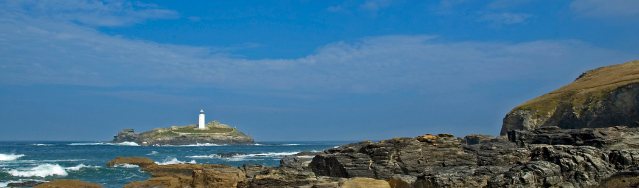
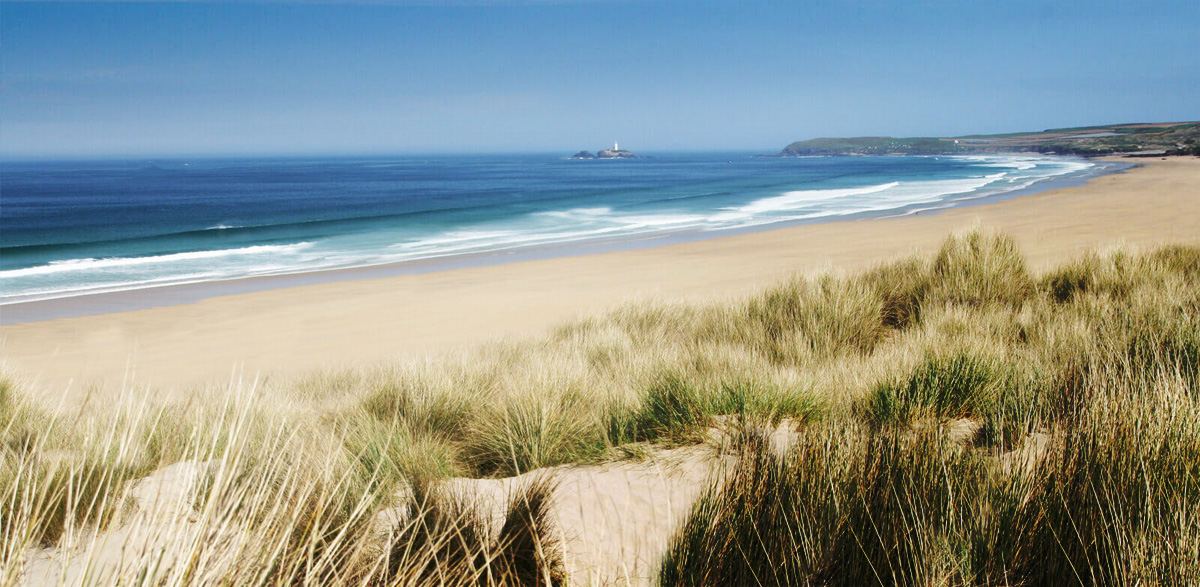
Hayle is a friendly harbour town on the estuary of the River Hayle in west Cornwall, sitting where the river meets the great sweep of St Ives Bay. From the mouth of the estuary a golden beach runs for some three miles to Godrevy Lighthouse, backed all the way by the towans – the Cornish word for sand dunes – with St Ives shining across the water.
It is a town of two halves and a lot of water. In the west, Foundry grew up around Harvey’s great engineering works and Foundry Square; in the east, Copperhouse grew around the smelting works of the Cornish Copper Company. Between them lie the quays of Hayle Harbour and the tidal pools of the Hayle Estuary, an RSPB nature reserve that is one of the best places in Cornwall to watch birds.
Two centuries ago Hayle was one of the most important industrial towns in Britain. Its foundries built giant steam engines for mines all over the world, and ships sailed from its quays with Cornish copper and tin. That history has earned the harbour and the town a place in the Cornwall and West Devon Mining Landscape World Heritage Site, and you can still trace it in the quays, the black slag-block walls and the grand buildings around Foundry Square.
Today Hayle is a relaxed, unpretentious base for a beach holiday. The towans are lined with holiday parks and cafés, there are lifeguarded beaches for swimming and surfing, an open-air pool beside Copperhouse Pool, Paradise Park for the children, and pasty shops that people drive miles to visit.
Hayle is also one of the best-connected towns in west Cornwall. It has a station on the main line from London, the St Ives Bay Line starts a mile away at St Erth, and the A30 runs past the edge of town – so St Ives, Penzance, Marazion and the mining towns of Camborne and Redruth are all within easy reach. To the north, the beach leads on to Gwithian and Godrevy.
For somewhere to stay, see Hayle holiday cottages and holidays and short breaks in Hayle.
Best Time to Visit Hayle
Summer is beach time – warm sand, lifeguards on the towans, the outdoor pool open and long evenings watching the sun set over St Ives. The holiday parks make the towans lively, so arrive early at the beach car parks on sunny days. Spring and autumn are quieter, ideal for walking the coast path and the estuary, and dogs can run on the whole beach outside July and August. Winter is the season for birdwatchers, when thousands of ducks, waders and gulls gather on the estuary, which never freezes – and a wild walk on the empty sands ends nicely with a pasty or a pint by the harbour.
↑ Back to topHAYLE BEACHES – THREE MILES OF GOLDEN SAND
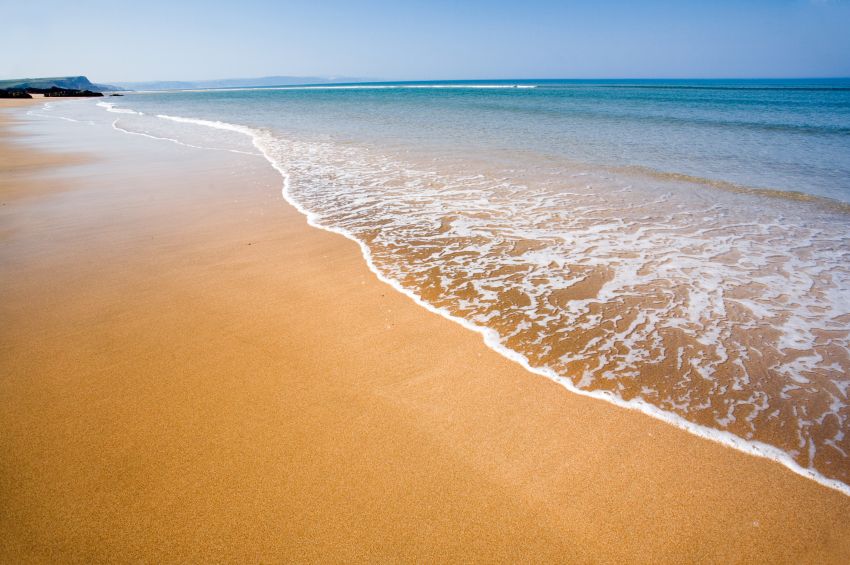
Hayle has one of the longest beaches in Cornwall. From the mouth of the estuary the sand curves north-east for about three miles to the rocks of Godrevy, and at low tide you can walk the whole way. Different stretches have their own names – Hayle Towans and Harvey’s Towans by the estuary, then Riviere Towans, Mexico Towans, Upton Towans and finally Gwithian Towans – but it is all one magnificent beach, with room for everyone even in August.
This is a beach for families. At low tide there are acres of firm, flat sand for games and sandcastles, shallow pools left by the tide, and dunes to explore behind. RNLI lifeguards patrol Hayle Towans and the neighbouring beaches in the main season, and the Atlantic surf makes the bay a favourite with bodyboarders and surfers, with surf schools along the towans offering lessons for beginners. Beach cafés and the facilities of the holiday parks are dotted along the dunes.
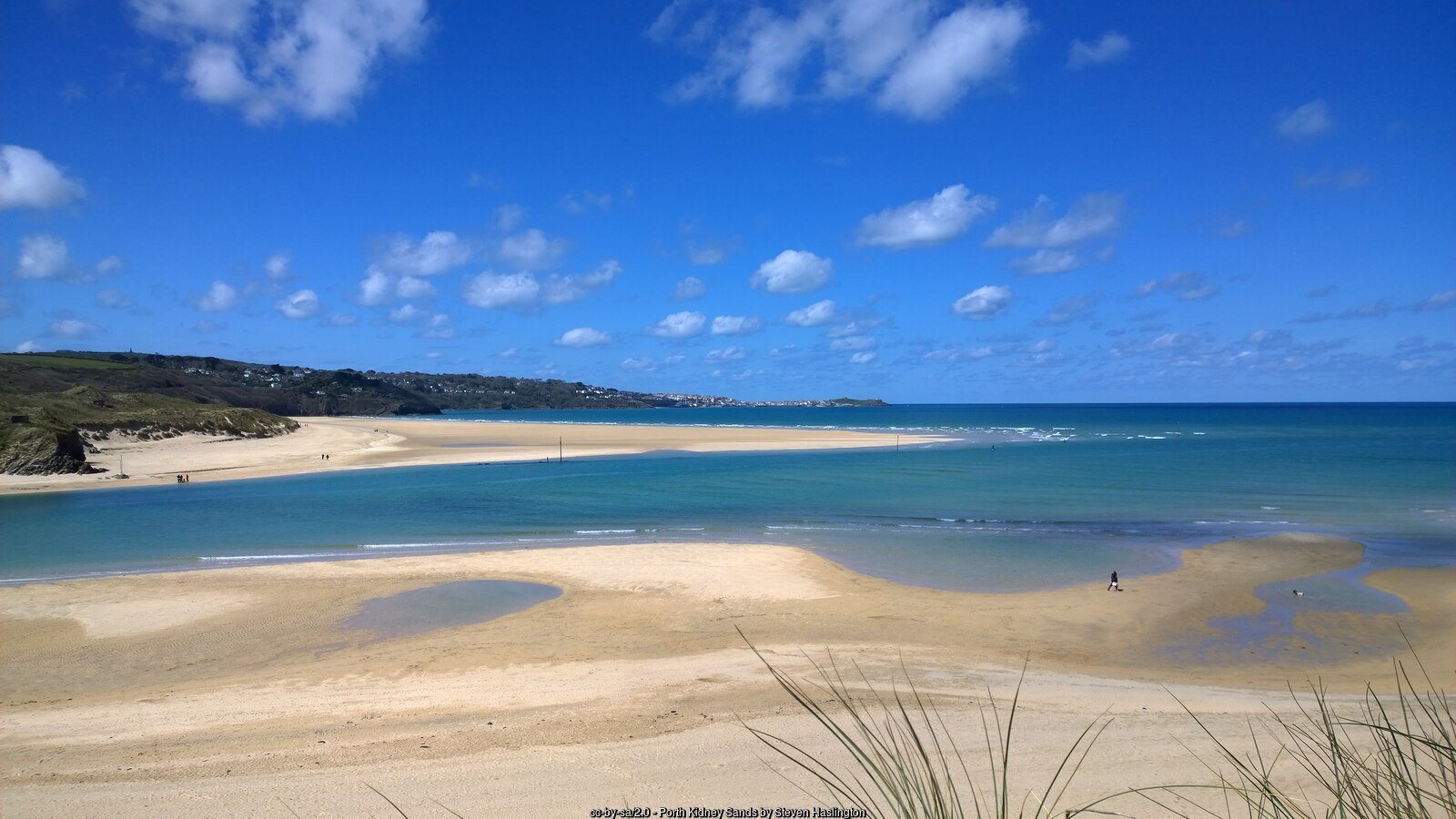
The one place to be wary of is the mouth of the estuary. Here the tide rushes in and out of the narrow channel with great force, and swimming is dangerous – stay on the lifeguarded beach and swim between the red and yellow flags. Across the estuary, Porthkidney Sands below Lelant is a vast, quiet beach backed by more dunes and the St Ives branch railway, but it has no lifeguards and is best enjoyed for walking.
At the north end of Hayle Towans a coal-fired power station stood beside the estuary from 1910 to 1973. It has long gone, and the dunes have reclaimed most of the site.
- Hayle Towans beach guide – parking, lifeguards and dogs
- Mexico Towans, Upton Towans and Gwithian Beach
- Porthkidney Sands, across the estuary at Lelant
- Surfing in Cornwall – Cornwall Online surf guide
Beach safety
Lifeguards: RNLI on Hayle Towans in the main season
Swim: between the red and yellow flags
Danger: strong tidal currents at the estuary mouth
Dogs: not allowed Harvey’s Towans to Godrevy Point, 1 July–31 August, 10am–6pm
THE TOWANS – HAYLE’S SAND DUNES
Behind the beach rise the towans, one of the largest dune systems in Cornwall, stretching all the way from Hayle to Gwithian. Marram grass binds the loose sand of the front dunes, and further back the older dunes are covered in a rich turf of wild flowers – wild thyme, bird’s-foot trefoil and orchids in early summer – that attracts a wonderful variety of butterflies. The dunes are protected as a Site of Special Scientific Interest, and the Cornwall Wildlife Trust manages a large reserve at Upton Towans.
The towans have a busy past. For years they were dug for sand, and from the late 19th century a huge explosives works spread across Upton Towans, making dynamite for the mines; its ruined buildings are still hidden among the dunes. Today much of the Hayle end is given over to holiday parks and chalets, while the dunes further north are wild and open.
Please keep to the marked paths – the dunes are fragile and easily eroded – and take your litter home.
↑ Back to top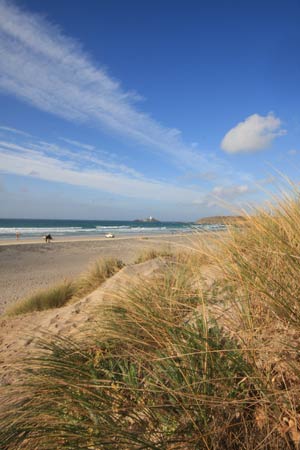
THE HAYLE ESTUARY & RSPB NATURE RESERVE
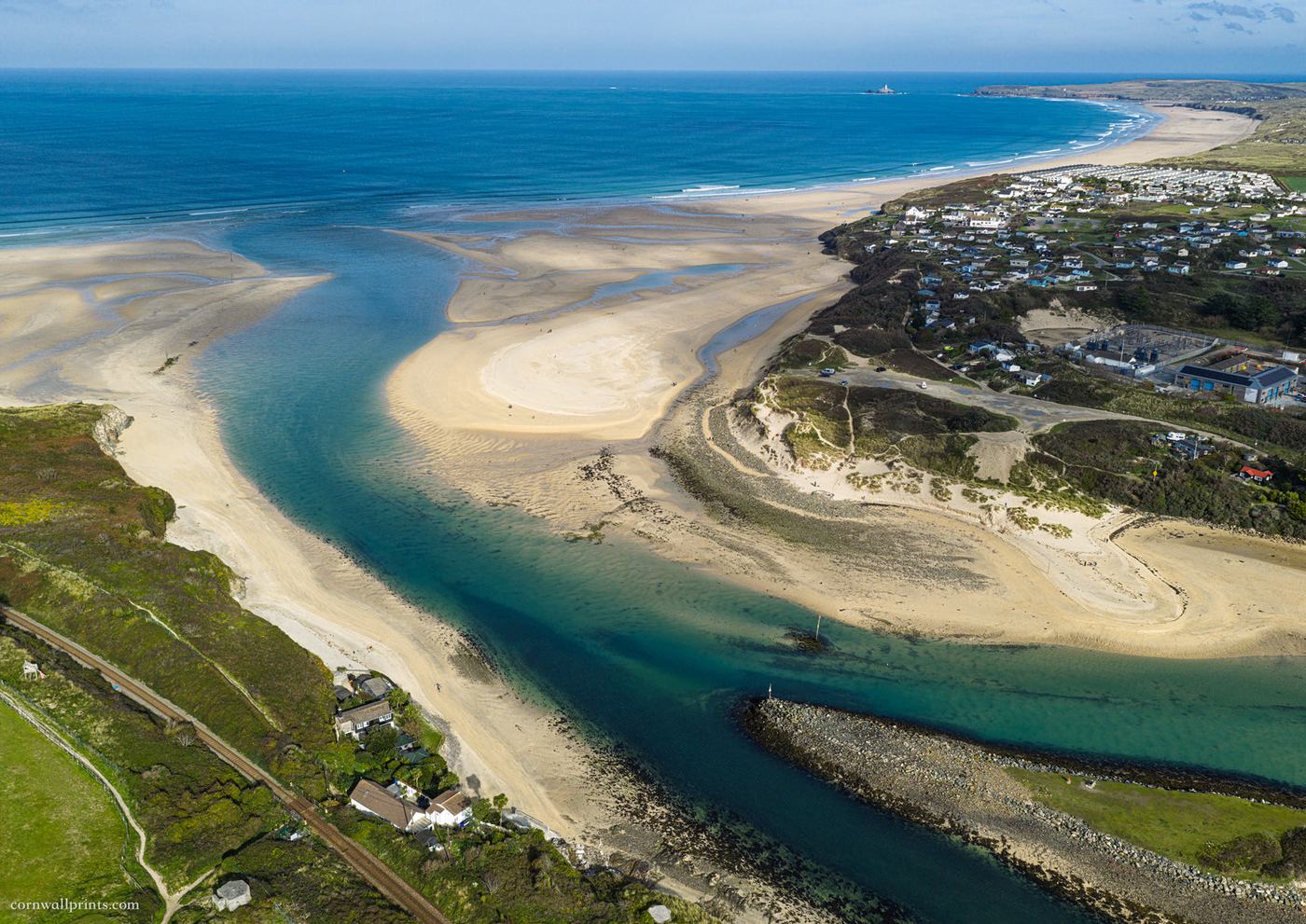
The name Hayle comes from the Cornish heyl, meaning ‘estuary’, and the estuary is still the heart of the town. At high tide it is a broad sheet of water; at low tide it becomes a maze of sandbanks, mudflats and channels, with Carnsew Pool on its west side, Copperhouse Pool reaching into the east of the town and the saltmarsh of Lelant Saltings to the south.
Much of the estuary is the RSPB Hayle Estuary nature reserve. It is the most south-westerly estuary in the UK and, because it never freezes, it is a refuge for birds in hard winters, when many thousands of wigeon, teal, waders and gulls gather here. Spring and autumn bring migrants, from terns to rare American waders, and you may see little egrets, curlews and kingfishers at any time of year.
The best places to watch are the hide at Ryan’s Field, off Chenhall’s Road on the St Erth side of town, the causeway on the B3301, the footpath around Carnsew Pool and the King George V Memorial Walk beside Copperhouse Pool. Dogs are not allowed on the estuary, Carnsew Pool or Copperhouse Pool at any time, to protect the birds.
↑ Back to topBirdwatching on the estuary
Best season: winter, for wildfowl, waders and gulls
Hide: Eric Grace Memorial Hide, Ryan’s Field, off Chenhall’s Road (free, step-free access)
Walks: Carnsew Pool path and the King George V Memorial Walk by Copperhouse Pool
Tip: come an hour or two either side of high tide, when the birds are pushed closer to the shore
Dogs: not allowed on the estuary or the pools
HAYLE HARBOUR & THE QUAYS
Hayle has been a port since the earliest times, one of the very few sheltered harbours on Cornwall’s north coast – though its entrance across the sand bar has never been easy. Its great age came in the 18th and 19th centuries, when the Cornish Copper Company and Harvey & Co built rival quays, docks and canals along the estuary to ship out copper ore and engines and bring in coal, iron and timber. Their feud was so bitter that it was nicknamed the ‘thirty years war’.
To keep the channels clear of sand, the harbour was sluiced: water was held back in Carnsew Pool and Copperhouse Pool at high tide, then released at low tide to scour the harbour bed. Sluicing was brought back in 2017. Harvey’s South Quay, built in 1819, and the long North Quay and East Quay survive and are listed, and the quaysides now have promenades where you can walk around the harbour.
Hayle Harbour today is a small working harbour, with fishing and leisure boats moored along the quays and the copper-clad Asda store on South Quay. Regeneration of North Quay has been on and off for decades: new homes and a marine renewables business park have been built, but work on some of the new apartments stalled in 2024 when the developer went into administration. Offshore, the Wave Hub renewable energy test site, connected to the grid at Hayle by an undersea cable, has changed hands and is being developed for floating offshore wind.
↑ Back to top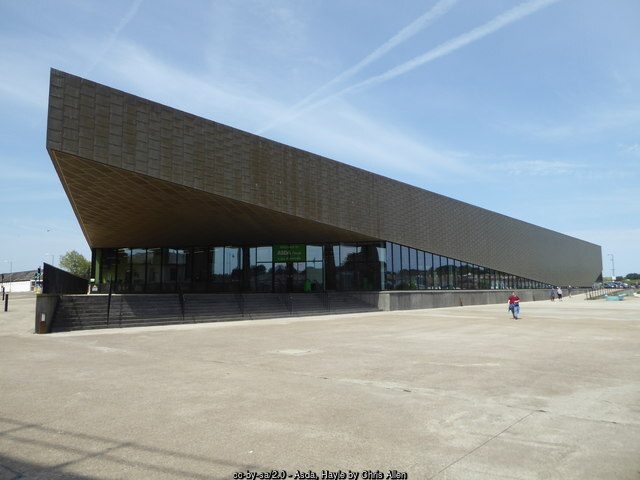
HARVEY’S FOUNDRY, COPPERHOUSE & HAYLE’S WORLD HERITAGE
Modern Hayle was born in the Industrial Revolution. In 1758 the Cornish Copper Company moved from Camborne to the eastern arm of the estuary and built its copper smelting works there, giving the district its name, Copperhouse. It cut a canal and built Copperhouse Dock in 1769, and its smelters left mountains of waste slag, which was cast into hard black blocks called scoria – look for them in walls and houses all over Hayle. When smelting stopped in 1819 the company turned to iron founding, and its Copperhouse Foundry built hundreds of Cornish beam engines.
In 1779 John Harvey, a blacksmith from Carnhell Green, set up a small foundry on the other side of the estuary to make pipes and parts for the mines. Under his son Henry Harvey, Harvey & Co grew into one of the greatest engineering works in the world, employing nearly 1,000 people by the 1840s. Harvey’s built shipyards, mills and a fleet of ships, and sent steam pumping engines to mines and waterworks across the globe – most famously the giant engine at Cruquius in the Netherlands, with a 12-foot cylinder, built in 1847 to drain the Haarlemmermeer and preserved there today as a museum.
The two companies fought for decades over the harbour until Harvey’s bought out its rival in 1867. As Cornish mining declined, Harvey’s engineering works and shipyard closed in the early 1900s, though the firm carried on as builders’ merchants for many years. In 2006 the harbour and its industrial buildings became part of the Cornwall and West Devon Mining Landscape World Heritage Site.
Harvey’s Foundry around Foundry Square has been restored by the Harvey’s Foundry Trust for offices, workshops and community use. Its Hayle Heritage Centre in John Harvey House, the company’s old office at 24 Foundry Square, tells the town’s story with free exhibitions. The centre has been closed for a major renovation, with reopening planned for 2026 – check its website before you visit.
↑ Back to topLook out for
Scoria blocks – shiny black slag blocks in walls around Copperhouse Pool and the dock
Black Bridge – built of scoria by the Cornish Copper Company in the early 19th century
Foundry Square – Harvey’s offices, the White Hart and the old foundry buildings
The quays – South, North and East Quays, and the Carnsew sluice
HAYLE’S RAILWAYS & THE VIADUCT
Hayle had one of Cornwall’s first railways. The Hayle Railway opened in December 1837 to carry copper ore from the mines around Camborne and Redruth down to the quays, with cable-worked inclines at Angarrack and Penponds, and passenger trains began in 1843. Branches ran right onto the quays to load the ships.
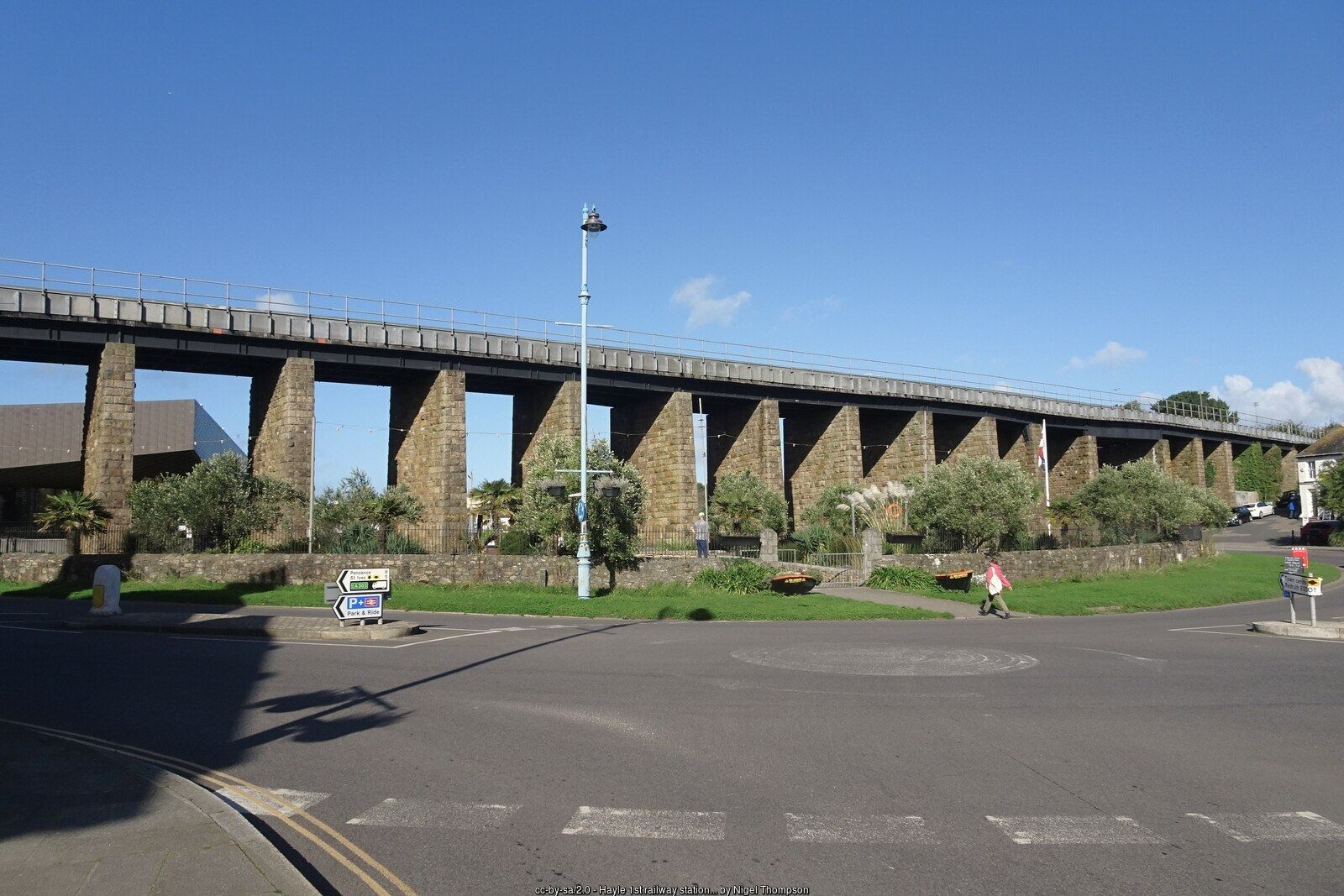
The site of the first Hayle station is now marked only by the photograph below. Opened in 1843 by the Hayle Railway, later part of the West Cornwall Railway, as the terminus of the line from Redruth, this station closed to passengers in 1852, when it was replaced by the current station on a completely different alignment. The first station was situated just in front of the later viaduct on a very sharp curve. The single-storey station building dated from 1837 and was demolished in 1948. Today, no trace remains.
In 1852 the West Cornwall Railway, engineered by Isambard Kingdom Brunel, rebuilt the line between Redruth and Penzance, replacing the inclines with viaducts and carrying the railway over the town on a timber viaduct. The Great Western Railway replaced it in 1885 with the Hayle Viaduct you see today, some 830 feet long, with iron girders on tall stone piers striding over Foundry. Hayle station still stands at the top of Station Hill, with trains to Penzance, Truro and London.
↑ Back to topRailway dates
1837 – Hayle Railway opens for goods
1843 – passenger trains begin
1852 – West Cornwall Railway opens; new station and Brunel’s timber viaduct
1877 – St Ives branch opens from St Erth
1885 – present Hayle Viaduct built
2019 – St Ives park and ride moves to St Erth
FOUNDRY, COPPERHOUSE & THE TOWN CENTRE
Hayle still has two centres, a mile apart along the estuary. Foundry, at the western end below the viaduct, gathers around Foundry Square, with the restored foundry buildings, the old Harvey’s offices and the White Hart Hotel, built in 1838 by Henry Harvey for his sister Jane, the widow of the engineer Richard Trevithick. From here Penpol Terrace leads past the harbour towards Copperhouse.
Copperhouse, at the eastern end, has the town’s main shopping street, Fore Street, with independent shops, cafés and the library on Commercial Road. Behind it, the King George V Memorial Walk runs along the shore of Copperhouse Pool, with gardens, a play area and the Hayle Outdoor Swimming Pool – a heated open-air pool run by the town council, which celebrated its 50th season in 2026 and opens from late May to early September.
Hayle is famous for its pasties. Philps, making pasties by hand since 1958, has its shops on East Quay and Foundry Hill, and Hampsons, a family butcher and pasty maker since 1966, is on Chapel Terrace – buy one and eat it by the harbour. Among the pubs, the Cornish Arms on Commercial Road is a roomy, family-friendly St Austell Brewery pub, and the historic Royal Standard on Penpol Terrace and the White Hart are close to the harbour.
For bigger shopping trips, the West Cornwall Shopping Park beside the A30 at Loggans Moor has Marks & Spencer, Next and Boots, with Lidl and a cluster of cafés and drive-throughs nearby.
↑ Back to top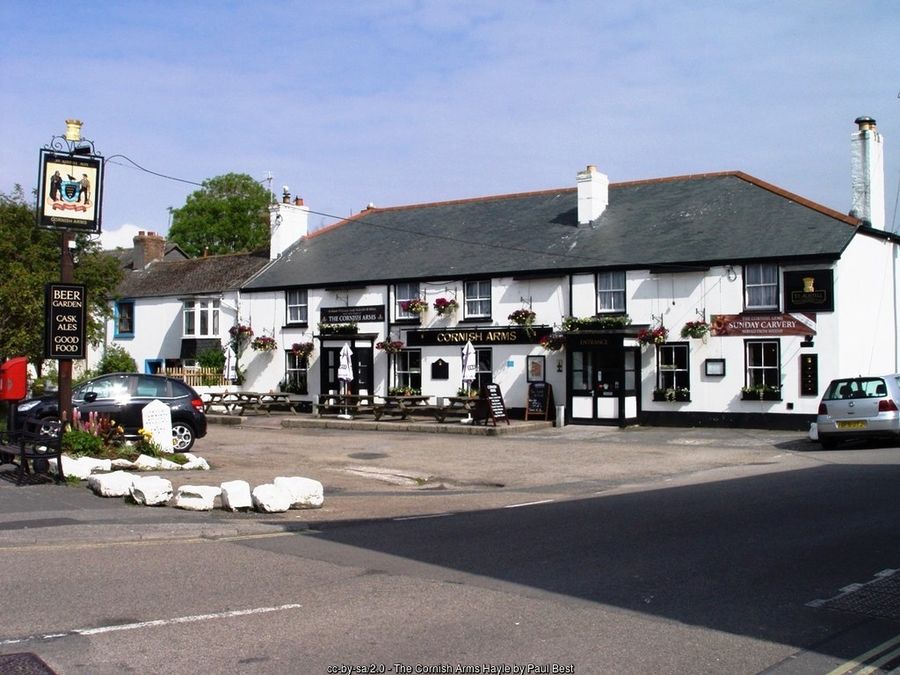
WALKS FROM HAYLE
Hayle, St Erth and Gwinear-Gwithian were the first area in Cornwall to gain Walkers are Welcome status, and the town makes a great base for walking, from flat estuary strolls to long beach walks.
Hayle Towans to Godrevy – at low tide, walk the three miles of sand from the estuary mouth to Godrevy, returning along the South West Coast Path through the dunes. It is a long, level walk with St Ives always behind you and the lighthouse ahead.
Carnsew Pool and the estuary – a short circuit of about a mile and a half from Foundry around Carnsew Pool, on a narrow path with some steps, with views across the estuary to Lelant and plenty of birds; carry on to the RSPB hide at Ryan’s Field.
Copperhouse Pool – follow the King George V Memorial Walk along the shore, cross Black Bridge and return by the Black Road causeway. The town council and Walkers are Welcome have produced a Copperhouse Family Activity Trail with a quiz and nature notes, and there is a Hayle Railways Walk that traces the old lines through the town.
St Michael’s Way – this waymarked pilgrims’ route, opened in 1994, starts at St Uny’s Church in Lelant across the estuary and crosses the peninsula for about 12 miles to Marazion and St Michael’s Mount.
- Walking in Cornwall – Cornwall Online walks
- Hayle Town Council – local trails and walks
- South West Coast Path
LELANT, ST ERTH & PHILLACK
Lelant looks across the estuary to Hayle from its western shore. In the Middle Ages it was the main port of the area, until the river mouth silted up and trade moved across the water to Hayle; the remains of its old quays can still be traced along the shore. Its largely 15th-century church of St Uny stands at the edge of the dunes, beside the links of the West Cornwall Golf Club, and below the village lies the great empty beach of Porthkidney Sands. Lelant and Lelant Saltings have stations on the St Ives Bay Line – the old park and ride at Lelant Saltings closed in 2019, when it moved to St Erth station.
St Erth, a mile south of Hayle at the head of the estuary, is a pretty village on the River Hayle with a medieval bridge, a parish church where Richard Trevithick married Jane Harvey in 1797, and the busy junction station for the St Ives branch. Just outside the village, St Erth Pits were dug from the 1830s until the early 1950s for clay and fine moulding sand, much of it used for casting at Harvey’s foundry. The old sandpit is now Cornwall Wildlife Trust’s first geological nature reserve and, with the neighbouring Vicarage Pit, a Site of Special Scientific Interest: its Pliocene sands and clays, laid down in a shallow sea some two million years ago, are packed with fossil shells and tiny sea creatures.
Phillack, on the north side of Copperhouse Pool below the towans, is one of the two ancient parishes, with St Erth, from which the town of Hayle grew. Its church of St Felicitas and St Piala keeps its medieval tower but was largely rebuilt in 1856, and above the porch is a stone carved with an early Christian chi-rho symbol, thought to date from the 5th century or even earlier.
↑ Back to topHISTORY OF HAYLE
People have lived around the Hayle estuary for thousands of years, and it was an important landing place long before the town existed – early Christian memorial stones have been found at Carnsew and Phillack, and early travellers between Ireland and Brittany are thought to have crossed the peninsula from here. In the Middle Ages the main settlements were the church towns of Phillack, St Erth and Lelant, and Lelant was the chief port until its harbour silted up.
The town of Hayle as we know it grew up in the 18th and 19th centuries, when the copper smelting works at Copperhouse and Harvey’s foundry turned the estuary into one of the busiest industrial centres in Cornwall. The two firms built the quays, docks, canals and causeways, the railways arrived from 1837, and Hayle engines, ships and machinery went out to the world. The rivalry ended in 1867 when Harvey’s took over the Copperhouse business, and with the collapse of Cornish mining the great works had closed by the early 1900s.
The 20th century brought new industries – a power station on the towans from 1910 to 1973 and explosives works on the dunes – and then, as they faded, tourism. Holiday parks spread along the towans, Paradise Park opened in 1973, and in 2006 the town’s industrial landscape was recognised as part of a World Heritage Site. Today Hayle is a growing town of about 9,800 people, and the long-awaited regeneration of its harbour continues.
↑ Back to topHayle timeline
1758 – Cornish Copper Company builds its smelting works at Copperhouse
1769 – Copperhouse canal and dock
1779 – John Harvey founds his foundry
c.1811 – Black Road and Black Bridge built
1819 – Harvey’s South Quay; smelting ends at Copperhouse
1837 – Hayle Railway opens
1847 – Cruquius engine built for the Netherlands
1852 – West Cornwall Railway and Brunel’s viaduct
1867 – Harvey’s buys out the Copperhouse company
1888 – St Elwyn’s Church consecrated
1903–04 – Harvey’s engineering works and shipyard close
1910–1973 – power station on Hayle Towans
1973 – Paradise Park opens
2006 – World Heritage Site status
2017 – harbour sluicing restored
KEY BUILDINGS & LANDMARKS IN HAYLE
- St Elwyn’s Church – Grade II* parish church above Foundry, 1886–88, one of the last works of the architect John Dando Sedding, with a great west ‘Friendship Window’ by Clayton & Bell (1934).
- Church of St Felicitas and St Piala, Phillack – Grade II* church with a medieval tower, largely rebuilt in 1856, with an early Christian chi-rho stone over the porch.
- John Harvey House and Harvey’s Foundry – the restored offices and buildings of Harvey & Co around Foundry Square, home of Hayle Heritage Centre.
- White Hart Hotel – Foundry Square, built in 1838 by Henry Harvey for his sister Jane Trevithick.
- Black Bridge and the Black Road – early 19th-century causeway and bridge across Copperhouse Creek, built of scoria by the Cornish Copper Company; the bridge is Grade II listed and the causeway a scheduled monument.
- Copperhouse Dock – Grade II listed canal dock built around 1769 for the Cornish Copper Company.
- Hayle Viaduct – the 1885 railway viaduct, about 830 feet long, that carries the main line over Foundry.
NOTABLE PEOPLE & HAYLE
- John Harvey (1730–1803) – blacksmith from Carnhell Green who founded Harvey & Co at Hayle in 1779.
- Henry Harvey (1775–1850) – John’s son, who built Harvey & Co into a world-famous engineering and shipbuilding business and built South Quay and the White Hart.
- Richard Trevithick (1771–1833) and Jane Trevithick (1772–1868) – the steam pioneer married Jane Harvey, John Harvey’s daughter, at St Erth in 1797, and worked closely with Harvey’s; Jane ran the White Hart and lived in Hayle until her death.
- Mike and Audrey Reynolds – opened ‘Bird Paradise’, now Paradise Park, in 1973 in the gardens of Glanmor House, built by the Harveys; Mike Reynolds founded the World Parrot Trust there in 1989.
THINGS TO DO IN HAYLE
Hayle is above all a beach town, and on a sunny day there is nowhere better than the three miles of sand on its doorstep. But there is plenty more to do, from birdwatching and heritage walks to one of Cornwall’s favourite family attractions.
The town is also perfectly placed for days out. St Ives is a short drive or a scenic train ride away, Godrevy and its seals are at the far end of the beach, and Penzance, Marazion and St Michael’s Mount are about twenty minutes by road.
Here are our favourite things to do in and around Hayle:
- Spend a day on Hayle Towans – sandcastles, bodyboarding and sunsets over St Ives.
- Visit Paradise Park, the wildlife sanctuary and home of the World Parrot Trust, with the indoor JungleBarn for wet days.
- Watch the birds on the RSPB Hayle Estuary from the hide at Ryan’s Field.
- Swim in the heated Hayle Outdoor Swimming Pool beside Copperhouse Pool in summer.
- Follow the town’s industrial story around Foundry Square, the quays and Black Bridge.
- Buy a hot Hayle pasty and eat it by the harbour.
- Take the St Ives Bay Line from St Erth along the estuary and the coast to St Ives.
- Walk the beach to Godrevy to see the lighthouse and the seals at Mutton Cove.
- Play a round on the links of the West Cornwall Golf Club at Lelant.
EVENTS IN HAYLE
Hayle has a lively calendar of community events, run mostly by local volunteers.
Hayle Carnival (early summer) – a colourful evening procession of floats, walking groups and bands from the Recreation Ground around the town; in recent years it has been held in June. A winter illuminated carnival has also been held in December.
Hayle Outdoor Pool season (late May to early September) – the open-air pool opens with its traditional opening day and hosts events through the summer.
Summer fun days (July and August) – community fun days, classic car shows and fundraising events on the Recreation Ground and around the harbour.
The Hayle Walk (early September) – a sponsored walk around the town in aid of Cornwall Hospice Care, supported by the mayor.
Christmas in Hayle (December) – Christmas lights in Foundry and Copperhouse, paid for by local fundraising through the year, and festive events in the run-up to Christmas.
Dates change each year – check the Hayle Town Council website for what’s on. Nearby, Trevithick Day in Camborne (late April) and the St Ives September Festival are well worth a visit.
↑ Back to topPLACES NEAR HAYLE
- Gwithian – village, surf beach and towans at the north end of the sands, about 3 miles.
- Godrevy – lighthouse, seals and National Trust headland, about 4 miles.
- St Ives – harbour, beaches and galleries, about 5 miles.
- Camborne – Richard Trevithick’s town and mining heritage, about 5 miles.
- Marazion – St Michael’s Mount and Mount’s Bay, about 6 miles.
- Penzance – promenade, Jubilee Pool and ferries to Scilly, about 8 miles.
- Portreath – harbour and beach on the north coast, about 9 miles.
Hayle, on the estuary of the River Hayle – Foundry and Copperhouse, the harbour and the towans, with St Ives across the bay.
VISITOR INFORMATION
Hayle is just off the A30. Coming from the east, leave at the Loggans Moor roundabout for Copperhouse, the towans and the harbour; from the west, the St Erth roundabout leads into Foundry. Hayle station is on the main line, and St Erth station, a mile away, has the park and ride for St Ives.
Parking & EV Charging
Foundry Square (TR27 4HQ) and Commercial Road, Copperhouse (TR27 4DE) – Cornwall Council car parks in the town. For the beach, car parks at Hayle Towans / Riviere Towans and on Harvey’s Towans. St Erth station (TR27 6JW) – large park and ride car park for the St Ives Bay Line. Charges change – check the signs.
EV charging: rapid and fast chargers in Foundry Square car park and on North Quay; chargers at Asda, South Quay; rapid chargers at Shell, Loggans Moor (A30); and at St Erth station.
Bus & Train
Hayle station is on the Cornish main line, with trains to Penzance, Truro, Plymouth and London Paddington. The St Ives Bay Line runs from St Erth, about a mile away. Frequent buses run through Foundry and Copperhouse to St Ives, Penzance, Camborne, Redruth and Truro, and in summer a coastal bus usually runs along the towans to Gwithian; and long-distance coaches stop in the town. Check timetables before you travel.
Facilities & Supermarkets
Public toilets at Foundry Square car park, Commercial Road, the Recreation Ground and Riviere Towans. Library on Commercial Road. Shops, banks and cafés in Foundry and on Fore Street, Copperhouse. Supermarkets:
- Asda – 1 South Quay, Hayle TR27 4EP
- Lidl – Carwin Rise, Loggans, Hayle TR27 5PN
- M&S Foodhall – West Cornwall Shopping Park, Marsh Lane, Hayle TR27 5LX
Cafés, Pubs & Pasties
Pasties: Philps (East Quay and Foundry Hill) and Hampsons (Chapel Terrace). Pubs: the White Hart (Foundry Square), the Royal Standard (Penpol Terrace), the Cornish Arms (86 Commercial Road) and the Bucket of Blood at Phillack. Cafés: in Foundry and Copperhouse, at the outdoor pool in summer and along the towans. Opening hours vary out of season.
Health
Bodriggy Health Centre, 60 Queensway, Hayle TR27 4PB (GP surgery with pharmacy); Copperhouse Pharmacy, Fore Street. The nearest urgent treatment centre is at West Cornwall Hospital, Penzance, and the nearest A&E is the Royal Cornwall Hospital at Treliske, Truro. On the beach, ask the lifeguards for first aid. Call NHS 111 for urgent advice, or 999 in an emergency.
Disabled Access
The King George V Memorial Walk beside Copperhouse Pool is a level two-mile circuit on tarmac and compacted gravel, and the RSPB hide at Ryan’s Field has step-free access from its car park; the harbourside promenades are also level. The path around Carnsew Pool is narrow, with some steps. Foundry Square car park has disabled bays. Access to the beach through the towans is over soft sand and steep dune paths, which are harder going.
Vets & Dogs
Dogs are not allowed on the beach from Harvey’s Towans to Godrevy Point from 1 July to 31 August, 10am to 6pm, and are banned all year from the Hayle Estuary, Carnsew Pool and Copperhouse Pool. Dogs are not allowed in the outdoor pool complex. There are vets in Hayle.
National Trust & English Heritage
The National Trust cares for Godrevy headland at the far end of the beach and the North Cliffs beyond, and runs East Pool Mine near Camborne – check opening before you go.
Attractions
Paradise Park, the RSPB Hayle Estuary reserve, Hayle Outdoor Swimming Pool and Hayle Heritage Centre are in the town, with Godrevy, the galleries of St Ives, St Michael’s Mount and the mining heritage of Camborne and Redruth close by.
STAY & EXPLORE IN HAYLE
Official Information
FAMILY HOLIDAYS & SHORT BREAKS IN HAYLE
Family holidays in Hayle are all about the beach – three miles of golden sand for games and sandcastles, lifeguards in summer, dunes to run down and the outdoor pool for a warm swim. Add Paradise Park, a train ride to St Ives and a pasty on the quay, and every member of the family has something to look forward to.
Browse Hayle holiday cottages for self-catering homes in the town and around the towans, or holidays and short breaks in Hayle for every type of accommodation, from cottages and B&Bs to holiday parks and campsites.
Short breaks in Hayle are a treat in any season – a spring walking weekend, an autumn escape for empty beaches, or a winter break for the birds of the estuary. With a main line station in the town, Hayle is one of the easiest places in west Cornwall to reach without a car. Booking direct with the owner means no agency fees.
↑ Back to topFREQUENTLY ASKED QUESTIONS ABOUT HAYLE
Hayle is a small town on the estuary of the River Hayle on the north coast of west Cornwall, on the east side of St Ives Bay. It is just off the A30 about 8 miles north-east of Penzance, 5 miles west of Camborne and 5 miles from St Ives, and it has its own station on the main railway line from London Paddington.
Yes. From the mouth of the estuary at Hayle Towans the sand runs for about three miles past Mexico, Upton and Gwithian Towans to Godrevy, backed all the way by dunes. RNLI lifeguards patrol Hayle Towans and the neighbouring beaches in season. Do not swim near the estuary mouth, where tidal currents are dangerous – always swim between the red and yellow flags.
In the town the Cornwall Council car parks are at Foundry Square (TR27 4HQ), which has electric vehicle chargers, and Commercial Road in Copperhouse (TR27 4DE). For the beach there are car parks at Hayle Towans and Riviere Towans and on Harvey’s Towans. St Erth station, a mile away, has a large park and ride car park for the St Ives Bay Line.
Dogs are allowed on the beach for most of the year, but not on the stretch from Harvey’s Towans to Godrevy Point between 1 July and 31 August, 10am to 6pm. Dogs are banned all year, day and night, from the Hayle Estuary, Carnsew Pool and Copperhouse Pool to protect the birds.
It is not safe to swim in the Hayle estuary or near its mouth. The tide floods in and out of the narrow channel very fast, creating strong currents, and the sandbanks are cut off quickly by the rising tide. Swim instead on the lifeguarded beaches of Hayle Towans, between the red and yellow flags.
Hayle is famous for its three miles of golden sand and dunes, for the RSPB Hayle Estuary bird reserve, and for its industrial past: Harvey & Co of Hayle built some of the largest steam engines in the world, and the harbour is part of the Cornwall and West Devon Mining Landscape World Heritage Site. It is also known for Paradise Park and for its pasty shops.
Hayle station is on the Cornish main line, with trains from Penzance, Truro, Plymouth and London Paddington. The St Ives Bay Line starts at St Erth, about a mile away, and runs along the estuary past Lelant and Carbis Bay to St Ives.
On a rainy day visit Paradise Park, which has the indoor JungleBarn play centre as well as its birds and animals, watch the birds from the RSPB hide at Ryan’s Field, or head for the galleries of St Ives or the mining heritage of Camborne and Redruth. Hayle Heritage Centre on Foundry Square has been closed for renovation – check before you go.
Yes. Since 2006 the Port of Hayle has been one of the ten areas of the Cornwall and West Devon Mining Landscape World Heritage Site, recognised for its quays, foundries and industrial buildings, which shipped Cornish copper and tin and exported mining engines around the world.
Cornwall Online | West Cornwall Towns and Villages | St Ives | Carbis Bay | Hayle | Gwithian Towans | Godrevy Head | Portreath | Porthtowan | St Agnes | Isles of Scilly | Sennen Cove & Land’s End | Pendeen | St Just | Porthcurno | Lamorna | Mousehole | Newlyn | Penzance | Marazion – St Michael’s Mount | Praa Sands | Porthleven