Holidays in Tintagel, North Cornwall – Castle, Legends & Coast
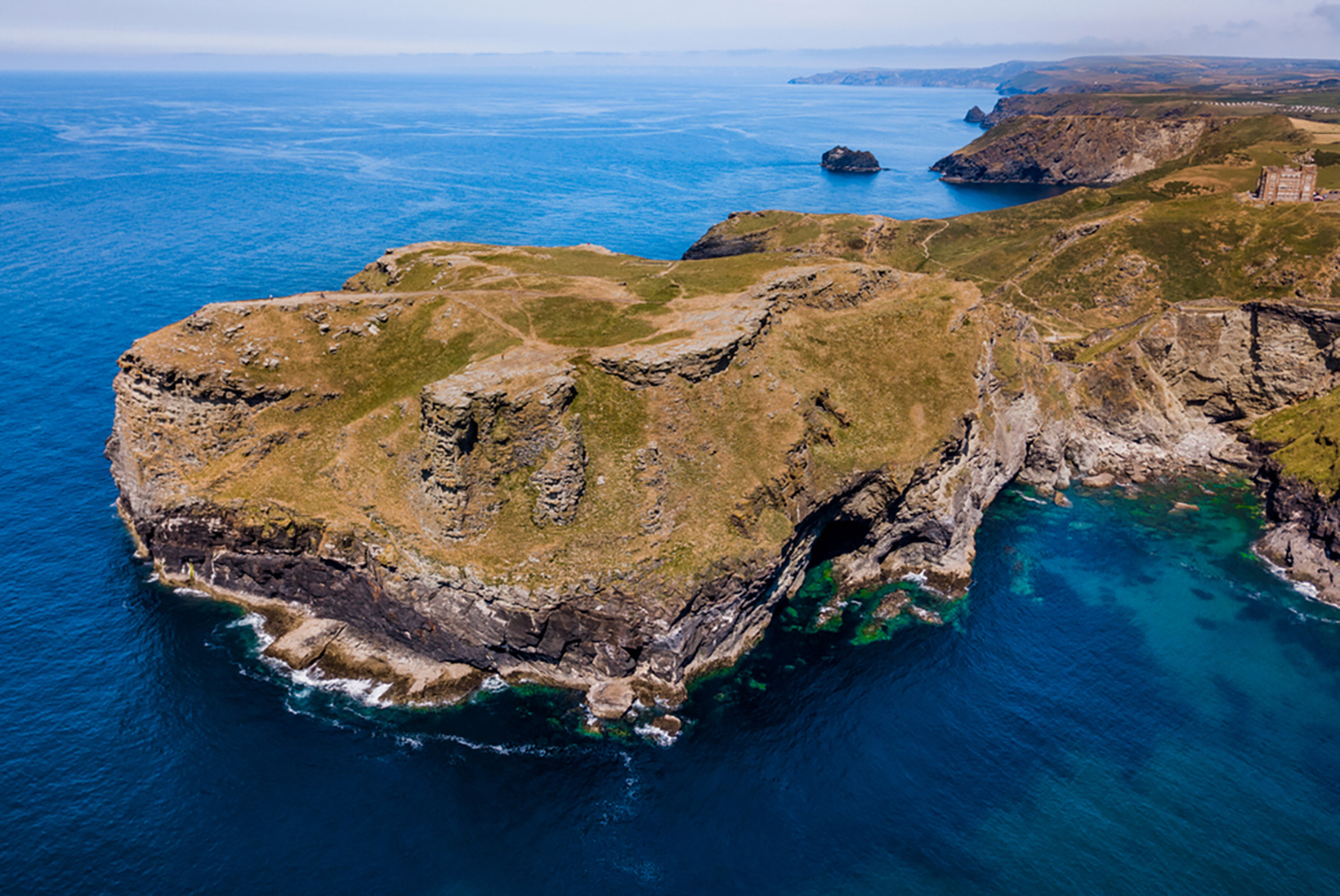
Tintagel in North Cornwall
North Cornwall Towns and Villages | Padstow | Wadebridge | The Camel Estuary | Rock | Daymer Bay | Polzeath | Port Isaac | Trebarwith Strand | Tintagel | Bossiney Cove | Rocky Valley | Boscastle | Crackington Haven | Bude | Launceston | Camelford | Altarnum | Bodmin |
On This Page
Tintagel at a Glance
A village on the North Cornwall coast, home to the legendary Tintagel Castle (English Heritage), the National Trust’s Old Post Office and King Arthur’s Great Halls. About 6 miles from Camelford, 3½ miles from Boscastle and 2½ miles from Trebarwith Strand. Sat-nav: PL34 0AA (Visitor Centre car park).
HOLIDAYS IN TINTAGEL
Few places in Britain are as wrapped in legend as Tintagel. On a rugged headland above the Atlantic, the ruins of a medieval castle cling to the cliffs where, according to the story told by Geoffrey of Monmouth in the 12th century, King Arthur was conceived. Today the castle, the island and the dramatic coastline around them draw visitors from all over the world.
But Tintagel is far more than its legend. Archaeologists have shown that the headland was a wealthy, high-status settlement in the 5th to 7th centuries, trading with the Mediterranean, long before Richard, Earl of Cornwall, built his castle here in the 1230s. Add the spectacular footbridge to the island, opened in 2019, Merlin’s Cave beneath the cliffs and the bronze figure of Gallos, and there is enough to fill a day at the castle alone.
The village itself runs along Fore Street, a short walk inland from the castle. Here you will find the National Trust’s 600-year-old Old Post Office with its wavy slate roof, King Arthur’s Great Halls with their remarkable stained glass, and a lively mix of pubs, cafés, gift shops and Arthurian souvenir shops. Above the village, St Materiana’s Church stands alone on the clifftop at Glebe Cliff.
Tintagel is also a superb base for exploring the North Cornwall coast. The South West Coast Path runs past the castle in both directions – north to Barras Nose, Bossiney Cove and Rocky Valley, and south along the old slate quarries to Trebarwith Strand. The harbour village of Boscastle, the waterfall at St Nectan’s Glen and the edge of Bodmin Moor are all within a short drive.
The village is busiest in summer, when the castle and Fore Street fill with visitors, but it is wonderful out of season too, when the Atlantic storms crash against the headland and the coast path is quiet. Many hotels, guest houses and holiday cottages are open all year, and the castle opens through much of the year – check English Heritage’s website for winter opening days.
This guide covers everything you need for a holiday in Tintagel: the castle, Merlin’s Cave and Tintagel Haven, the village and its historic buildings, history and notable people, film locations, things to do, walks, the places around Tintagel and local events, plus practical visitor information on parking, buses, shops and health services.
↑ Back to top
TINTAGEL CASTLE
Tintagel Castle, cared for by English Heritage on land owned by the Duchy of Cornwall, is one of the most dramatic historic sites in Britain. The ruins stand on both the mainland and the rocky headland known as Tintagel Island, separated by a deep natural chasm. Since 2019 a slender footbridge, designed by Ney & Partners with William Matthews Associates, has reconnected the two halves, following roughly the line of the original crossing and replacing the steep steps visitors once had to climb.
The castle you see today was built by Richard, Earl of Cornwall, younger brother of King Henry III, who acquired the site in the 1230s. Tintagel had little strategic value – Richard chose it for its legendary associations, linking himself with the ancient kings of Cornwall. Its great hall, chapel, walls and terraces were built or adapted through the 13th and 14th centuries, but the exposed headland was hard to maintain, and by around 1600 the castle was in ruins.
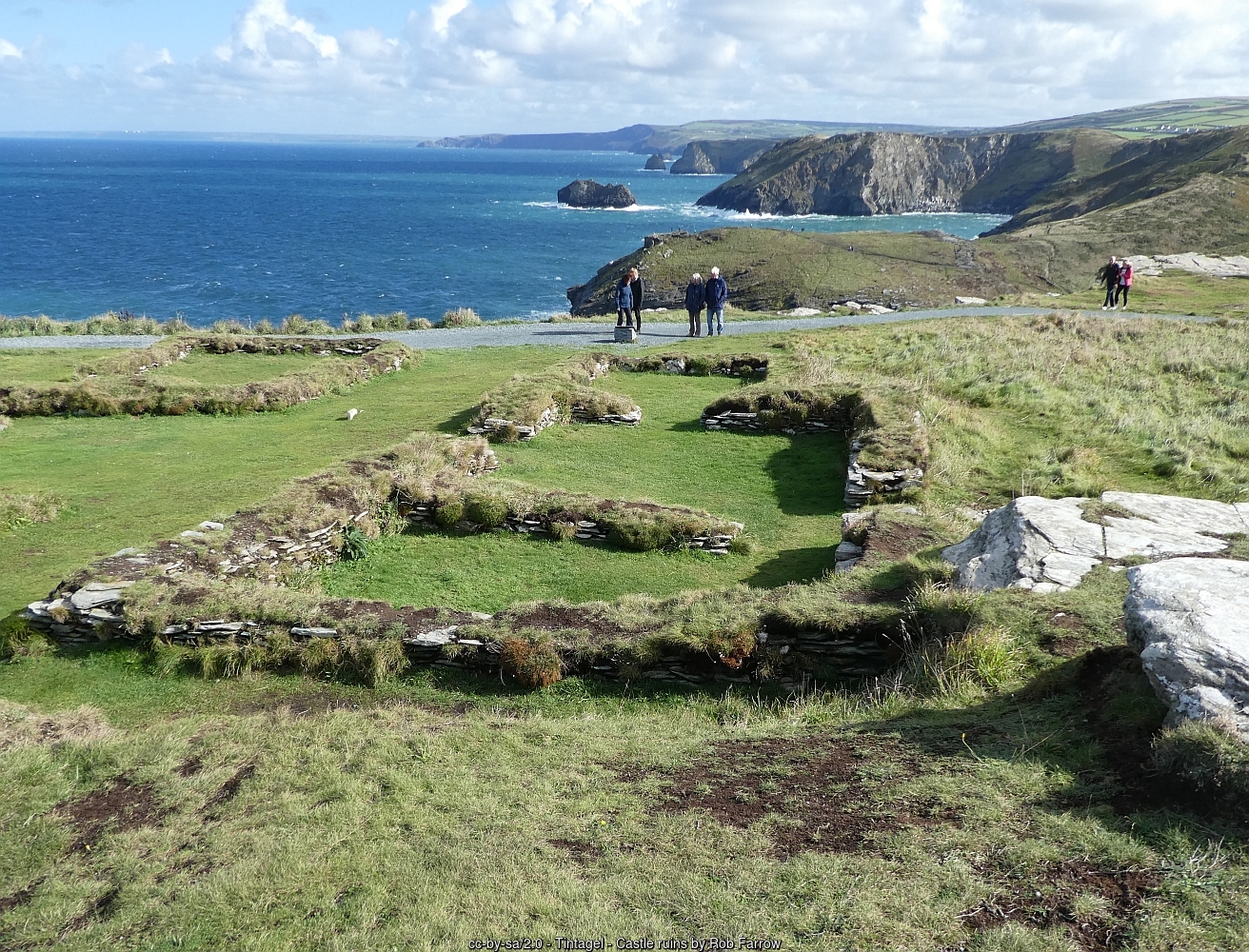
Much older remains lie beneath and around the medieval walls. Excavations from the 1930s onwards have revealed the foundations of many buildings and large quantities of imported pottery from the Mediterranean, showing that in the 5th to 7th centuries Tintagel was a wealthy, high-status settlement – probably a residence of the rulers of the kingdom of Dumnonia.
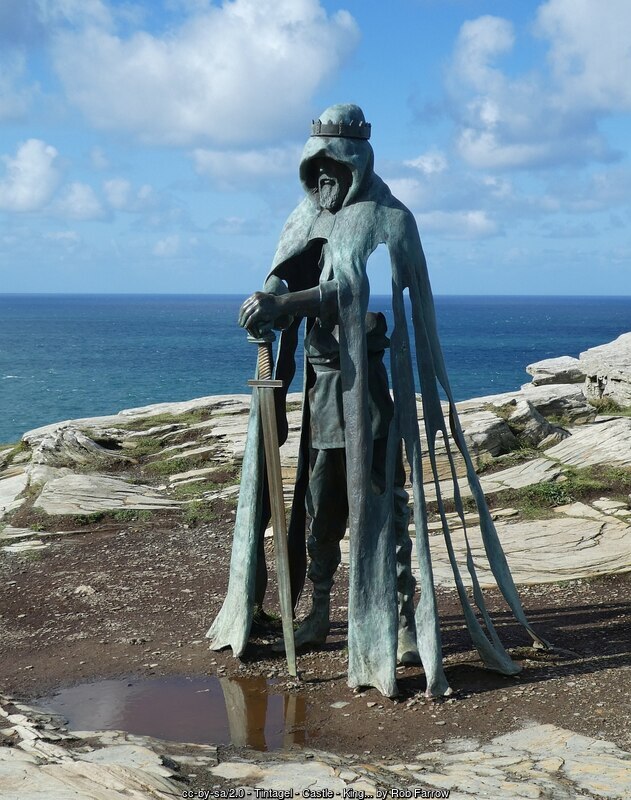
On the island stands Gallos, an eight-foot bronze figure by sculptor Rubin Eynon, installed in 2016. Its name is the Cornish word for “power”, and it is designed to evoke Tintagel’s kings and legends rather than to depict Arthur himself. The views from the island along the coast towards Boscastle and Port Isaac are breathtaking.
When the old land bridge between the mainland and the island collapsed, centuries ago, the two halves of the castle were cut off from each other, and for generations visitors reached the island by steep steps down one side of the chasm and up the other. The new footbridge is made of two cantilevers reaching out from either side, which do not quite touch: a narrow gap is left where they meet in the middle, symbolising the passage between the mainland and the island, between history and legend.
On the island, look for the remains of the medieval chapel, the great hall and the walls of Earl Richard’s inner ward, as well as a small walled garden thought to date from the medieval period. Near the summit is a hollow in the rock known as King Arthur’s Footprint, where legend says the kings of Cornwall were crowned. Across the island the low walls of many early medieval buildings can still be traced in the turf.
Archaeology continues to reveal new secrets. In 1998 a piece of slate inscribed with the name Artognou was found on the island, and excavations in 2016–2018 uncovered the walls of substantial buildings, fine Mediterranean pottery and glass, confirming Tintagel as one of the most important early medieval sites in Britain. The exhibition near the entrance tells the story of the finds and of the legends that grew up around them.
There is no parking at the castle; it is about 600 metres’ walk down a steep lane from the village car parks. Allow at least two hours for a visit, wear sturdy footwear and be prepared for steep slopes, uneven paths and many steps. Booking ahead is advised in summer, and there is a café and exhibition near the entrance.
↑ Back to top
English Heritage
Tintagel Castle is one of Cornwall’s major English Heritage sites. See our Tintagel Castle guide for opening times and visitor information.
MERLIN’S CAVE & TINTAGEL HAVEN
Below the castle lies Tintagel Haven, a small cove of sand, shingle and rock hemmed in by dark, contorted cliffs. In the 5th to 7th centuries it probably served as the natural harbour where traders landed the fine pottery and goods found in the settlement above. Later, slate from the clifftop quarries was shipped out from coves like this one.
Its most famous feature is Merlin’s Cave, a natural sea tunnel about 100 metres long that runs right through the base of the headland to a smaller cove on the western side. At low tide you can walk through it on firm sand, but it floods completely as the tide rises. The link with Merlin is a Victorian one, encouraged by Tennyson’s Idylls of the King, and in 2016 a carved face of the wizard was added to the rock beside the cave.
The beach is reached by steep steps within the castle site, so visiting usually means paying castle admission. There are no lifeguards and swimming is not recommended; time your visit for a falling or low tide, check the tide times in advance, and leave the cave well before the sea returns.
↑ Back to top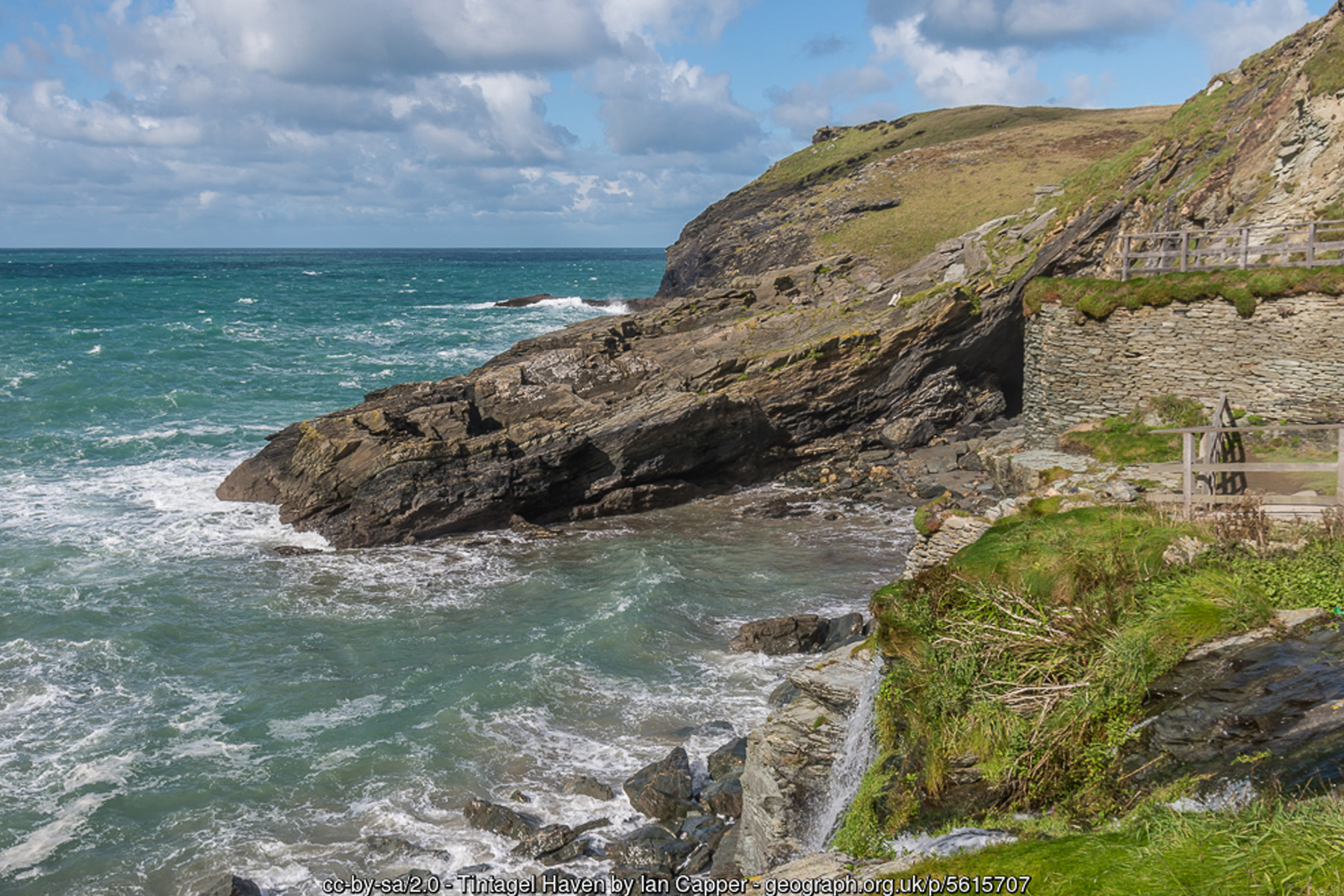
TINTAGEL VILLAGE
Tintagel village grew up along Fore Street, a short walk inland from the castle. Until the 19th century the village was known as Trevena – “the village on the hill” – and the name Tintagel referred only to the headland and the parish; it was the Post Office that began using “Tintagel” for the village in the mid-1800s.
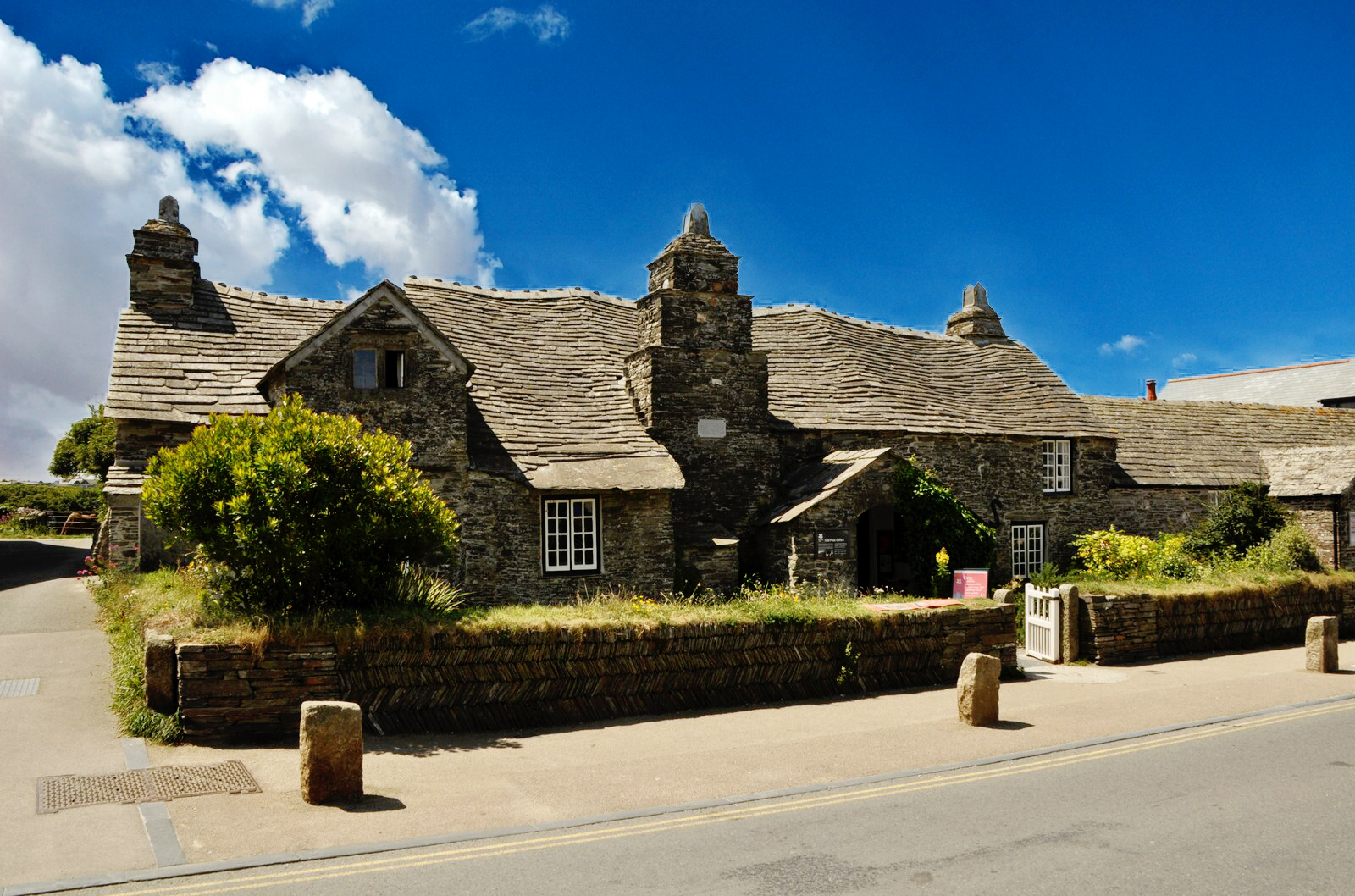
The jewel of Fore Street is the Old Post Office, a Grade I listed medieval farmhouse built around 1380, with uneven floors, an open hall and a famous wavy slate roof. In Victorian times it housed the village letter-receiving office. Threatened with demolition in the 1890s, it was bought by local artist Catherine Johns and restored by architect Detmar Blow, and it has been cared for by the National Trust since 1903.
Further along the street is King Arthur’s Great Halls, built by the philanthropist Frederick Thomas Glasscock and opened in 1933 as the headquarters of his Fellowship of the Knights of the Round Table. Built from 53 different types of Cornish stone, it contains 72 stained glass windows by Veronica Whall telling the story of Arthur and his knights, together with a round table, granite thrones and a narrated light show.
Fore Street is lined with pubs, cafés, tea rooms, bakeries, galleries and gift shops, many of them with an Arthurian theme.
To the south-west of the village, St Materiana’s Church stands alone on the clifftop of Glebe Cliff. The present church may date from the late 11th or early 12th century, with Norman doorways and a Norman font carved with snakes, and the 14th-century tower is a landmark for miles along the coast. In the churchyard is a wooden cross marking the grave of a young sailor from the barque Iota, wrecked in 1893.
↑ Back to top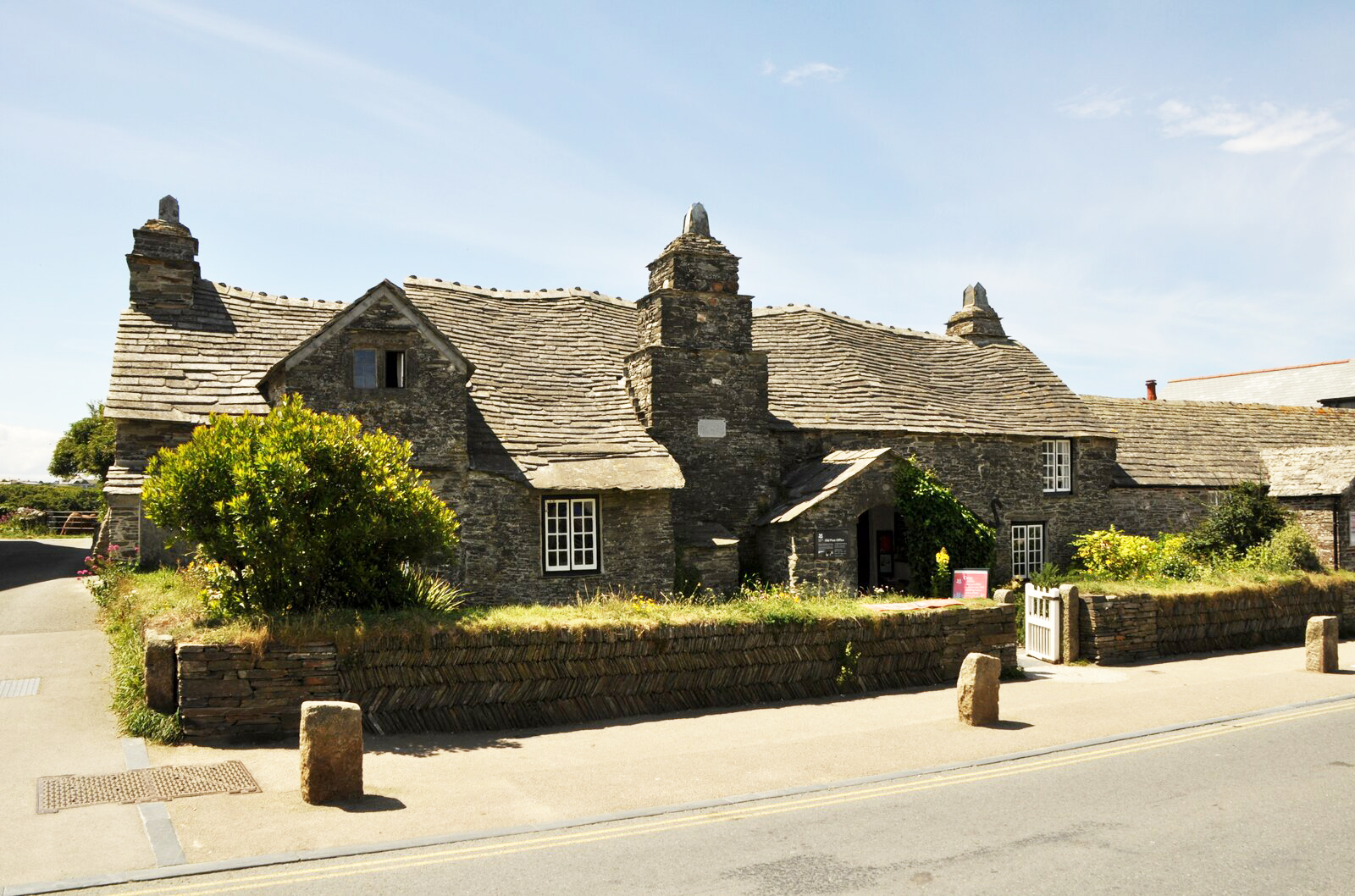
King Arthur’s Great Halls
Open every day except Christmas Day, with a narrated light show and 72 stained glass windows. See our King Arthur’s Great Halls guide for details.
MAP OF TINTAGEL
HISTORY OF TINTAGEL
People have lived on the Tintagel coast for thousands of years: flint tools found on Barras Nose show activity there at least 4,000 years ago. The headland itself became a major settlement in the 5th to 7th centuries, when its rulers, probably trading Cornish tin, imported wine, oil and fine pottery from the Mediterranean – making Tintagel one of the most important sites of its age in Britain.
In the 12th century Geoffrey of Monmouth’s History of the Kings of Britain made Tintagel the place where Arthur was conceived, and later writers added the stories of King Mark, Tristan and Iseult. Inspired by the legend, Richard, Earl of Cornwall, built his castle on the headland in the 1230s. After the Duchy of Cornwall was created in 1337 the castle passed to the Duchy, but it was already decaying, and by around 1600 it was abandoned.
For centuries the parish lived by farming, fishing and above all slate. From the 15th century until the early 20th century, quarries were cut into the cliffs between Tintagel and Trebarwith, giving the coast south of the village its jagged outline; the last coastal quarry, Long Grass, closed in 1937, and its old buildings are now the youth hostel on Glebe Cliff.
The Victorians rediscovered Tintagel through the poetry of Tennyson and the romance of the Arthurian legends. Visitors arrived by coach from the railway at Camelford, hotels were built, and in 1897 a local campaign led the National Trust to buy Barras Nose, the headland beside the castle, to save it from development – the Trust’s first coastal purchase. Six years later the Trust took on the Old Post Office.
In the 20th century Tintagel became one of Cornwall’s best-known visitor destinations. Excavations from the 1930s transformed understanding of the headland, Glasscock’s Great Halls opened in 1933, and the new footbridge of 2019 has made the castle accessible to more visitors than ever. Tintagel hosted the Gorsedh Kernow, Cornwall’s gathering of bards, in 1964.
↑ Back to top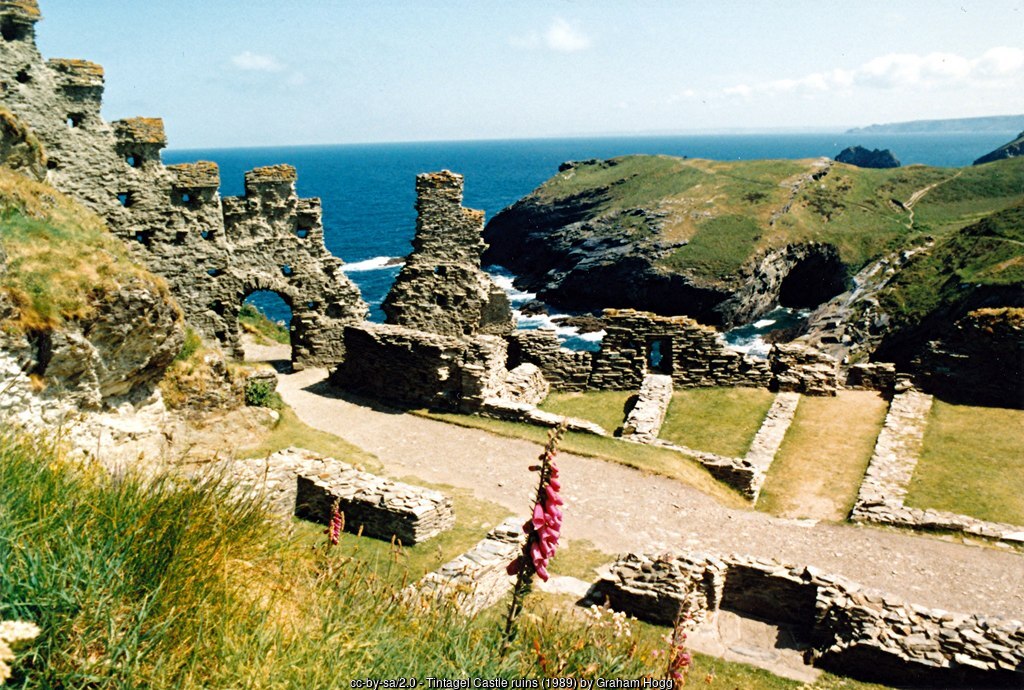

NOTABLE PEOPLE
Geoffrey of Monmouth (c. 1095–1155) put Tintagel on the map of legend. In his History of the Kings of Britain, written in the 1130s, he described how Uther Pendragon, disguised by Merlin, entered the fortress of Tintagel – a story that has shaped the place ever since.
Alfred, Lord Tennyson, the Victorian Poet Laureate, visited Tintagel while working on his Arthurian poems, the Idylls of the King, and did much to make the village a destination for Victorian tourists. Thomas Hardy, who met his first wife Emma at nearby St Juliot, set his verse drama The Famous Tragedy of the Queen of Cornwall (1923) at Tintagel.
Frederick Thomas Glasscock (died 1934), a wealthy philanthropist, built King Arthur’s Great Halls and founded the Fellowship of the Knights of the Round Table in 1927. Catherine Johns, a local artist, saved the Old Post Office from demolition when she bought it at auction in 1895.
John Douglas Cook (1808–1868), the founding editor of the Saturday Review, lived at Tintagel and is buried in the churchyard of St Materiana’s Church on Glebe Cliff.
↑ Back to topTintagel in Literature
From Geoffrey of Monmouth to Tennyson, Swinburne and Hardy, Tintagel has inspired writers for nearly 900 years – and the castle’s exhibition tells the story of how legend and history became entwined.
THINGS TO DO IN TINTAGEL
Most visits to Tintagel begin at the castle, but it is worth giving the village and its surroundings at least another day. Historic buildings, clifftop walks, hidden coves and waterfalls are all within a short walk or drive.
Families will enjoy the legends, the footbridge and the light show at the Great Halls; walkers can follow the coast path in both directions; and history lovers will find Norman churches, medieval houses and slate quarries to explore.
Here are some of the best things to do in and around Tintagel:
- Explore Tintagel Castle – cross the footbridge to the island, find Gallos and explore the ruins of the great hall and chapel.
- Walk through Merlin’s Cave – at low tide, explore the 100-metre sea tunnel beneath the castle.
- Visit the Old Post Office – step inside the National Trust’s 14th-century house and its Victorian post room.
- See King Arthur’s Great Halls – the stained glass, round table and light show on Fore Street.
- Find St Materiana’s Church – the ancient clifftop church on Glebe Cliff, with its Norman font.
- Walk out to Barras Nose and Willapark – the headlands either side of the castle, with superb views and seabirds.
- Discover Rocky Valley – the wooded valley at Trevillet with its old mill and labyrinth carvings.
- Visit St Nectan’s Glen – walk through ancient woodland to the waterfall at Trethevy.
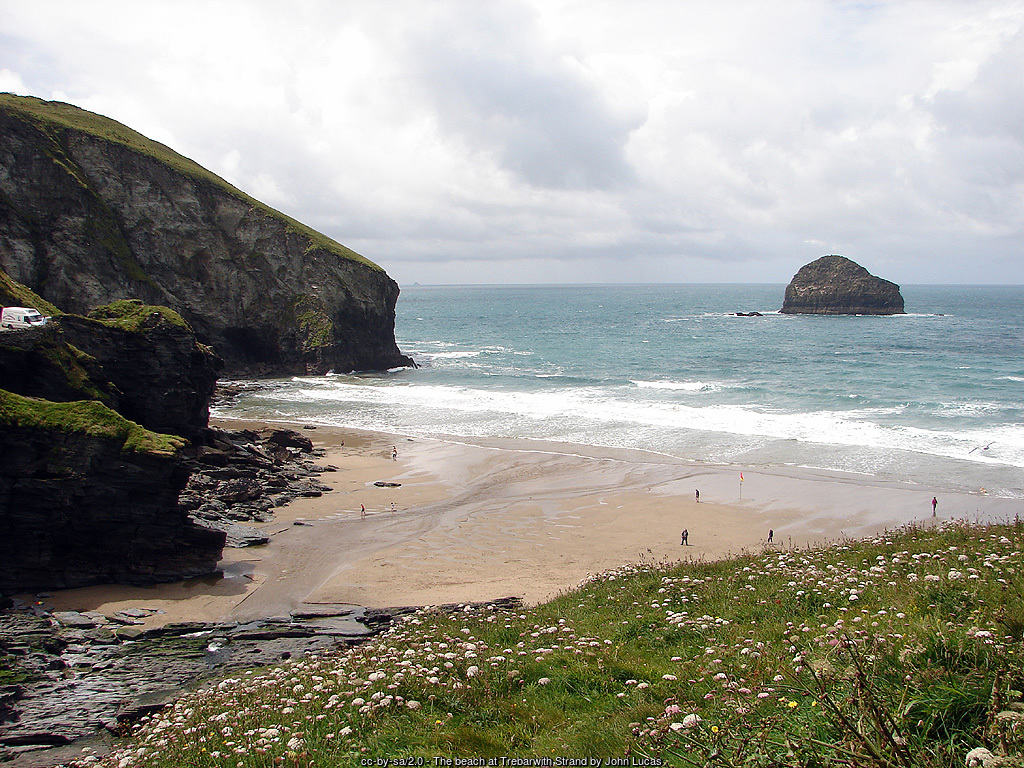
- Spend a day at Trebarwith Strand – golden sand at low tide, surf and sunsets behind Gull Rock.
- Explore Boscastle – the National Trust harbour village, a few miles along the coast.

St Nectan’s Glen
A walk through ancient woodland at Trethevy, about 2 miles from Tintagel, leads to the waterfall where the stream plunges through a hole in the rock into a pool known as the Kieve. The glen is privately owned – check opening times before you visit.
COAST PATH WALKS FROM TINTAGEL
The South West Coast Path passes right by Tintagel Castle, and some of the finest walking in Cornwall starts from the village. Heading south, the path climbs past St Materiana’s Church and the youth hostel on Glebe Cliff, then follows the old quarrymen’s tracks past Lambshouse, Penhallic Point and Lanterdan Quarry to Trebarwith Strand.
Our Trebarwith Strand & Tintagel circular walk combines this stretch with a return across the fields via Treknow – about 3½ miles, or nearer 5 miles including the castle and village. Heading north instead, a gentle stroll takes you out to Barras Nose and Willapark, with views back to the castle.
Further north the coast path continues to Bossiney Cove and Rocky Valley and on to Boscastle, around 5 miles of dramatic clifftop walking with steep ups and downs. Buses link Boscastle and Tintagel if you want to walk one way. Wherever you walk, keep well back from the cliff edges, take care in wet or windy weather and keep dogs close.
↑ Back to topWalking Guides
See our North Cornwall walks, including the Boscastle circular walk and the Trebarwith Strand & Tintagel walk.

AROUND TINTAGEL
- Bossiney & Rocky Valley – Bossiney Cove and its Elephant Rock, and the wooded Rocky Valley with its ancient labyrinth carvings, just north of the village.
- St Nectan’s Glen – a woodland walk to the waterfall at Trethevy, about 2 miles north-east.
- Trebarwith Strand – golden sand and surf below the slate cliffs, about 2½ miles south.
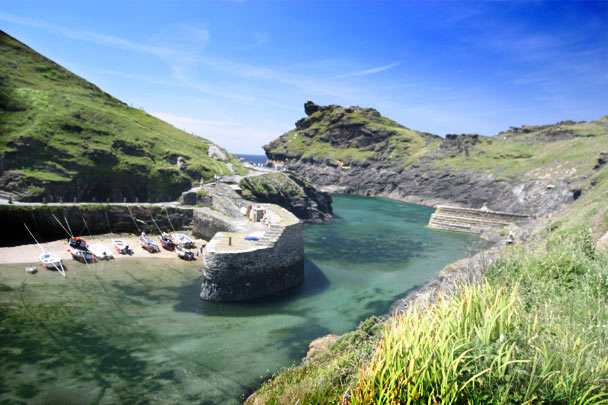
- Boscastle – the National Trust harbour village in its deep valley, about 3½ miles north.
- Camelford – the market town on the River Camel, gateway to Rough Tor and Bodmin Moor, about 6 miles inland.
- Port Isaac – the fishing village famous as Portwenn in Doc Martin.
Delabole
A few miles south, Delabole is home to one of the largest slate quarries in England, worked for centuries and still producing slate today.

LOCAL EVENTS
Tintagel’s calendar revolves around the castle, where English Heritage runs family events, activities and living history days through the school holidays. Traditionally the parish feast was held around 19 October, St Denys’s Day, and Tintagel has hosted the Gorsedh Kernow, Cornwall’s gathering of bards. Further afield, there are festivals and shows across North Cornwall through the year.
- English Heritage events (school holidays) – family activities and living history at Tintagel Castle.
- Padstow May Day (1 May) – the ’Obby ’Oss celebrations in Padstow.
- Royal Cornwall Show (June) – three days at the Royal Cornwall Showground near Wadebridge.
- Cornwall Folk Festival (August bank holiday weekend) – music and dance across Wadebridge.
Dates change from year to year, so check before you travel.
↑ Back to topCheck Before You Go
Dates change from year to year – check our Cornwall events guide, the English Heritage website and the organisers’ own websites before you travel.
VISITOR INFORMATION
Parking & EV Charging
There is no parking at the castle. The main car park is the Cornwall Council long-stay car park at the Tintagel Visitor Centre, Bossiney Road (PL34 0AA), with several private pay-and-display car parks around Fore Street and the National Trust car park at Glebe Cliff, near St Materiana’s Church. From the village it is about 600 metres down a steep lane to the castle entrance.
Electric vehicle charging:
- Tintagel Visitor Centre car park, Bossiney Road – 2 slow chargers with 4 connectors (Evolt Network)
- Wadebridge – rapid chargers at the Jubilee Road old railway site, Piggy Lane car park and West Hill, about 14 miles away
Bus & Train
Go Cornwall Bus route 95 links Tintagel with Boscastle and Bude to the north and Camelford and Wadebridge to the south. The nearest main line station is Bodmin Parkway. Some services are seasonal – check timetables before you travel.
Facilities & Supermarkets
Public toilets (including accessible facilities) at Trevena Square, cash machines, gift shops, galleries and convenience stores along Fore Street. The nearest large supermarkets are in Wadebridge. Supermarkets include:
- SPAR – Fore Street, Tintagel PL34 0DB
- Co-op – High Street, Camelford PL32 9PQ
- Aldi – 8 Dunveth Business Park, West Hill, Wadebridge PL27 7FE
- Co-op – Jubilee Road, Wadebridge PL27 7DA
- Lidl – Eddystone Road, Wadebridge PL27 7AL
- Tesco Superstore – West Hill, Wadebridge PL27 7HW
Cafés & Restaurants
Pubs, cafés, tea rooms, bakeries and restaurants along Fore Street, with the castle’s own café near the entrance and pubs at Trebarwith Strand and Boscastle nearby. Booking ahead is wise for evening meals in summer.
Health
Tintagel Medical Centre, Bossiney Road, Tintagel PL34 0AE. The nearest Minor Injury Units are at Launceston and Bodmin Community Hospitals – check opening hours before travelling. Call NHS 111 for urgent advice and 999 in an emergency – ask for the Coastguard for incidents at sea or on the cliffs. The nearest major A&E is the Royal Cornwall Hospital, Truro.
Disabled Access
Fore Street is fairly level, with accessible toilets at Trevena Square. The Old Post Office has a portable ramp for the ground floor, and King Arthur’s Great Halls are on Fore Street. Tintagel Castle has steep slopes, uneven paths and many steps, and Tintagel Haven is not accessible. Check English Heritage’s access information before visiting.
Vets & Dogs
Penbode Vets, Inns Park, Camelford PL32 9RX, about 6 miles away. Dogs are not allowed inside King Arthur’s Great Halls or the Old Post Office (assistance dogs excepted); check English Heritage’s rules for the castle.
National Trust & English Heritage
Tintagel Castle (English Heritage) and the Old Post Office (National Trust) are both in Tintagel, and the National Trust cares for Barras Nose, Glebe Cliff and much of the coast around the village, as well as Boscastle harbour.
Beaches
Tintagel Haven below the castle; Bossiney Cove just north; Trebarwith Strand to the south; and Boscastle harbour beach a few miles along the coast.
STAY & EXPLORE NEAR TINTAGEL
FAMILY HOLIDAYS & SHORT BREAKS IN TINTAGEL
Family holidays in Tintagel are full of legend and adventure. Children love crossing the footbridge to the castle island, hunting for Merlin’s Cave at low tide, meeting Gallos and hearing the stories of King Arthur in the Great Halls, while the coast path, Bossiney Cove and the sands of Trebarwith Strand are all close by.
A self-catering holiday in Tintagel gives you the freedom to explore at your own pace: holiday cottages in the village a short walk from Fore Street and the castle, farmhouses and barn conversions in the surrounding countryside, and homes in Treknow, Trenale and Bossiney with sea views. Many holiday cottages around Tintagel welcome dogs too.
Tintagel is also a wonderful choice for a short break or weekend away, especially out of season, when the castle is quieter, the Atlantic storms are spectacular and the coast path is at its most peaceful. A few nights in a B&B, inn, hotel or campsite nearby is the perfect escape. Booking direct with the owner means no agency fees.
Browse self-catering holidays in Tintagel for holiday cottages and apartments, or holidays and short breaks in Tintagel for every type of accommodation – B&Bs, hotels, inns, holiday parks, camping and glamping – all listed on Cornwall Online by their owners.
↑ Back to topFREQUENTLY ASKED QUESTIONS ABOUT TINTAGEL
Yes – Tintagel Castle is one of Cornwall’s most extraordinary historic places. The ruins of Richard, Earl of Cornwall’s 13th-century castle stand on a dramatic Atlantic headland, linked to the mainland by a footbridge opened in 2019, with the remains of a 5th to 7th-century settlement, the Gallos sculpture and spectacular coastal views. Allow at least two hours, and book ahead in summer.
That is the legend. In the 12th century Geoffrey of Monmouth wrote that Arthur was conceived at Tintagel, when Merlin disguised Uther Pendragon as Gorlois, Duke of Cornwall. There is no historical evidence for the story: Geoffrey’s History of the Kings of Britain is now usually considered a literary forgery containing little reliable history, and many modern scholars agree with William of Newburgh, who wrote around 1190 that “it is quite clear that everything this man wrote about Arthur and his successors, or indeed about his predecessors from Vortigern onwards, was made up, partly by himself and partly by others”. Archaeology, however, has shown that the headland was a wealthy, high-status settlement in the 5th to 7th centuries, trading with the Mediterranean – which is remarkable in its own right.
There is no parking at the castle itself. Use the Cornwall Council long-stay car park at the Tintagel Visitor Centre on Bossiney Road (PL34 0AA) or one of the private pay-and-display car parks around Fore Street, then walk down the lane to the castle entrance, about 600 metres from the village. The National Trust has a car park at Glebe Cliff, near St Materiana’s Church.
Yes, but only around low tide. Merlin’s Cave is a natural sea tunnel about 100 metres long running right through the headland beneath the castle, reached from Tintagel Haven by steep steps within the castle site. It floods completely at high tide, so always check the tide times before going down to the beach.
The village itself, Fore Street, the Old Post Office’s ground floor and King Arthur’s Great Halls are reasonably accessible, but Tintagel Castle involves steep slopes, uneven paths and many steps, and the beach below is not accessible. Check English Heritage’s access information before visiting the castle.
Tintagel Old Post Office is a Grade I listed medieval farmhouse on Fore Street, dating from around 1380, with a famous wavy slate roof. It housed the village letter-receiving office in Victorian times, and has been cared for by the National Trust since 1903 – one of its earliest properties in Cornwall.
Dogs on leads are generally welcome in the grounds of Tintagel Castle, but check English Heritage’s current rules before you visit. Dogs are not allowed inside King Arthur’s Great Halls, and only assistance dogs may enter the Old Post Office. The coast path around Tintagel is popular with dog walkers – keep dogs on a lead near cliff edges and livestock.
Within a few miles are Bossiney Cove, the wooded Rocky Valley with its ancient labyrinth carvings, St Nectan’s Glen and its waterfall, the beach at Trebarwith Strand and the harbour village of Boscastle. St Materiana’s Church on Glebe Cliff and the headlands of Barras Nose and Willapark are a short walk from the village.
Go Cornwall Bus route 95 links Tintagel with Boscastle and Bude to the north and Camelford and Wadebridge to the south. The nearest main line railway station is Bodmin Parkway. Check current timetables before you travel, as some services are seasonal.
North Cornwall Towns and Villages | Padstow | Wadebridge | The Camel Estuary | Rock | Daymer Bay | Polzeath | Port Isaac | Trebarwith Strand | Tintagel | Bossiney Cove | Rocky Valley | Boscastle | Crackington Haven | Bude | Launceston | Camelford | Altarnum | Bodmin |