Holidays in Boscastle, North Cornwall – Harbour, Village & Hardy Country

North Cornwall Towns and Villages | Padstow | Wadebridge | The Camel Estuary | Rock | Daymer Bay | Polzeath | Port Isaac | Trebarwith Strand | Tintagel | Bossiney Cove | Rocky Valley | Boscastle | Crackington Haven | Bude | Launceston | Camelford | Altarnum | Bodmin |
On This Page
Boscastle at a Glance
A National Trust harbour village on the North Cornwall coast, about 14 miles south of Bude and 3½ miles from Tintagel, where the Rivers Valency and Jordan meet. Elizabethan harbour, Museum of Witchcraft and Magic, historic inns, the Valency Valley and Hardy country. Sat-nav: PL35 0HE (car park).
HOLIDAYS IN BOSCASTLE
Boscastle is one of the most picturesque villages in Cornwall. Hidden in a steep, wooded valley where the Rivers Valency and Jordan meet, it winds down to a tiny harbour at the end of a narrow, twisting inlet between towering cliffs – for centuries the only safe haven on a long stretch of this wild north coast.
The harbour walls were built in 1584 by Sir Richard Grenville, later famous as the commander of the Revenge, and today the harbour and much of the surrounding coast and countryside are cared for by the National Trust. Whitewashed cottages, slate-roofed inns and old warehouses line the river, and the coast path climbs out of the village to dramatic headlands on either side.
There is a great deal to discover. The Museum of Witchcraft and Magic, beside the harbour, holds the largest collection of its kind in the world. The Valency Valley leads inland through ancient woodland to the churches of Minster and St Juliot, at the heart of Thomas Hardy country. And on the headlands, the white lookout on Willapark, the blowhole at Penally Point and the medieval strip fields of Forrabury Stitches are all within a short walk.
Boscastle is also a village with a remarkable recent story. On 16 August 2004 a devastating flash flood swept through the valley, carrying cars out to sea and wrecking homes and businesses – yet no one died. The village has been lovingly rebuilt, and today it is busier and more beautiful than ever.
Boscastle makes an excellent base for exploring North Cornwall. Tintagel and Bossiney & Rocky Valley are a few miles south, Crackington Haven and Bude lie to the north, and Bodmin Moor is a short drive inland. Many holiday cottages, inns and B&Bs are open all year.
This guide covers everything you need for a holiday in Boscastle: the harbour, the village and its inns, the Museum of Witchcraft and Magic, the 2004 flood, history and Thomas Hardy, things to do, walks, places nearby and local events, plus practical visitor information on parking, buses, shops and health services.
↑ Back to top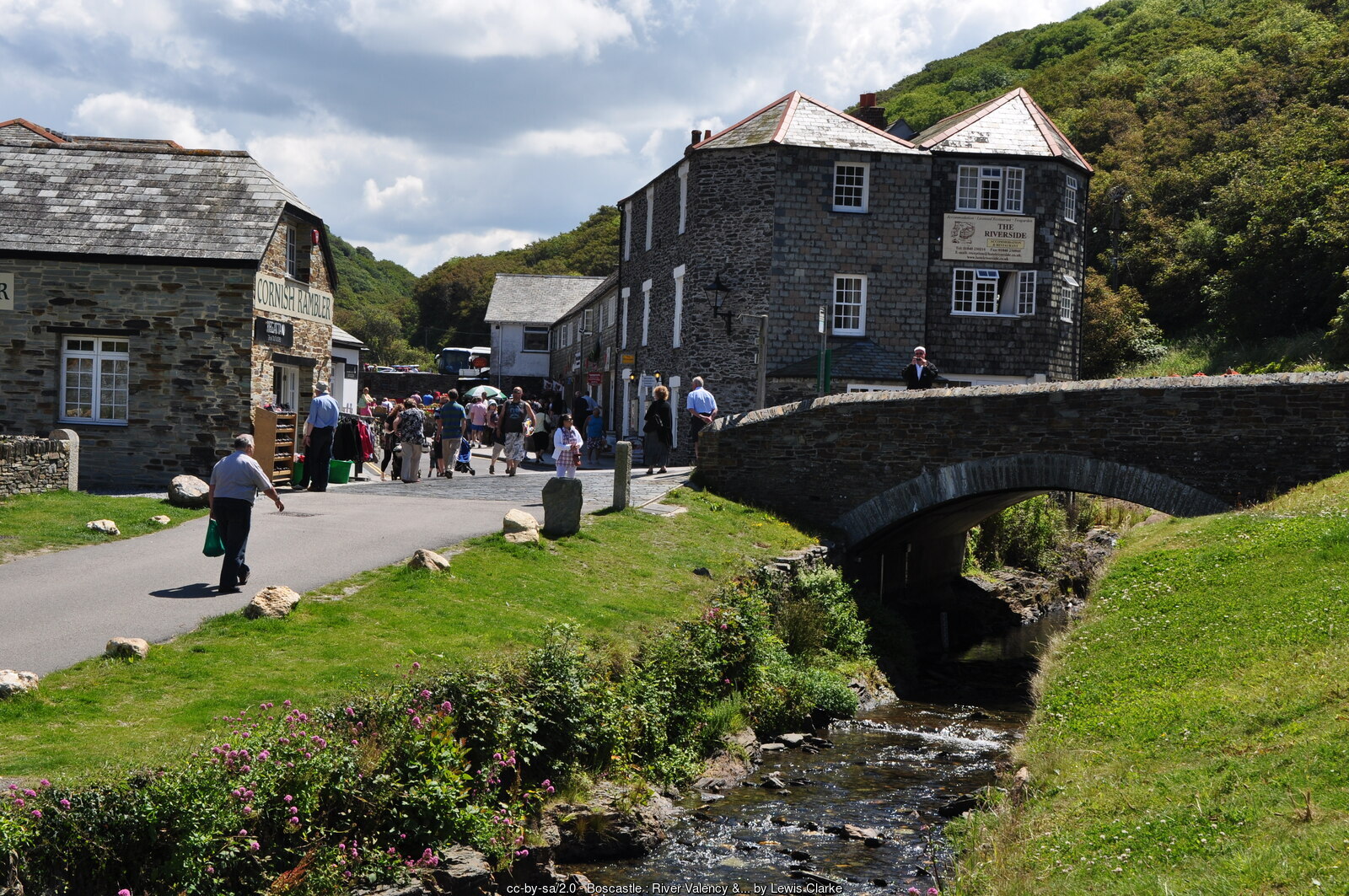
BOSCASTLE HARBOUR
Boscastle’s harbour is one of the most remarkable on the Cornish coast. The river runs out to sea through a narrow, S-shaped inlet between high slate cliffs, and the sharp bend in the channel helps to break the force of the Atlantic swell before it reaches the boats moored inside. It is the only point on this stretch of coast where a natural inlet allowed a harbour to be built at all.
The inner harbour walls date from 1584, when Sir Richard Grenville rebuilt them; a pier already existed here by the 1540s. The outer breakwater was added in the 19th century to give more shelter. During the Second World War it was destroyed when a drifting mine exploded in the harbour in 1941, and it was not rebuilt until 1962.
For around three centuries Boscastle was a busy little port. Ketches and schooners squeezed through the narrow entrance bringing coal, limestone, wine and pottery from South Wales and Bristol, and took away corn, slate, bark and, in the 19th century, manganese and china clay. Horses were used to tow the boats in and out of the channel. The arrival of the railway at Camelford in 1893 took much of the trade, and today the harbour shelters a handful of fishing and pleasure boats.
At the harbour mouth, on Penally Point, is the Devil’s Bellows, a blowhole that, around an hour either side of low water and with a swell running, sends spray booming across the entrance. As the tide falls, a small shingle and boulder foreshore appears around the harbour, with rock pools to explore and the remains of an old tidal bathing pool – but there is no sandy beach, and the harbour is not a place for swimming.
The National Trust looks after both sides of the harbour, the old warehouses and much of the surrounding coast. Its shop and café are beside the harbour, and the coast path climbs from here up to Penally Point and Willapark, with wonderful views back down into the inlet.
↑ Back to top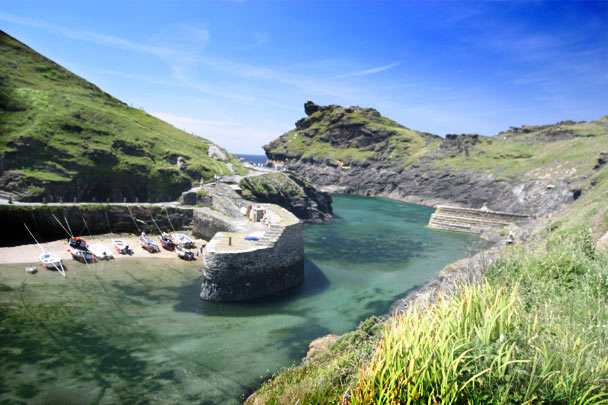

THE VILLAGE
Boscastle grew up in two parts. Down by the harbour and along the river are the old warehouses, cottages and inns of the lower village, many now shops, galleries and cafés, while the older upper village climbs the hill along Fore Street and Dunn Street towards the site of the castle that gave Boscastle its name.
That castle, Bottreaux Castle, was a motte and bailey built in the 12th century by the de Bottreaux family. It has long since vanished, but much of the village is said to have been built from its stone, and the name “Bottreaux’s castle” was gradually worn down to Boscastle.
The village is famous for its inns. The Wellington, near the harbour, is a 16th-century coaching inn whose church lamps are said to have been given by Thomas Hardy; the Cobweb, by the river, is one of the best-known pubs in North Cornwall; and the Napoleon, at the top of the village, is a traditional inn in the old upper town.
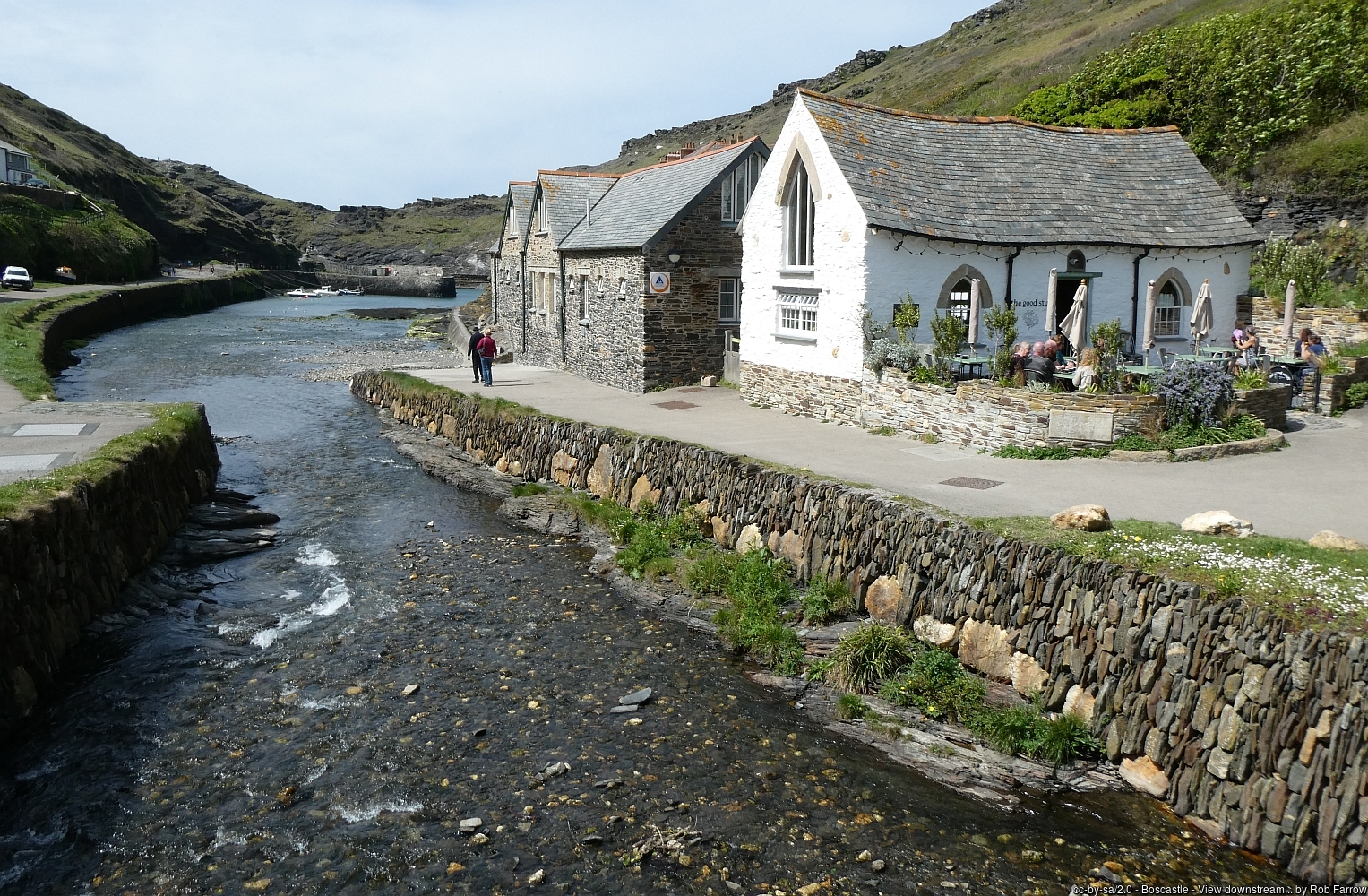
Along the riverside you will find gift shops, galleries, a pottery, a bakery, tea rooms and the National Trust’s shop and café. Look out for the white, Grade II listed “Pixie House” beside the River Valency, one of the most photographed buildings in the village.
The heart of the lower village is the old stone bridge over the River Valency, where the road crosses the river below the car park. From here a riverside path runs down past the shops and cottages to the harbour, with the clear water of the Valency tumbling over the stones beside you. After the 2004 flood the river channel through the village was widened and deepened and the bridges rebuilt, but the village still looks much as it has for centuries.
Down by the harbour, many of the old buildings that once served the port have found new uses. The former harbour stables are now the youth hostel, popular with walkers on the coast path, while old warehouses and lime kilns house the National Trust’s visitor centre, shop and café. Benches along the harbour wall are the perfect place to sit with an ice cream and watch the boats come and go.
The upper village, a steep climb up the valley of the River Jordan, is quieter and full of character, with slate-hung cottages, narrow lanes and fine views back down the valley to the sea. It is well worth the walk, both for the old buildings and for the chance to see a different side of Boscastle away from the busy harbour, and the coast path at Forrabury is only a few minutes beyond.
Above the village, the little church of St Symphorian at Forrabury stands on the hill near the coast path, beside the Forrabury Stitches – one of the few surviving medieval strip-field systems still farmed in England. In the valley inland lies Minster Church, dedicated to St Merthiana, almost hidden among the trees.
↑ Back to top


MUSEUM OF WITCHCRAFT & MAGIC
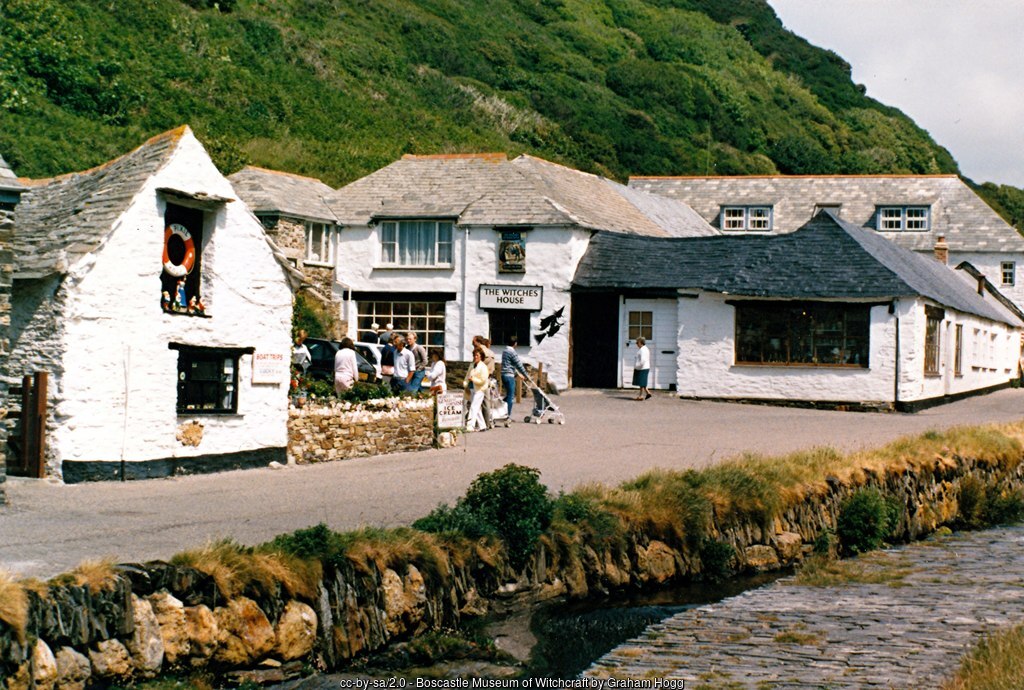
Beside the harbour stands one of Cornwall’s most distinctive museums. The Museum of Witchcraft and Magic claims to house the world’s largest collection of witchcraft-related artefacts and regalia, from folk magic, charms and cunning-folk traditions to the history of the witch trials and the development of modern Wicca.
The museum was founded in 1951 by Cecil Williamson, a collector and researcher of folk magic, who opened it first on the Isle of Man before bringing the collection to Boscastle, where it has been for more than sixty years. Williamson sold it in 1996 to Graham King, who expanded the collection, and since 2013 it has been owned and run by the designer and folklorist Simon Costin.
The museum is open seasonally, usually from around April to October, and most visitors spend about an hour inside. It is a fascinating place for anyone interested in folklore and social history – see our Museum of Witchcraft and Magic guide for more details.
↑ Back to top
MAP OF BOSCASTLE
THE 2004 FLOOD
On the afternoon of 16 August 2004, after days of wet weather, an intense, slow-moving thunderstorm dropped extraordinary amounts of rain onto the small catchments of the Valency and Jordan above the village. Funnelled by the steep valley sides, the rivers rose with almost no warning, and a torrent of water swept through Boscastle.
Cars were carried down through the village into the harbour and out to sea, several buildings were destroyed and many more badly damaged, and bridges were swept away. Helicopter crews from the RAF, the Royal Navy and the Coastguard worked into the night, lifting people from rooftops, trees and cars. Remarkably, no one was killed.
In the years that followed, the village was rebuilt and a major flood defence scheme was completed, widening and lowering the river channel, rebuilding bridges and raising the car park. The National Trust’s visitor centre tells the story of the flood and the village’s recovery.
Today, standing by the peaceful river on a summer afternoon, it is hard to imagine the scenes of 2004 – a reminder of the power of nature, and of the resilience of a small community.
↑ Back to top
HISTORY OF BOSCASTLE
Boscastle’s story begins with the Norman castle of the de Bottreaux family, built between 1154 and 1189 on the high ground at the top of the village. A small medieval town grew up around it, while the parishes of Forrabury and Minster shared the valley and the coast.
The harbour made Boscastle’s fortune. A pier existed by the 1540s, and in 1584 Sir Richard Grenville rebuilt the walls that still stand today. Not everyone was impressed: the 16th-century antiquary John Leland described the village as “a very filthy town and il kept”. Over the following centuries the harbour saw privateers and smugglers, wreckers and lifesavers, as well as a steady coastal trade.
By the 19th century Boscastle was a busy little port, with warehouses, workshops, shipyards and timber yards crowding the quay. The railway’s arrival at Camelford in 1893 brought an end to much of the sea trade, but it also brought the first tourists, drawn by the scenery, the legends of nearby Tintagel and the romance of Hardy’s novels.
In the 20th century the National Trust gradually took the harbour and much of the surrounding land into its care, protecting it from development. Fishing continued on a small scale, and tourism became the mainstay of the village. The Boscastle and Crackington Pilot Gig Club was formed in 2004, reviving the tradition of rowing on this coast.
The flood of 2004 was the greatest test in the village’s modern history, but Boscastle has emerged stronger, and in 2019 the then Prince of Wales, now King Charles III, visited to see the rebuilt village.

THOMAS HARDY & HARDY COUNTRY
In March 1870 a young architect named Thomas Hardy travelled to the remote parish of St Juliot, up the Valency Valley from Boscastle, to oversee the restoration of its church. There he met Emma Gifford, the rector’s sister-in-law, and fell in love. They married in 1874, after a four-year courtship.
The landscape of their courtship – the valleys, the cliffs and the wild coast up to High Cliff, the highest sheer cliff in Cornwall at around 223 metres (732 feet) – found its way into Hardy’s novel A Pair of Blue Eyes (1873), whose heroine shares much with Emma.
The marriage was not a happy one, but after Emma’s death in 1912 Hardy returned to Boscastle and St Juliot and wrote some of his most moving poems about the places where they had first met. St Juliot’s Church, which still contains reminders of Hardy’s work and his connection with the parish, is a peaceful walk up the Valency Valley from the village.
Today the Valency Valley and the lanes and churches around it are known as Hardy country, and following in his footsteps is one of the most rewarding walks from Boscastle.
↑ Back to topSt Juliot’s Church
A walk of about two miles up the Valency Valley from Boscastle, through National Trust woodland, leads to St Juliot’s Church, restored by Hardy in the 1870s. Minster Church, hidden among the trees, can be visited along the way.
THINGS TO DO IN BOSCASTLE
Boscastle is a village to explore slowly. The harbour, the riverside shops and the inns will fill a morning, but the real joy lies in the walks – along the cliffs, up the wooded valley and out to the headlands either side of the harbour.
Families will love the harbour, the blowhole and the rock pools; walkers have some of the finest coast and valley paths in Cornwall on the doorstep; and history and literature lovers can follow in the footsteps of Grenville and Hardy.
Here are some of the best things to do in and around Boscastle:
- Explore the harbour – walk out along the harbour walls to the mouth of the inlet.
- Watch the Devil’s Bellows – the blowhole at Penally Point, around an hour either side of low water in a swell.
- Visit the Museum of Witchcraft and Magic – the world’s largest collection of its kind, beside the harbour.
- Climb to Willapark – the headland with its white lookout tower and Iron Age earthworks.
- Walk the Valency Valley – through ancient woodland to Minster Church and St Juliot.
- See the Forrabury Stitches – medieval strip fields still farmed above the village.
- Find Pentargon waterfall – a short walk north along the coast path to the dramatic waterfall and cove.
- Enjoy a pint at a historic inn – the Wellington, the Cobweb or the Napoleon.
- Visit Tintagel – the legendary castle and the Old Post Office, a few miles along the coast.
- Discover Crackington Haven – the sandy cove and dramatic folded cliffs to the north.

Willapark Lookout
The white tower on Willapark, the headland on the south side of the harbour, was built in the 19th century as a summer house and is now used as a lookout by the National Coastwatch Institution, keeping watch over this stretch of coast.
WALKS FROM BOSCASTLE
Boscastle is a superb centre for walking. The Valency Valley walk follows the river inland through National Trust woodland to Minster Church and on to St Juliot’s Church, returning along the other side of the valley or the lanes – around four miles of gentle walking through the heart of Hardy country.
Heading north, the South West Coast Path climbs past Penally Point and on to Pentargon, where a stream plunges over the cliff in a dramatic waterfall into a rocky cove. Beyond, the path continues to Beeny Cliff, High Cliff and Crackington Haven – some of the toughest and most spectacular walking in Cornwall.
Heading south, the coast path climbs to Willapark and Forrabury Stitches and continues along the cliffs past Trevalga and Rocky Valley to Bossiney and Tintagel, about five miles away. The 95 bus makes it easy to walk one way and ride back.
Wherever you walk, wear good boots, take water and keep well back from unfenced cliff edges. The paths can be steep and muddy, and dogs should be kept under close control near livestock.
↑ Back to topBoscastle Circular Walk
Our Boscastle circular walk has full route directions and a map. See also our Crackington Haven walks and all North Cornwall walks.

AROUND BOSCASTLE
- Crackington Haven – a sandy cove in a deep valley, with dramatically folded cliffs and High Cliff nearby.
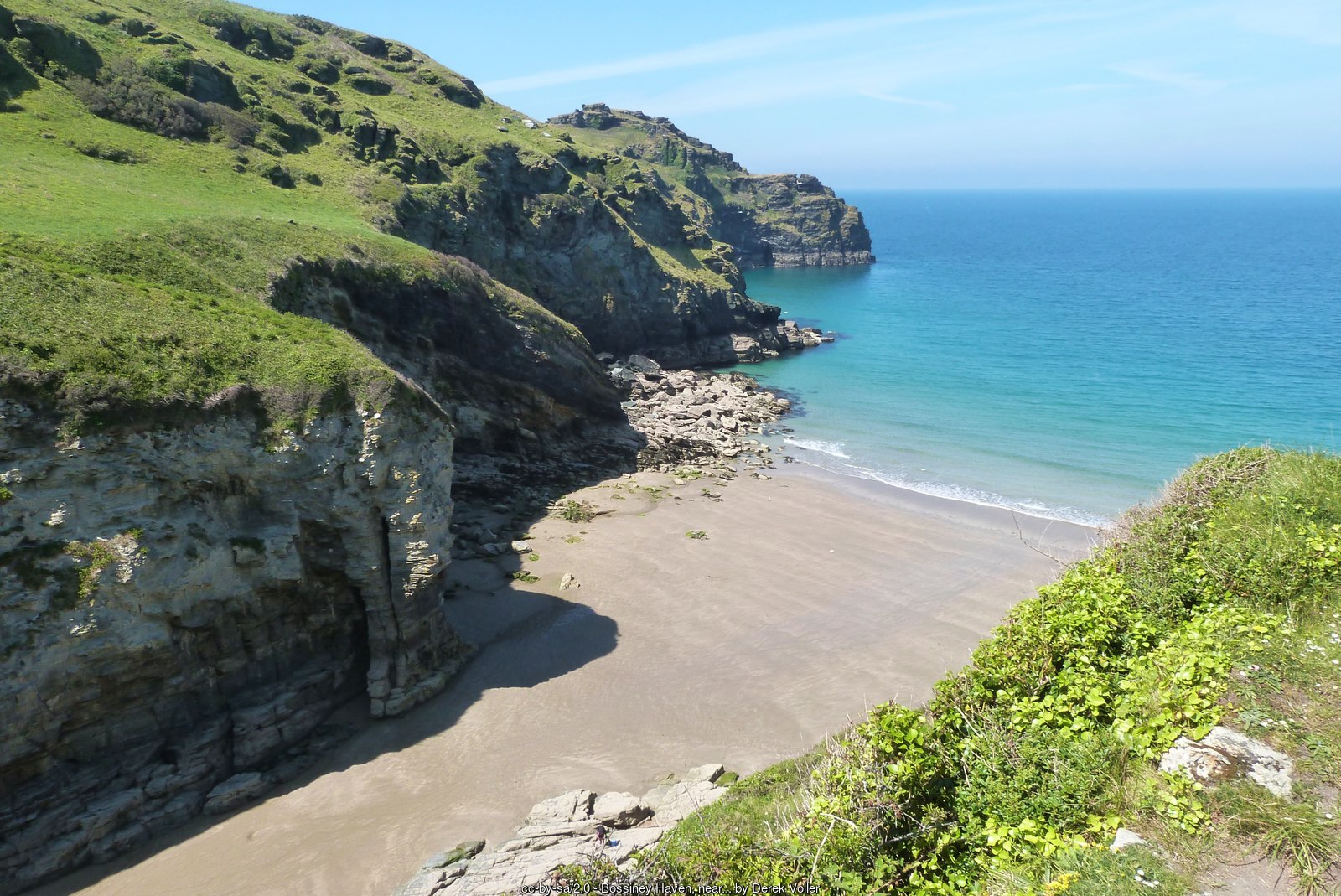
- Bossiney & Rocky Valley – Bossiney Haven’s Elephant Rock and the wooded Rocky Valley, about three miles south.
- Tintagel – the legendary castle, Merlin’s Cave and the Old Post Office, about 3½ miles south.
- St Nectan’s Glen – a woodland walk to the waterfall at Trethevy (privately owned – check opening times).
- Camelford – the market town on the River Camel, gateway to Rough Tor and Bodmin Moor.
- Bude – surf beaches, the sea pool and the canal, about 14 miles north.



LOCAL EVENTS
Boscastle’s calendar follows the seasons. In summer, gig rowing and National Trust activities bring the harbour to life, and in recent years the village has hosted a food, art and craft festival in early October, drawing crowds from across Cornwall.
- Pilot gig racing (summer) – the Boscastle and Crackington Pilot Gig Club rows and races along this coast.
- Boscastle Food, Art & Craft Festival (early October, in recent years) – chefs’ demonstrations, local producers, arts, crafts and music.
- National Trust events (school holidays) – guided walks and family activities around the harbour and valley.
- Royal Cornwall Show (June) – three days at the Royal Cornwall Showground near Wadebridge.
Dates change from year to year, so check before you travel.
↑ Back to topCheck Before You Go
Dates change from year to year – check our Cornwall events guide, the National Trust’s Boscastle page and the organisers’ own websites before you travel.
VISITOR INFORMATION
Parking & EV Charging
The main car park is the Cornwall Council long-stay car park in the valley (PL35 0HE), about 100 yards from the harbour, with Blue Badge spaces and public toilets alongside. It is pay and display and fills quickly in summer – arrive early. Roadside parking in the village is very limited.
Electric vehicle charging:
- Tintagel Visitor Centre car park, Bossiney Road – 2 slow chargers with 4 connectors (Evolt Network), about 3½ miles away
- The Crescent car park, Bude – rapid chargers (43–50kW), EX23 8LE, about 14 miles away
Bus & Train
Go Cornwall Bus route 95 links Boscastle with Bude to the north and Tintagel, Camelford and Wadebridge to the south. The nearest main line station is Bodmin Parkway. Some services are seasonal – check timetables before you travel.
Facilities & Supermarkets
Public toilets by the main car park, the National Trust shop, gift shops, galleries, a pottery and a bakery in the village. For a full weekly shop, the nearest supermarkets are in Tintagel, Camelford and Wadebridge, with more in Bude. Supermarkets include:
- SPAR – Fore Street, Tintagel PL34 0DB
- Co-op – High Street, Camelford PL32 9PQ
- Aldi – 8 Dunveth Business Park, West Hill, Wadebridge PL27 7FE
- Co-op – Jubilee Road, Wadebridge PL27 7DA
- Lidl – Eddystone Road, Wadebridge PL27 7AL
- Tesco Superstore – West Hill, Wadebridge PL27 7HW
Cafés & Restaurants
The Wellington, the Cobweb and the Napoleon inns, the National Trust café by the harbour (pasties, cream teas and ice cream), tea rooms, a bakery and restaurants. Booking ahead is wise for evening meals in summer.
Health
The nearest GP practices are Tintagel Medical Centre, Bossiney Road PL34 0AE, and Camelford Medical Centre, Church Field, Camelford PL32 9YT. The nearest Minor Injury Units are at Launceston and Bodmin Community Hospitals – check opening hours before travelling. Call NHS 111 for urgent advice and 999 in an emergency – ask for the Coastguard for incidents at sea or on the cliffs. The nearest major A&E is the Royal Cornwall Hospital, Truro.
Disabled Access
The car park has Blue Badge spaces, and the riverside paths and pavements down to the harbour are mostly level. The National Trust café and shop have level access. There are steps and uneven ground near the harbour entrance and on the coast path, and the Valency Valley path is uneven in places.
Vets & Dogs
Penbode Vets, Inns Park, Camelford PL32 9RX, about 6 miles away. Dogs are welcome around the harbour, in the valley and on the coast path under close control, especially near livestock and cliff edges.
National Trust & English Heritage
The National Trust cares for Boscastle harbour, Willapark, Forrabury Stitches, the Valency Valley and much of the coast, as well as the Old Post Office in Tintagel. Tintagel Castle (English Heritage) is about 3½ miles away.
Beaches
Boscastle harbour foreshore at low tide; Pentargon cove to the north; Crackington Haven and The Strangles further north; and Bossiney Cove and Trebarwith Strand to the south.
STAY & EXPLORE NEAR BOSCASTLE
Official Information
FAMILY HOLIDAYS & SHORT BREAKS IN BOSCASTLE
Family holidays in Boscastle are full of adventure. Children love exploring the harbour and its rock pools, watching the blowhole at Penally Point, spotting the boats on the river and discovering the curious collection at the Museum of Witchcraft and Magic, while the sands of Crackington Haven and Trebarwith Strand are a short drive away.
A self-catering holiday in Boscastle lets you enjoy the village at your own pace: holiday cottages beside the river and harbour, homes in the old upper village with views down the valley, and farmhouses and barn conversions in the countryside around Hardy’s St Juliot. Many holiday cottages in and around Boscastle welcome dogs too.
Boscastle is also a wonderful choice for a short break or weekend away, especially out of season, when the village is quiet, the Atlantic storms are spectacular and the Valency Valley is at its most peaceful. A few nights in a B&B, inn or campsite nearby is the perfect escape. Booking direct with the owner means no agency fees.
Browse self-catering holidays in Boscastle for holiday cottages and apartments, or holidays and short breaks in Boscastle for every type of accommodation – B&Bs, inns, hotels, holiday parks, camping and glamping – all listed on Cornwall Online by their owners.
↑ Back to topFREQUENTLY ASKED QUESTIONS ABOUT BOSCASTLE
Yes – Boscastle is one of the most beautiful villages in Cornwall. Its Elizabethan harbour sits at the end of a narrow, winding inlet between high cliffs, cared for by the National Trust, with the Museum of Witchcraft and Magic, historic inns, the wooded Valency Valley and superb coast path walks all close at hand.
The main pay-and-display car park is in the valley about 100 yards from the harbour, with Blue Badge spaces and public toilets alongside. It is a Cornwall Council long-stay car park (PL35 0HE). It fills quickly in summer, so arrive early.
On 16 August 2004, after torrential rain, a flash flood swept down the Valency and Jordan valleys into the village. Cars were carried into the harbour and out to sea and many buildings were badly damaged, but rescuers – including RAF and Royal Navy helicopter crews – brought everyone to safety and no lives were lost. The village has since been rebuilt, with a major flood defence scheme.
The Museum of Witchcraft and Magic, beside the harbour, usually opens from around April to October and closes over the winter. Check the museum’s own website for current opening dates before you visit.
Known as the Devil’s Bellows, the blowhole is in the rocks of Penally Point at the harbour mouth. Around an hour either side of low water, with a swell running, it sends water and spray booming across the entrance to the harbour – best watched from the harbour walls or the path above.
In March 1870 the young architect Thomas Hardy came to restore St Juliot’s Church, up the Valency Valley, and fell in love with Emma Gifford, the rector’s sister-in-law. They married in 1874. His novel A Pair of Blue Eyes draws on the landscape around Boscastle, and after Emma’s death in 1912 he wrote some of his most moving poems about the places where they had met.
Yes. Dogs are welcome around the harbour, in the Valency Valley and on the coast path, under close control – especially near livestock and cliff edges. Many of the village pubs and cafés welcome well-behaved dogs too; check with each before you go in.
Boscastle has no sandy beach. As the tide falls, a small foreshore of shingle, boulders and slate appears around the harbour mouth, with rock pools to explore, but it is not a place for swimming. For sandy beaches, head to Crackington Haven to the north or Trebarwith Strand to the south.
Go Cornwall Bus route 95 links Boscastle with Bude to the north and Tintagel, Camelford and Wadebridge to the south. The nearest main line railway station is Bodmin Parkway. Check current timetables before you travel, as some services are seasonal.
North Cornwall Towns and Villages | Padstow | Wadebridge | The Camel Estuary | Rock | Daymer Bay | Polzeath | Port Isaac | Trebarwith Strand | Tintagel | Bossiney Cove | Rocky Valley | Boscastle | Crackington Haven | Bude | Launceston | Camelford | Altarnum | Bodmin |