Polperro Cornwall – Historic Fishing Village, Smuggling Harbour & Coastal Walks
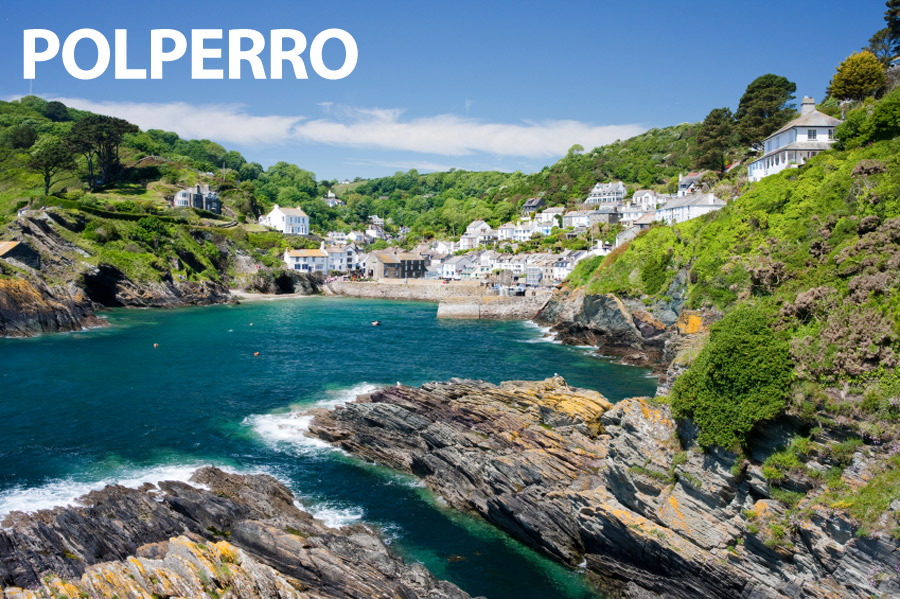
Polperro in Cornwall
Cornwall Online | South East Cornwall Towns and Villages | Looe | Talland Bay | Polperro | Polruan | Fowey | Lostwithiel | Mevagissey | Whitsand Bay & The Rame Peninsula | Kingsand | Cawsand | Mount Edgcumbe Country Park | Torpoint | St Germans | Saltash | Liskeard | Siblyback Lake - Water Park | Minions - Hurlers - Bodmin Moor | St Neot | St Cleer | Callington | Gunnislake | Calstock | Cardinham Woods - Walking & Cycle Trails | Launceston |
On This Page
POLPERRO – A HISTORIC FISHING VILLAGE IN SOUTH EAST CORNWALL
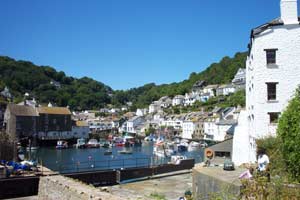
Polperro is a picture-postcard fishing village on Cornwall’s south coast, about four miles west of Looe. Sheltered in a steep, narrow valley where the River Pol meets the sea, it is an enchanting jumble of colour-washed cottages, many built in the traditional style of a Cornish fisherman’s home – gear and the pilchard catch stored below, living quarters above, reached by outside stone or wooden steps.
Cars are kept out of the village centre, so you wander down to the harbour on foot along lanes where barrows of fish were once carted and, under cover of night, brandy casks and tobacco bales were spirited into hidden cellars. This peaceful cove was once one of Cornwall’s most notorious smuggling centres.
The “free traders” have long since passed into folklore, and the great shoals of pilchards that sustained the village are gone – but a visit to the Heritage Museum of Fishing and Smuggling, in the old pilchard factory on the harbourside, brings that past vividly back to life. Today, in cellars where smugglers once dodged the customs men, you will find galleries, craft shops, pubs and restaurants.
↑ Back to top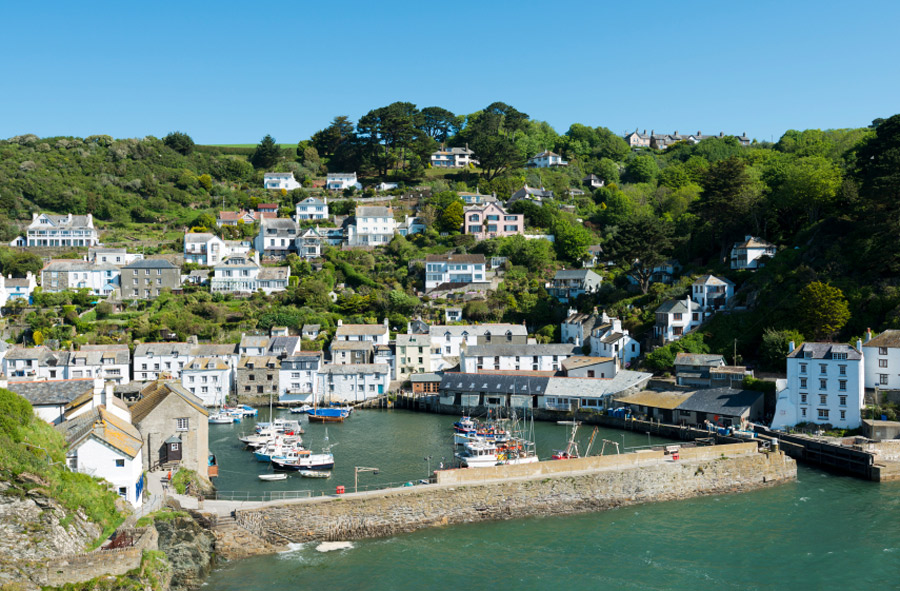
THINGS TO DO IN POLPERRO
Polperro is small enough to explore in a morning, but there is plenty to fill a longer stay – from tidal swimming and coast path walks to museums and boat trips. Here are ten of the best things to do in and around the village.
- Explore the harbour and the old village – follow the River Pol down through the narrow lanes, past the House on Props and the Saxon Bridge, to the inner harbour and the Peak at its mouth. Early morning and evening are the quietest times.
- Visit the Heritage Museum of Fishing and Smuggling – housed in the former pilchard factory on the harbourside, with photographs from the 1860s onwards, ship models, family history records and the hand-knitted fishermen’s “knitfrocks”. Usually open daily from Easter to October. Polperro Harbour Trust – museum
- Swim in Chapel Pool – a tidal pool built into the rocks on the seaward side of Chapel Cliff in the 1940s. It is reachable from about half tide down steep steps, restored by the National Trust and the Royal Engineers in 2001, and warms in the sun once the waves stop topping it up.
- Walk the coast path to Talland Bay and Looe – head east past Talland Bay’s coves to Looe, about 5.7 miles, and catch the bus back. Route details – South West Coast Path
- Walk west to Lansallos and Lantic Bay – the cliff path runs through National Trust land to the secluded coves at Lansallos and Lantic Bay, two of the most unspoilt beaches in this part of Cornwall. Lansallos guide · Lantic Bay guide
- Visit the Polperro Model Village – a miniature version of Polperro itself, together with the Land of Legend exhibition of Cornish myths. Open from Easter to November. Polperro Model Village
- Take a boat trip – in season, fishing trips and short pleasure cruises leave from the harbour; arriving back into Polperro from the sea is unforgettable.
- Eat local seafood – the village has a remarkable number of pubs, cafés and restaurants for its size, many serving fish landed on the quay. Fresh fish is sometimes sold straight from the quayside.
- Look out for the artists’ Polperro – the village has drawn painters for well over a century; Oskar Kokoschka painted the harbour in 1939, and galleries around the village still sell local work.
- Visit Looe – Looe’s sandy beach, Looe Island boat trips and Beyond Paradise locations are just four miles away by bus or car. Looe town guide
HISTORY OF POLPERRO
Polperro’s name comes from the Cornish Porthpyra, usually read as “Pyra’s cove”. The village was a recognised fishing settlement by the 13th century – its first known record is in a Royal Ordinance of 1303 – and a chapel of St Peter is mentioned here in 1398. For centuries the village was split between two manors and two parishes: Raphael, in Lansallos parish to the west of the River Pol, and Killigarth, in Talland parish to the east.
Pilchards were the village’s lifeblood for hundreds of years. The fish were salted and pressed in cellars around the harbour, the oil used for heating and lighting, and the catch exported across Europe. The industry finally ended as the mainstay of the village in the 1960s.
Smuggling reached its peak in the late 18th century, when wartime taxes made it hugely profitable to run spirits, tobacco and other goods across from Guernsey. Much of Polperro’s trade was financed and organised by the local merchant Zephaniah Job, remembered as the “Smugglers’ Banker”. A better-organised Coast Guard gradually brought the free trade under control during the 19th century.
The sea has also taken its toll. Great storms in January 1817 wrecked thirty large boats and two seine boats in the harbour, and in November 1824 nearly fifty boats were dashed to pieces, after which a new pier was built to give the harbour better protection. In the 20th century, as fishing declined, artists and then holidaymakers discovered the village, and keeping cars out of its narrow streets has helped preserve the character that draws visitors today.
↑ Back to topKEY BUILDINGS & LANDMARKS IN POLPERRO
- The House on Props – reputed to date from the 16th century, this much-photographed cottage is jettied out over the River Pol on wooden posts.
- The Saxon and Roman bridges – despite their names, both of the village’s old stone bridges over the Pol date from the 19th century.
- The Net Loft – a Grade II listed building owned by the National Trust on the edge of the harbour, a reminder of the days when nets were stored and mended here.
- The Heritage Museum building – the former pilchard factory on the harbourside, which processed fish until the early 1900s and now houses the museum.
- Couch’s House, Lansallos Street – home of Dr Jonathan Couch, Polperro’s doctor and naturalist for most of the 19th century.
- Chapel Rock and the Peak – the rocky headlands that guard the harbour entrance, with Chapel Pool tucked into the seaward side.
THE HARBOUR & THE FISHING FLEET
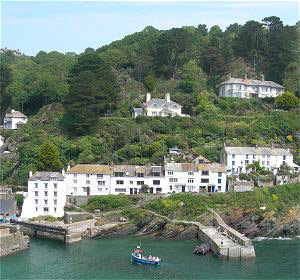
Polperro’s tiny harbour, protected by its piers and the rocks at its mouth, has been home to a fishing fleet for at least seven centuries. In the days of the pilchard fishery it was crowded with seine boats and luggers; today it is far quieter, but it is still a working harbour, with around a dozen commercial boats landing flatfish, scallops, crab, monkfish, ray, pollock, bass and cod.
The harbour is looked after by the Polperro Harbour Trust, a volunteer-run body that also runs the Heritage Museum. Fresh fish and seafood are sometimes sold directly on the quayside, and the boats coming and going on the tide are as much a part of Polperro’s appeal as its cottages and lanes.
The harbour dries out at low tide, leaving the boats resting on the mud – one of the classic Polperro views. Come back at high water to see the inner harbour full again.
↑ Back to top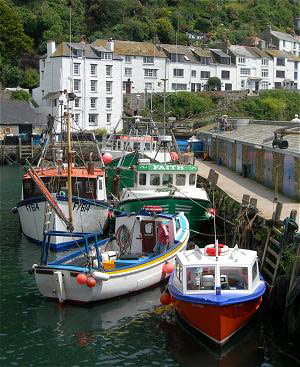
NOTABLE PEOPLE FROM POLPERRO
- Dr Jonathan Couch (1789–1870) – Polperro’s village doctor for most of the 19th century, a respected naturalist and author of a History of Polperro, published by his son Thomas Quiller Couch in 1871. He looked after the welfare of the fishermen and studied the fish they caught. His grandson was the novelist Sir Arthur Quiller-Couch, “Q”.
- Zephaniah Job (1749–1822) – the Polperro merchant who controlled much of the village’s smuggling trade at its height, acting as banker, agent and accountant to the free traders – hence his nickname, the “Smugglers’ Banker”.
- Oskar Kokoschka (1886–1980) – the Austrian Expressionist painter, who had fled Prague, spent nine months in Polperro in 1939 at Cliff End Cottage. His views of the harbour, including Polperro II, now hang in Tate Britain.
LOCAL EVENTS IN POLPERRO
- Polperro Festival (mid-to-late June) – a free, volunteer-run festival held over about a week around midsummer, with live music, comedy, competitions, food and children’s entertainment in marquees on the Big Green, and the light-hearted naming of the next “Lord Mayor of Polperro”.
- Polperro Fishermen’s Choir – founded in 1923, the choir is one of the village’s best-loved traditions and a regular part of the festival programme.
Dates change from year to year, so check local listings before planning a visit around an event. Neighbouring Looe has a busy calendar of its own – see the events in Looe.
↑ Back to topBEACHES NEAR POLPERRO
Polperro’s own beach is tiny, but some of the most beautiful coves in South East Cornwall lie within a short walk or drive. Each has a full guide in our Looe & Polperro beaches section, with parking, facilities, dog rules and access details.
Polperro Beach & Chapel Pool
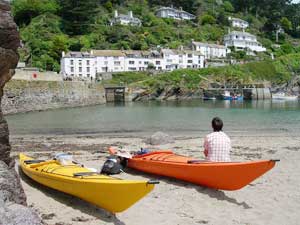
A small sand-and-shingle beach lies just outside the harbour wall, below Willy Wilcox’s Cave – said to have been used by smugglers. It almost disappears at high tide, so it is best for a low-tide paddle and explore. A seasonal dog restriction, typically from Easter to 1 October, applies.
On the seaward side of Chapel Cliff, Chapel Pool is a tidal swimming pool built in the 1940s. Go a couple of hours either side of low tide – it is completely submerged at high water. The steps down are steep with no handrails, and there is no lifeguard cover. Full guide to Polperro Beach →
Talland Bay
Just over a mile east along the coast path, Talland Bay has two small coves of sand and rock pools among steeply tilted Meadfoot rocks, seasonal cafés and parking, below the church of St Tallanus. Talland Bay beach guide · Talland Bay village guide
Lansallos Beach
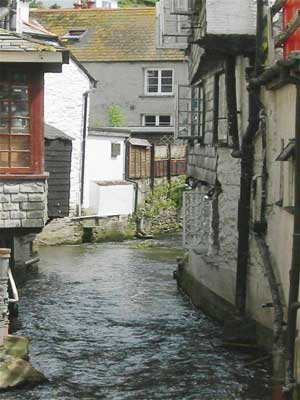
A couple of miles west, a footpath from beside Lansallos’ Grade I listed church of St Ildierna drops for almost a mile through woodland to a quiet, south-facing cove of sand and shingle, with a small waterfall at its western end. There are no facilities, and the path is unsuitable for wheelchairs and pushchairs. A small National Trust car park is in the village. Full guide to Lansallos →
Lantic Bay & Pencarrow Head
Further west towards Fowey, Lantic Bay is one of the most beautiful beaches in this part of Cornwall – pale sand and clear water beneath dramatic National Trust cliffs. Reaching it means a steep 20–25 minute walk down from the National Trust car park and the same back up, and there are no facilities or lifeguards. Full guide to Lantic Bay →
AROUND POLPERRO
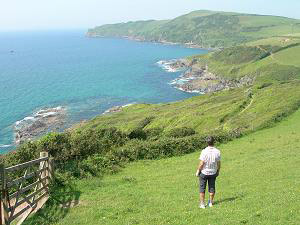
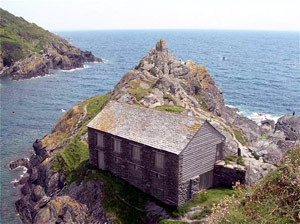
The coast here is part of the Cornwall National Landscape (formerly the Area of Outstanding Natural Beauty). From Polperro, the coast path runs east to Talland and Looe and west to Lansallos and the Fowey estuary – secluded coves that, over the centuries, gave the smugglers ample opportunity.
Pelynt & the Song of the Western Men
A few miles inland, Pelynt is the parish where Bishop Jonathan Trelawny was born, at Trelawne, in 1650. He was one of the Seven Bishops imprisoned in the Tower of London by James II in 1688 – their acquittal was celebrated with bells rung in Pelynt – and he was buried in Pelynt’s parish church. He is traditionally linked to Robert Stephen Hawker’s Song of the Western Men, with its famous refrain “And shall Trelawny die?”
Polruan & the Fowey Estuary
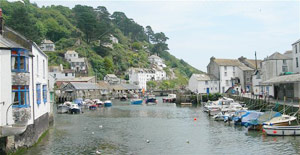
At the mouth of the River Fowey, the village of Polruan faces Fowey across the water. In medieval times a defensive chain could be strung across the harbour mouth between blockhouses on either side to bar enemy ships. Today the river carries pleasure craft and china clay ships instead, with a passenger ferry from Polruan and a car ferry from Bodinnick, both crossing to Fowey.
Literary Connections
- Beside the Bodinnick ferry slipway stands Ferryside, where a young Daphne du Maurier began her first novel, The Loving Spirit, in 1929 – inspired by the schooner Jane Slade, whose hulk lay in nearby Pont Pill.
- On the quiet southern bank of Pont Pill, the writer Leo Walmsley lived in an old army hut through the 1930s, later writing his autobiographical Love in the Sun.
- At Penleath Point, on the Hall Walk, stands the granite memorial to “Q” – Sir Arthur Quiller-Couch, grandson of Polperro’s Dr Jonathan Couch, who lived in Fowey for over fifty years and immortalised it as “Troy Town”.
VISITOR INFORMATION
Parking
Cars are not allowed into the village centre. Park in the large pay-and-display car park at Crumplehorn, at the top of the village – carry coins in case the machines don’t take cards. From there it is about half a mile, 10–15 minutes, down to the harbour, or take the seasonal tuk-tuk shuttle (usually Easter to October). National Trust car parks serve Lansallos and Lantic Bay.
Bus & Train
Polperro has no station – the nearest is Looe, about four miles away, on the Looe Valley Line from Liskeard. Buses link Polperro with Looe and Liskeard (route 73) and with Polruan (481); check current timetables before you travel.
Facilities
Public toilets near the car park and in the village, plus pubs, cafés, galleries and craft shops around the harbour. Not every small business takes cards, so it is worth carrying some cash. There are no facilities at Lansallos or Lantic Bay.
Cafés & Restaurants
Despite its size, Polperro has a great concentration of pubs, cafés and restaurants clustered around the harbour, many serving locally landed seafood. The Crumplehorn Inn, a former mill beside the main car park, makes a good first or last stop.
Boat Trips & Walks
Fishing trips and pleasure cruises run from the harbour in season. The coast path offers walks east to Talland Bay and Looe, and west to Lansallos, Lantic Bay and the Fowey estuary.
Disabled Access
Polperro is a difficult village for wheelchair and pushchair users: the half-mile route down from the car park is fairly gentle, but the lanes around the harbour are narrow and steep, and the beach and Chapel Pool are not step-free. Blue Badge holders should check locally for bays near the Crumplehorn car park.
STAY & EXPLORE NEAR POLPERRO
Accommodation in Polperro
Local Beaches
- Polperro Beach & Chapel Pool – in Polperro
- Talland Bay – approx. 1 mile
- Lansallos – approx. 2 miles
- Lantic Bay – approx. 4 miles
- Hannafore Beach, West Looe – approx. 4 miles
- East Looe Beach – approx. 4 miles
- Looe & Polperro beaches guide – all seven beaches
- Beaches in Cornwall – complete guide
Local Attractions
- Heritage Museum of Fishing & Smuggling – in Polperro
- Polperro Model Village – in Polperro
- Looe – approx. 4 miles
- Talland Bay – approx. 1 mile
- Polruan – approx. 6 miles
- Porfell Wildlife Park & Sanctuary – approx. 6 miles
- National Trust coast walks – from Polperro
FREQUENTLY ASKED QUESTIONS ABOUT POLPERRO
No. Cars are not allowed into the village centre because the streets are too narrow. Visitors park in the large pay-and-display car park at Crumplehorn, at the top of the village, and walk about half a mile down the valley to the harbour – roughly 10 to 15 minutes. A seasonal tuk-tuk shuttle usually runs between the car park and the village from Easter to October.
Polperro is about 4 miles west of Looe by road. On foot, the South West Coast Path route from Looe station via Hannafore and Talland Bay is about 5.7 miles, and you can catch a bus back from Crumplehorn.
Yes – a small sand-and-shingle beach just outside the harbour wall, which almost disappears at high tide. There is also Chapel Pool, a tidal swimming pool built into the rocks in the 1940s, reached from about half tide down steep steps.
Dogs are welcome in the village, many pubs and on the coast path. A seasonal dog restriction, typically from Easter to 1 October, applies to the harbour beach, while dogs are allowed at Chapel Pool and at Lansallos all year. Check the signs when you arrive.
Polperro is famous for its smuggling history – at its late 18th-century peak, much of the trade was financed by the merchant Zephaniah Job, the “Smugglers’ Banker” – and for centuries of pilchard fishing. Today it is known as one of Cornwall’s prettiest car-free harbour villages.
Yes. Around a dozen commercial boats still work from the harbour, landing flatfish, scallops, crab, monkfish, pollock, bass and cod, although tourism is now the main source of income.
The Polperro Festival is held each year over about a week in mid-to-late June, around midsummer. It is free and run by volunteers, with live music, comedy, food and children’s events in marquees on the Big Green.
The Heritage Museum of Fishing and Smuggling, in the former pilchard factory on the harbourside, is usually open daily from Easter to the October half term. Check with the Polperro Harbour Trust before you travel.
Yes, from about half tide until a couple of hours after low water – the pool is completely covered at high tide. The steps down are steep with no handrails, and there is no lifeguard cover, so check the tide times before you go.
Back to the South East Cornwall area guide – all Caradon towns & villages
Cornwall Online | South East Cornwall Towns and Villages | Looe | Talland Bay | Polperro | Polruan | Fowey | Lostwithiel | Mevagissey | Whitsand Bay & The Rame Peninsula | Kingsand | Cawsand | Mount Edgcumbe Country Park | Torpoint | St Germans | Saltash | Liskeard | Siblyback Lake - Water Park | Minions - Hurlers - Bodmin Moor | St Neot | St Cleer | Callington | Gunnislake | Calstock | Cardinham Woods - Walking & Cycle Trails | Launceston |