Lamorna Cove, Cornwall – Granite Harbour, Artists’ Valley & Coast Path
Lamorna
Cornwall Online | West Cornwall Towns and Villages | Isles of Scilly | Sennen Cove & Land’s End | Pendeen | St Just | Porthcurno | Lamorna | Mousehole | Newlyn | Penzance | Marazion – St Michael’s Mount | Praa Sands | Porthleven | Gunwalloe – Church Cove | Mullion | Helston | The Lizard Peninsula
On This Page
- Holidays in Lamorna
- Best Time to Visit
- Lamorna Cove & the Quay
- The Granite Quarries
- The Valley & the Wink
- The Lamorna Artists
- Walks from Lamorna
- History of Lamorna
- Key Buildings
- Notable People
- Things to Do
- Events
- Places near Lamorna
- Visitor Information
- Stay & Explore
- Family Holidays & Short Breaks
- Frequently Asked Questions
Lamorna at a Glance
Village, wooded valley and cove on Mount’s Bay, about 4 miles south of Penzance. Cornish name Nansmornow. Parish of St Buryan, Lamorna and Paul, in the Cornwall National Landscape (AONB). Granite quarried here 1849–1911; Grade II listed quay. Home of the Lamorna artists’ colony. On the South West Coast Path between Mousehole and Porthcurno. Postcode TR19.
Lamorna distances
Mousehole – about 2½ miles by coast path
Penzance – about 4 miles
St Buryan – about 3 miles
Porthcurno – about 6 miles by road
Land’s End – about 9 miles
HOLIDAYS IN LAMORNA
A delightful approach down the deeply wooded Lamorna Valley leads to the famous Lamorna Cove and the glittering sea of Mount’s Bay. It is one of the loveliest corners of west Cornwall – a stream tumbling through trees past old mills and cottages, a pub with a smuggling name, and at the bottom a little granite harbour framed by cliffs, boulders and remarkably clear water.
Nature has taken back what was once a centre of Victorian industry. Quarrying for high quality granite began here in 1849, and for more than sixty years Lamorna stone was cut from the cliffs and shipped or hauled away to build lighthouses, piers and the Thames Embankment. The quarries closed in 1911, and the waste tips and the granite quay are their reminders today.
Then came the painters. In the early 1900s the valley’s exquisite landscape attracted artists of distinction – Samuel John ‘Lamorna’ Birch, Laura and Harold Knight, Alfred Munnings, Dod and Ernest Procter and many more – and Lamorna became one of the most celebrated artists’ colonies in Britain.
Today all is peace and beauty in Lamorna. It is a place for a swim or a snorkel in the cove, a pint at the Wink, a pottery and a gallery or two, and above all for walking: the coast path runs east through the Kemyel Crease reserve to Mousehole and west past Tater Du lighthouse towards Porthcurno, while inland are the Merry Maidens stone circle and the Pipers.
For somewhere to stay, see Lamorna holiday cottages and holidays and short breaks in Lamorna.
Best Time to Visit Lamorna
Spring is magical in the valley, with bluebells and wild garlic under the trees and the first warm days on the coast path. Summer brings the clearest water for swimming and snorkelling and the café open by the quay, but the lane and the small car park are very busy – arrive early or walk in along the coast path from Mousehole. Autumn and winter are quiet and dramatic, with big seas on the cliffs, the Wink’s fire lit and the walks almost to yourself.
↑ Back to topLAMORNA COVE & THE GRANITE QUAY
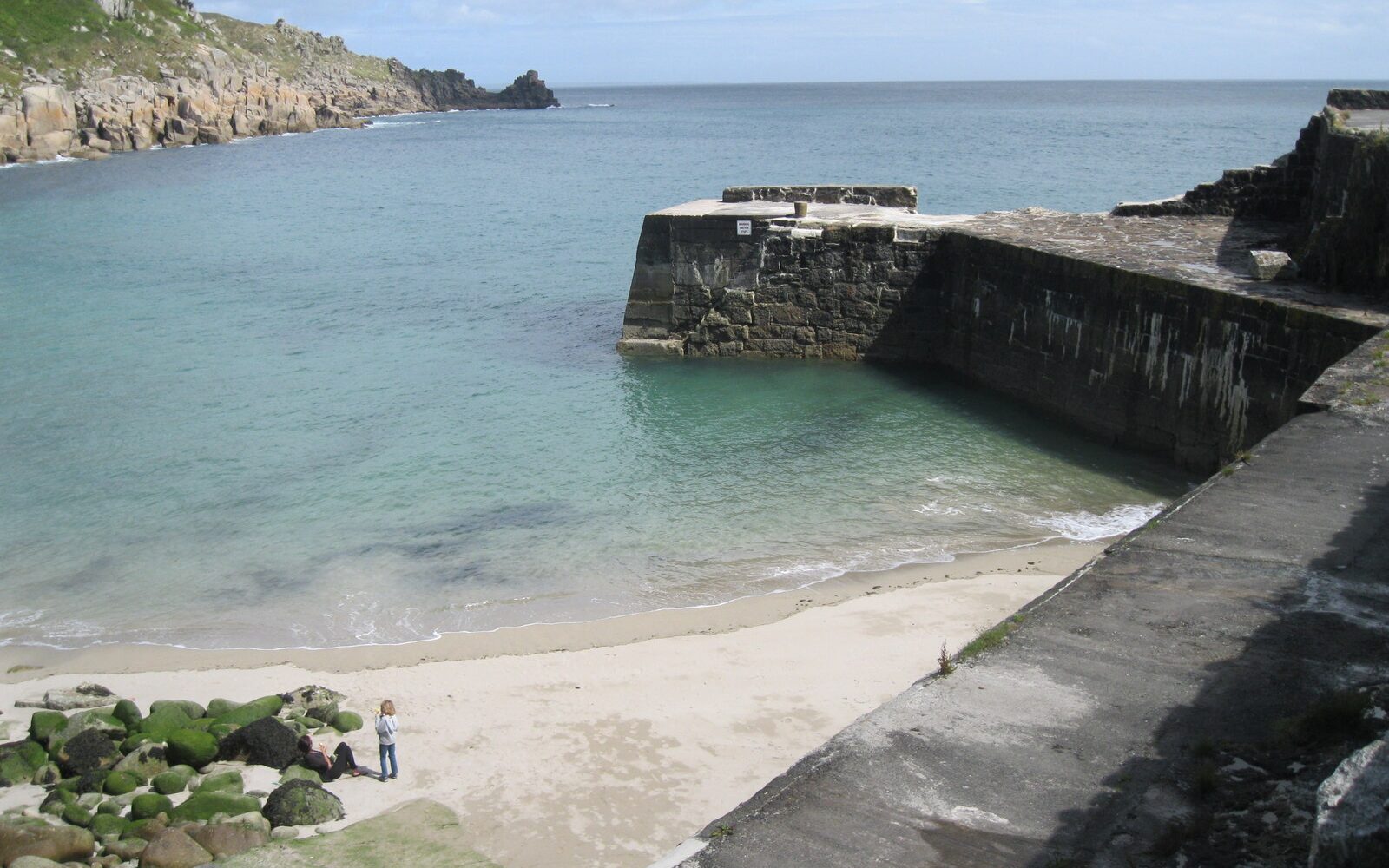
Lamorna Cove lies at the seaward end of the valley, between the dark headland of Carn-du (Black Rock) on the east and Lamorna Point on the west, facing south-east across Mount’s Bay. It is a small, dramatic cove rather than a big sandy beach: great rounded granite boulders line its edges, the stream runs out beside the quay, and a little sand appears inside the harbour wall as the tide falls.
The harbour is built from the granite blocks that were quarried locally. A timber jetty was first used to load the stone onto ships, followed by a stone pier, but heavy seas often delayed loading and threatened the vessels at their moorings, so the stone was increasingly carted overland through Newlyn instead. The present quay dates from the late 19th century, has been repaired and rebuilt after storms over the years, and is listed Grade II. It is still used occasionally by visiting boats and by divers and kayakers.
The water at Lamorna is often beautifully clear, and the cove is popular with swimmers, snorkellers and divers – the remains of a 17th-century privateer, with cannon on the seabed, make it a well-known dive site. There are no lifeguards, so take care on the slippery granite and keep an eye on the tide and the swell. Rock pools among the boulders hold crabs, anemones and small fish, and the cliffs above are good for spotting choughs, peregrines and seabirds.
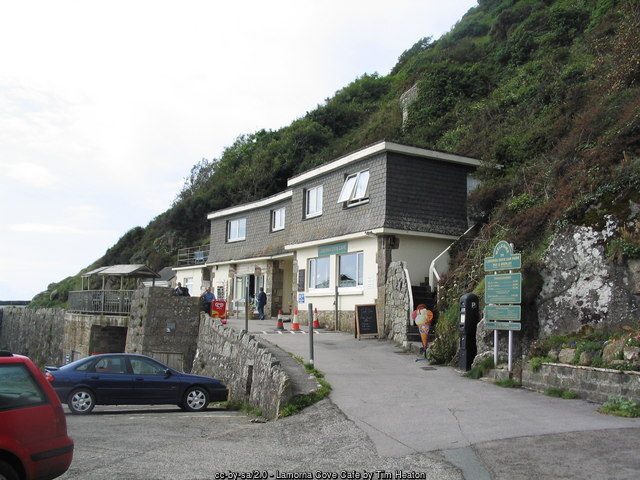
By the quay are the Lamorna Cove Cafe, toilets and a small private car park; above the cove stands the former Lamorna Cove Hotel, built in the 1870s as Cliffe House, the quarry manager’s home.
↑ Back to top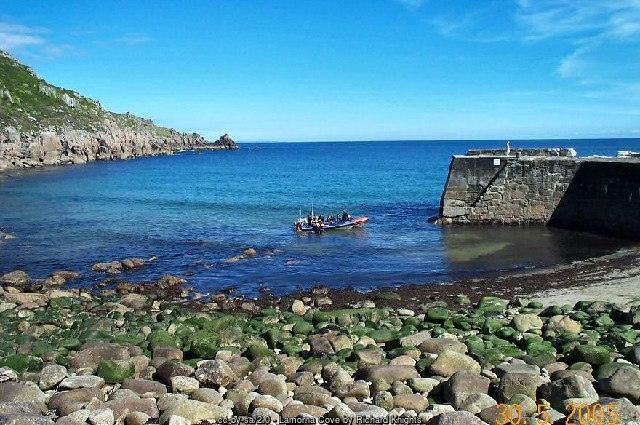
The cove in brief
Beach: boulders and rocks, sand inside the quay at low tide
Lifeguards: none
Good for: swimming, snorkelling, diving, rock pooling, kayaking
Facilities: seasonal café, toilets, private pay car park
THE LAMORNA GRANITE QUARRIES
The cliffs around the cove are part of the Land’s End granite, and in 1849 John Freeman opened quarries on the eastern side of the cove, on land belonging to the St Aubyn family. The stone was hard, fine and good-looking, and Lamorna granite was soon in demand for some of the great engineering works of the Victorian age.
It went into the Thames Embankment and London County Council offices in London, Admiralty Pier at Dover and Portland Breakwater, and closer to home into the north pier at Mousehole and two of the most exposed lighthouses in Britain, the Wolf Rock and the Bishop Rock. A huge 20-ton block was sent by sea to the Great Exhibition of 1851.
Loading ships in the open cove proved slow and dangerous, so in time the blocks went by road instead, hauled up the hill through Kemyel and Paul and down through Newlyn to cutting yards at Wherrytown in Penzance. A second quarry on the west side of the cove failed because its granite held too much quartz. Work dwindled in the later 19th century and the quarries finally closed in 1911. Today the overgrown waste tips on the eastern side of the cove, crossed by the coast path, are the main reminder of a busy industrial past.
↑ Back to topBuilt with Lamorna granite
Thames Embankment, London
Admiralty Pier, Dover
Portland Breakwater, Dorset
Wolf Rock Lighthouse
Bishop Rock Lighthouse
Mousehole north pier
THE LAMORNA VALLEY & THE WINK
The Lamorna Valley runs south-east from the B3315 down to the sea, its stream once marking the boundary between the parishes of St Buryan and Paul. Sheltered from the Atlantic winds, it is thickly wooded – a rare thing in Penwith – and the little village of Lamorna lies along the lane about half a mile above the cove.
People have worked this valley for centuries. Tin streaming here is recorded in the 1380s, and the Hoskyn family ran Kemyel Mill from at least the 14th century until the 1920s. In more recent times the sheltered slopes grew daffodils and early potatoes, with flowers sent away by train to Covent Garden and other markets.
At the heart of the village is the Lamorna Wink. The name of Lamorna’s pub alludes to smuggling, ‘the wink’ being a signal that contraband could be obtained. Its walls are hung with a fine collection of maritime memorabilia, and the pub is the subject of a novel by Martha Grimes, The Lamorna Wink.
At the top of the valley, on the main road, Lamorna Pottery was founded in 1947 and is still a working pottery with a shop and café. Galleries and studios in and around the valley carry on the artistic tradition.
↑ Back to top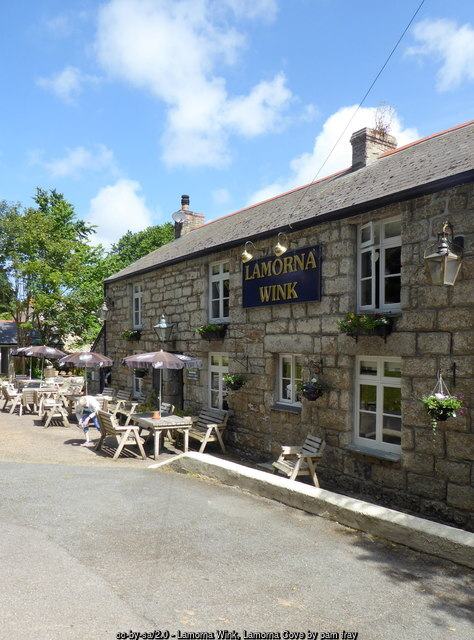
THE LAMORNA ARTISTS
In the late 19th century Newlyn, just along the coast, became famous for its colony of painters, drawn by the light and the working life of the fishing harbour. Lamorna grew into its quieter, greener offshoot. Samuel John Birch settled in the valley in 1892 and, at the suggestion of Stanhope Forbes, added ‘Lamorna’ to his name to tell him apart from another painter called Birch. After his marriage in 1902 he made his home at Flagstaff Cottage, the old harbourmaster’s house above the cove, and painted the valley, its stream and its rocks for the rest of his long life.
Birch drew others after him. Laura and Harold Knight arrived in west Cornwall in 1907 and were soon regulars in Lamorna, where Laura painted her famous sunlit pictures of figures on the cliffs and rocks. Alfred Munnings, later President of the Royal Academy, joined them, along with the jeweller Ella Naper and her husband Charles, Dod and Ernest Procter and many more. The colony was at its height in the decade between about 1910 and 1920.
That world was brought vividly back to life by Jonathan Smith’s novel Summer in February, which was filmed in and around Lamorna and released in 2013. The Lamorna Society keeps the history of the valley’s artists, and Penlee House Gallery in Penzance holds and shows many of their paintings.
↑ Back to topPainters of Lamorna
S J ‘Lamorna’ Birch (1869–1955)
Laura Knight (1877–1970)
Harold Knight (1874–1961)
Alfred Munnings (1878–1959)
Charles and Ella Naper
Dod and Ernest Procter
WALKS FROM LAMORNA
Lamorna to Mousehole – the South West Coast Path climbs out of the cove past the old quarry tips and round Carn-du, then runs through the Kemyel Crease nature reserve, a Cornwall Wildlife Trust woodland of tall pines and cypresses planted as windbreaks for tiny Victorian flower and vegetable fields called quillets. It reaches Mousehole after about two and a half miles. Return the same way or inland through the fields.
Lamorna to Tater Du and Penberth – west of the cove the path is rough and rocky, climbing over Lamorna Point to Tater Du lighthouse, built by Trinity House in 1965 after the Spanish coaster Juan Ferrer was wrecked at nearby Boscawen Point in October 1963 with the loss of eleven lives. Beyond lie St Loy’s Cove, the fishing cove of Penberth and, after about five miles, Porthcurno.
The Merry Maidens – inland, beside the B3315 above the valley, stands the Merry Maidens, a complete circle of 19 granite stones. Legend says they were girls turned to stone for dancing on a Sunday, and the two tall standing stones in the field nearby, the Pipers, were the musicians. Close by is the Tregiffian burial chamber, a prehistoric entrance grave beside the road.
The paths around Lamorna are steep, rocky and often muddy – wear good boots and allow plenty of time.
- Walking in Cornwall – Cornwall Online walks
- South West Coast Path
- Cornwall Wildlife Trust – Kemyel Crease
Walks at a glance
Mousehole – about 2½ miles, via Kemyel Crease
Tater Du lighthouse – about 1½ miles west
Porthcurno – about 5 miles west, via Penberth
Merry Maidens – inland, beside the B3315
HISTORY OF LAMORNA
Lamorna’s Cornish name is Nansmornow, recorded from the early 14th century; nans means valley. The country around it is full of the remains of prehistoric people – the Merry Maidens, the Pipers and Tregiffian are among the finest monuments in Penwith.
For centuries the valley was a quiet place of mills, tin streams and small farms. In the 17th century a privateer belonging to the Penrose family was moored in the cove and was wrecked there in a storm; cannon and silver coins have since been found on the seabed. The quarries brought sudden industry in 1849, with a harbour, cottages, a powder magazine, a water-wheel and, in 1881, a small school for the quarrymen’s children.
When the quarries closed in 1911, the artists were already in residence, and the 20th century turned Lamorna into a place for painters, writers and walkers. During the Second World War, French fishing families working out of Newlyn lived in the old Cliffe House above the cove. Later the writers Derek and Jean Tangye farmed on the cliffs nearby, and Derek’s Minack Chronicles made this stretch of coast famous with a whole generation of readers.
↑ Back to topLamorna timeline
Prehistory – Merry Maidens, Pipers and Tregiffian
1380s – tin streaming recorded in the valley
17th century – privateer wrecked in the cove
1849 – John Freeman opens the granite quarries
1851 – 20-ton Lamorna block at the Great Exhibition
1870s – Cliffe House built for the quarry manager
1881 – school opens for the quarry families
1892 – S J Birch settles in the valley
1911 – the quarries close
1910–1920 – the artists’ colony at its height
1947 – Lamorna Pottery founded
1963 – Juan Ferrer wrecked at Boscawen Point
1965 – Tater Du lighthouse built
1974 – Cornwall Wildlife Trust buys Kemyel Crease
2013 – Summer in February film released
KEY BUILDINGS & LANDMARKS AROUND LAMORNA
- Lamorna Cove quay – the granite harbour of the quarry days, late 19th century, listed Grade II.
- Flagstaff Cottage – the former harbourmaster’s house above the cove, home of ‘Lamorna’ Birch from 1902.
- Cliffe House – built in the 1870s for the quarry manager, later the Lamorna Cove Hotel.
- Kemyel Mill – the old valley mills, run by the Hoskyn family for centuries and listed Grade II.
- The Lamorna Wink – the village pub, with its collection of maritime memorabilia.
- The Merry Maidens and the Pipers – the 19-stone circle and two tall standing stones beside the B3315.
- Tregiffian burial chamber – a prehistoric entrance grave beside the road near the Merry Maidens.
- Tater Du lighthouse – Cornwall’s newest lighthouse, built in 1965 on the cliffs west of the cove.
NOTABLE PEOPLE & LAMORNA
- Samuel John ‘Lamorna’ Birch (1869–1955) – landscape painter, who settled in the valley in 1892 and gave the place its artistic fame.
- Laura Knight (1877–1970) – one of the best-known British painters of the 20th century, who painted some of her most celebrated pictures on the cliffs at Lamorna.
- Alfred Munnings (1878–1959) – painter of horses and country life, part of the Lamorna circle before the First World War and later President of the Royal Academy.
- Derek and Jean Tangye – the writers who farmed flowers on the cliffs near Lamorna; Derek’s Minack Chronicles drew readers to this coast for decades.
- Robert Newton (1905–1956) – the actor famous as Long John Silver, who went to school in Lamorna; his ashes were scattered at sea off the village.
THINGS TO DO IN LAMORNA
Lamorna is a place to slow down. There are no big attractions in the valley itself, but the cove, the coast path and the countryside around it are some of the most beautiful in Cornwall, and Mousehole, Newlyn and Penzance are only a few minutes away by car.
Here are our favourite things to do in and around Lamorna:
- Swim or snorkel in the clear water of Lamorna Cove on a calm day.
- Walk the coast path to Mousehole through the Kemyel Crease woods.
- Head west to Tater Du lighthouse and look for seals and dolphins offshore.
- See the Merry Maidens, the Pipers and Tregiffian burial chamber.
- Stop for a drink at the Lamorna Wink.
- Browse Lamorna Pottery and the valley’s galleries.
- See the Lamorna and Newlyn painters at Penlee House Gallery in Penzance.
- Drive on to the Minack Theatre and Porthcurno beach.
EVENTS NEAR LAMORNA
Lamorna is a small, quiet place, and most of the big events are just along the coast. The Lamorna Arts Festival, launched in 2009, has celebrated the valley’s artists past and present with exhibitions and events. In Mousehole, the famous harbour Christmas lights shine from mid-December, and Tom Bawcock’s Eve is celebrated on 23 December. Penzance has the Golowan Festival around midsummer and Montol in December, and Newlyn holds its Fish Festival in late summer.
Dates change each year – check with the organisers before you travel.
↑ Back to topPLACES NEAR LAMORNA
- Mousehole – granite fishing village and harbour, about 2½ miles by the coast path.
- Newlyn – Cornwall’s biggest fishing port and home of the Newlyn School of painters.
- Penzance – promenade, Jubilee Pool, Penlee House and ferries to Scilly, about 4 miles.
- St Buryan – inland village with one of Cornwall’s tallest church towers, about 3 miles.
- Porthcurno – white sand, the Minack Theatre and the telegraph museum, about 6 miles by road.
- Marazion – St Michael’s Mount, across Mount’s Bay.
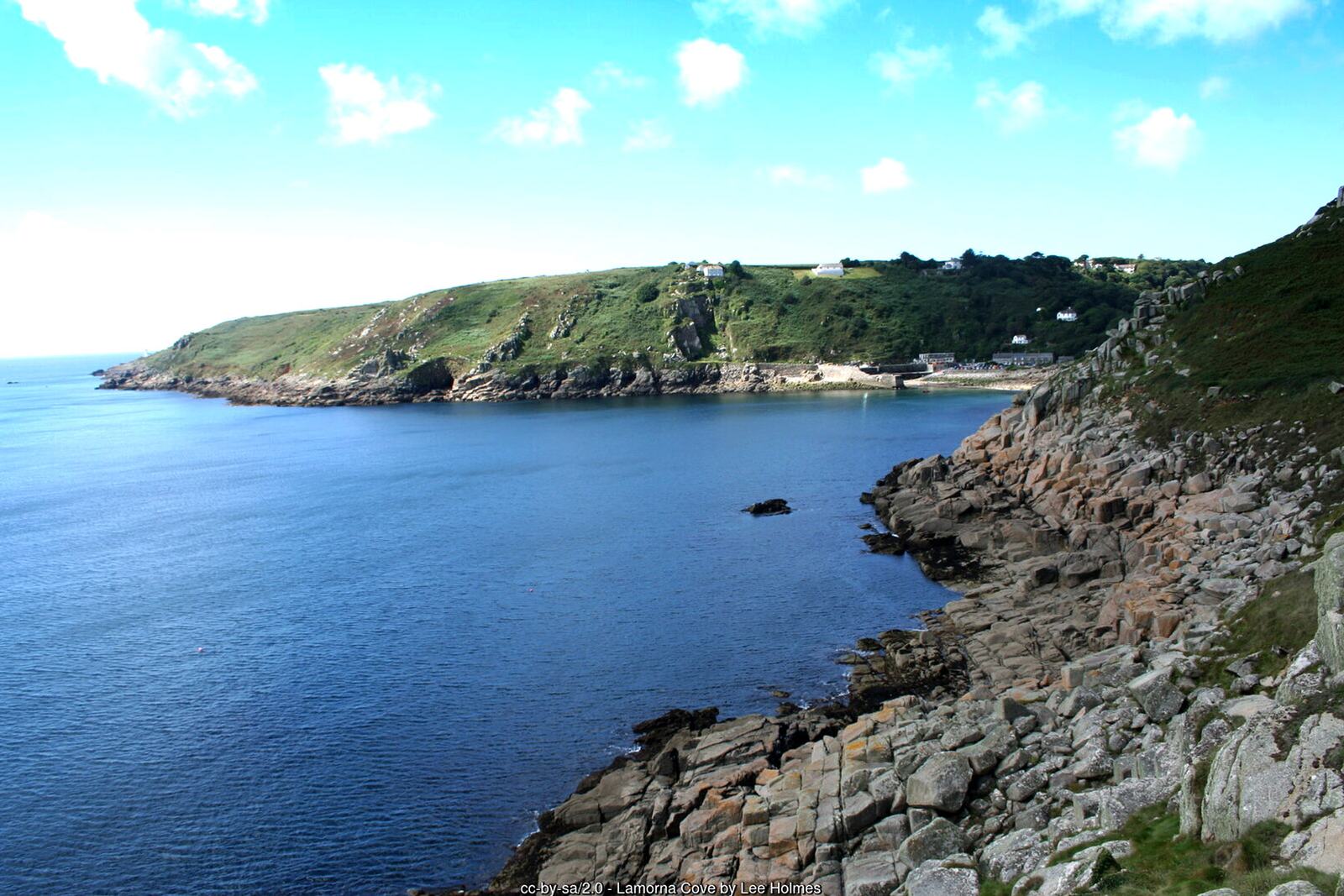
Lamorna – the cove and quay at the foot of the wooded valley, with the village and the Wink further up the lane.
VISITOR INFORMATION
From Penzance, follow the B3315 through Newlyn towards Land’s End and turn left at the Lamorna sign. The lane down the valley is narrow and winding, with few passing places, and leads past the Wink to the car park at the cove. On busy summer days it is often easier to walk in along the coast path from Mousehole, or to come by bus to Lamorna Turn and walk down the valley.
Parking & EV Charging
Lamorna Cove car park (TR19 6XJ) – a small, privately owned pay and display car park beside the quay, monitored by ANPR cameras. The machines have taken cash only, so bring coins. It fills early in summer and there is very little roadside parking in the valley.
EV charging: there are no public chargers at Lamorna – the nearest are in Newlyn and Penzance.
Bus & Train
Bus: services on the Penzance to Land’s End route along the B3315 stop at Lamorna Turn and Lamorna Pottery, about a mile up the valley from the cove. Train: the nearest station is Penzance, at the end of the main line from London Paddington, about 4 miles away. Check timetables before you travel.
Facilities & Supermarkets
Toilets and a seasonal café at the cove; the Lamorna Wink pub in the village; Lamorna Pottery shop and café on the B3315. There are no shops in Lamorna – the nearest are in Mousehole and Newlyn, and the large supermarkets are in Penzance.
Cafés & Pubs
The Lamorna Cove Cafe by the quay (seasonal; hours vary), the Lamorna Wink in the village, and the café at Lamorna Pottery on the main road. Mousehole and Newlyn, a few minutes’ drive away, have plenty more pubs, cafés and restaurants.
Health
The nearest GP surgeries and pharmacies are in Newlyn and Penzance. West Cornwall Hospital in Penzance has an urgent treatment centre, and the nearest A&E is the Royal Cornwall Hospital at Treliske, Truro. Call NHS 111 for urgent advice, or 999 in an emergency – and note that mobile signal can be poor in the cove.
Disabled Access
The car park is right beside the quay, so the café, the quay and the views of the cove can be reached with little walking. The beach itself is boulders and rock with sand only at low tide, and the coast path in both directions is steep and rocky. The Merry Maidens are a short walk across a field from the roadside.
Vets & Dogs
Dogs are generally welcome at Lamorna Cove and on the coast path, under control – the cove is privately owned, so check any signs on arrival. Keep dogs on a lead near livestock on the cliffs and under close control in the Kemyel Crease reserve. The nearest vets are in Penzance.
National Trust & English Heritage
St Michael’s Mount (National Trust) is across Mount’s Bay at Marazion, and the Trust cares for long stretches of the Land’s End coast. English Heritage looks after prehistoric sites in Penwith such as Carn Euny and Chysauster.
Attractions
The Minack Theatre and PK Porthcurno (the telegraph museum) at Porthcurno, Penlee House Gallery and the Jubilee Pool in Penzance, and St Michael’s Mount are all within half an hour.
STAY & EXPLORE IN LAMORNA
Official Information
FAMILY HOLIDAYS & SHORT BREAKS IN LAMORNA
Family holidays in Lamorna are about the simple pleasures – rock pooling among the boulders, a swim inside the quay on a calm day, ice creams from the café, and walks along the cliffs looking for seals, dolphins and choughs. Sandy beaches at Porthcurno, Mousehole and Penzance’s Jubilee Pool are a short drive away for bucket-and-spade days.
Browse Lamorna holiday cottages for cottages in the valley and near the cove, or holidays and short breaks in Lamorna for every type of accommodation, from cottages and B&Bs to campsites nearby.
Short breaks in Lamorna are a treat in any season – spring walks among the bluebells, a quiet autumn week on the coast path, or a winter break by the fire at the Wink. Booking direct with the owner means no agency fees.
↑ Back to topFREQUENTLY ASKED QUESTIONS ABOUT LAMORNA
Lamorna is a village, valley and cove on the south coast of the Penwith peninsula in west Cornwall, about four miles south of Penzance on Mount’s Bay. The village lies in the wooded Lamorna Valley, with the cove about half a mile below it, between Mousehole and Porthcurno on the South West Coast Path.
Yes. There is a small, privately owned pay and display car park beside the cove and the quay (postcode TR19 6XJ). It is camera-controlled and the machines have taken cash only, so bring coins. The lane down the valley is narrow with few passing places, and the car park fills early on fine summer days.
Lamorna Cove is a rocky cove with a small area of sand that appears inside the quay as the tide falls. The water is often very clear and it is popular for swimming, snorkelling and diving, but there are no lifeguards, so take care on the wet granite and check the tide and sea conditions.
Dogs are generally welcome at Lamorna Cove and on the coast path, as long as they are kept under control. The cove is privately owned rather than a council beach, so check any signs on arrival, and keep dogs on a lead near livestock on the cliffs.
Buses on the Penzance to Land’s End route along the B3315 stop at Lamorna Turn and Lamorna Pottery, at the top of the valley. From there it is a walk of about a mile down the lane, past the Wink, to the cove. Check current timetables with Transport for Cornwall before you travel.
Lamorna became a colony of painters in the early 20th century, an offshoot of the Newlyn School. Samuel John Birch settled in the valley in 1892 and took the name ‘Lamorna’ Birch; Laura and Harold Knight, Alfred Munnings and others joined him, and the colony was at its height between about 1910 and 1920.
Granite was quarried at Lamorna from 1849 until 1911. Lamorna stone went into the Thames Embankment in London, Admiralty Pier at Dover, Portland Breakwater, the Wolf Rock and Bishop Rock lighthouses and the north pier at Mousehole.
Yes. The South West Coast Path runs east from Lamorna Cove round Carn-du and through the Kemyel Crease nature reserve to Mousehole, about two and a half miles of rocky, up-and-down path. Westward the path leads past Tater Du lighthouse towards Penberth and Porthcurno.
The Lamorna Wink is the pub in Lamorna village, up the valley from the cove. Its name is said to come from smuggling days, when a ‘wink’ was the signal that contraband could be had, and it gave its name to Martha Grimes’s 1999 crime novel The Lamorna Wink.