Portholland, Cornwall – East & West Portholland on Veryan Bay

Portholland & the Caerhays Coast
The
Lizard Peninsula | Falmouth
| The Roseland
Peninsula | Truro
| St Mawes
| Veryan
& Portloe | Tregony
| St
Just in Roseland |Gorran
Haven | The
Lost Gardens of Heligan | Mevagissey
| Fowey | Golant | Charlestown |
Portholland | Port Loe
| St Austell | Lost
Gardens of Heligan
On This Page
- Holidays in Portholland
- Best Time to Visit
- Portholland Beach
- History of Portholland
- Miss Peregrine Filming Guide
- Notable People
- Coast Path Walks
- Caerhays Castle & Porthluney Cove
- Things to Do
- Local Events
- Places near Portholland
- Visitor Information
- Stay & Explore
- Family Holidays & Short Breaks
- Frequently Asked Questions
Portholland at a Glance
Two tiny hamlets, East and West Portholland, on Veryan Bay on Cornwall’s south coast, between Portloe and Caerhays. Two small coves joined by sand at low tide, a seasonal café, toilets and a small car park at East Portholland. Dogs welcome all year; no lifeguards. On the South West Coast Path.

HOLIDAYS IN PORTHOLLAND
Portholland is one of the quietest and least changed corners of the Cornish coast. It is really two tiny hamlets, East Portholland and West Portholland, each tucked into its own small cove on Veryan Bay, on the south coast between Portloe and Caerhays. A rocky outcrop separates the two coves at high tide, but as the tide drops the sand joins up and you can walk along the beach from one hamlet to the other.
Almost all of Portholland belongs to the Caerhays Estate, home of the Williams family since the 1850s, and careful management by the estate has kept the hamlets much as they were in Victorian times – a row of stone cottages, an old lime kiln, two chapels and a working farm, with no shops, pubs or seaside amusements. Fewer than fifty people live here all year round.
Portholland is a peaceful place for a quiet family holiday, a walking break or a day on the beach. Children love the rock pools and the stream at East Portholland, the sand at low tide is perfect for a game of cricket, and dogs are welcome on the beach all year round. There are no lifeguards, so swimmers should take care, especially as the tide turns.
The South West Coast Path runs through both hamlets, west to the fishing village of Portloe and east to Porthluney Cove and Caerhays Castle, John Nash’s castellated mansion with its famous spring gardens. Beyond lie Hemmick, Vault Beach and the great headland of the Dodman, and inland the lanes lead to Veryan, Tregony and St Austell.
Film fans may recognise East Portholland, too: it was transformed into the Welsh island village of Cairnholm for Tim Burton’s 2016 film Miss Peregrine’s Home for Peculiar Children.
This guide covers the beach, the history of the two hamlets, the film location, coast path walks, Caerhays and Porthluney Cove, things to do and places nearby, plus practical visitor information. For somewhere to stay, see Portholland holiday cottages and holidays and short breaks in Portholland.
Best Time to Visit Portholland
Spring is a lovely time to come, when the gardens at Caerhays are in full flower and primroses line the coast path. Summer brings warm sand and calm days for swimming and rock pooling, but the little car park fills quickly, so arrive early. Autumn and winter are quiet and atmospheric, ideal for walks along the coast with the dog.
The beach is largely covered at high tide, so plan your visit around low tide, when the two coves join and the rock pools are uncovered.
↑ Back to top
PORTHOLLAND BEACH
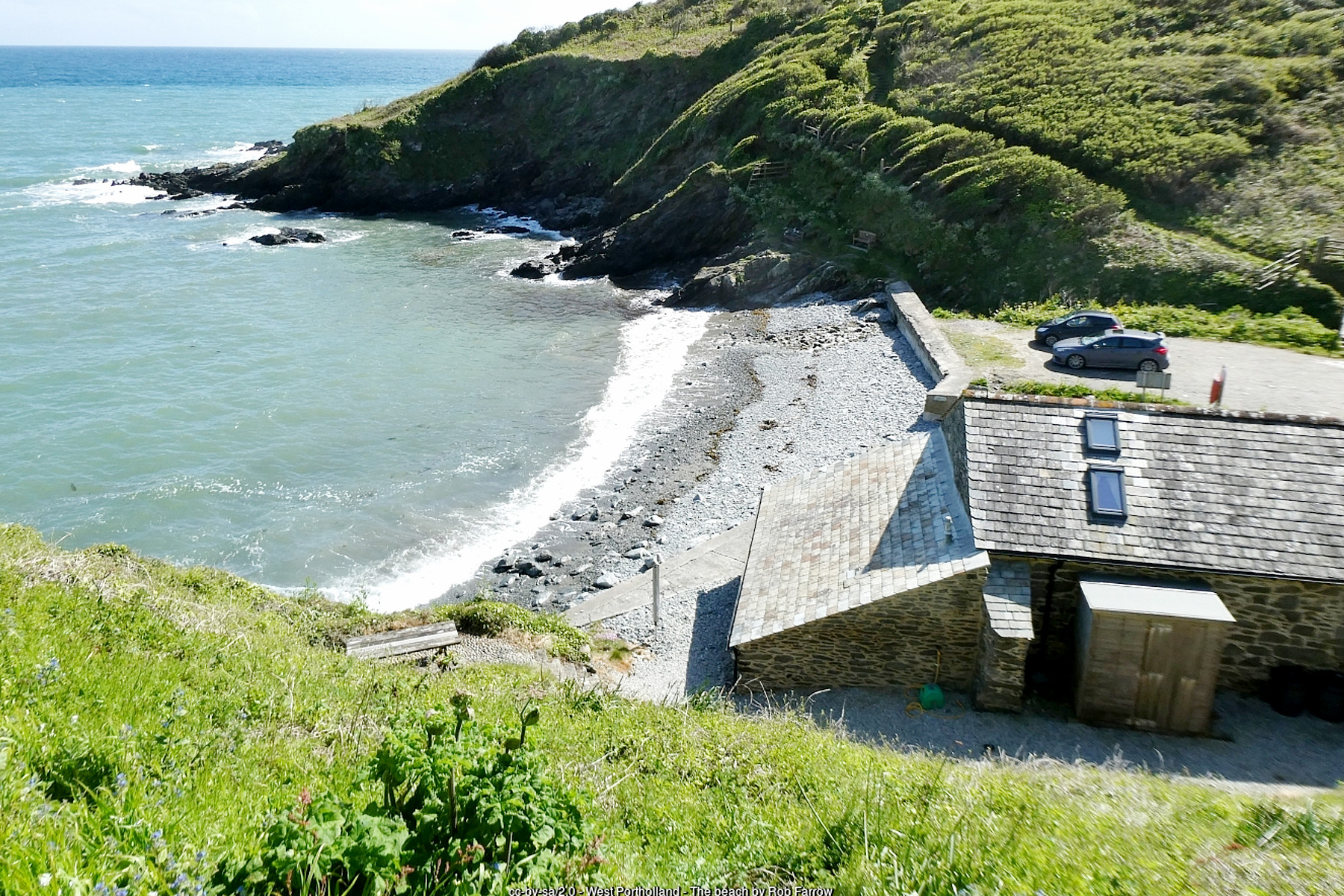
Portholland’s beach is really two small coves. At high tide the sea comes right up to the sea walls and the shingle at the top of each cove, and the two are cut off from each other by the rocks in the middle. As the tide falls, a sandy beach is uncovered below, the rocks between the coves are exposed only at their base, and you can walk the full length of the shore from East to West Portholland.
East Portholland is the slightly larger cove, with a sea wall, a slipway and a small stream running down to the beach, and the car park, toilets and café nearby. West Portholland is smaller and quieter still, with level access onto a mixture of sand and shingle beside the old lime kiln.
The rocks at either side of the coves are good for rock pooling at low tide, and the beach is generally sheltered from westerly winds. There is no lifeguard cover, the beach shelves into deeper water as the tide rises, and the cliffs can be unstable, so keep away from the cliff foot, check the tide times and take care when swimming.
See our Portholland beach guide in Cornwall Beaches for more, alongside the other beaches of the Roseland Peninsula.
↑ Back to topPortholland Beach at a glance
Where: Veryan Bay, between Portloe and Caerhays
Beach: sand and shingle, two coves joined at low tide
Faces: south, onto Veryan Bay
Lifeguards: none
Dogs: allowed all year
Parking: small car park at East Portholland, a few spaces at West
Facilities: toilets and seasonal café at East Portholland
Check the Met Office beach forecast and tide times before you go – the beach is mostly covered at high tide.
HISTORY OF PORTHOLLAND
The Cornish name is Porthalan, from porth, a cove or harbour, and Alan, probably the old name of the little river that runs down to the sea here. The stream between the two coves is also a parish boundary: East Portholland lies in the parish of St Michael Caerhays, while West Portholland is in Veryan.
For centuries Portholland was a small farming and fishing community. Boats were drawn up on the beach, and lime was burnt in the kilns at West Portholland to sweeten the acid fields – the twin kilns there are probably 18th-century and are now listed. Above West Portholland, Pengelly Farm is one of the last of Cornwall’s medieval coastal farmsteads, with records going back to the 15th century.
The land belonged to the Caerhays estate, held by the Arundell and then the Trevanion families from the Middle Ages. After John Bettesworth-Trevanion bankrupted himself building Caerhays Castle, the estate was sold in 1853 to the mining magnate and MP Michael Williams, whose descendants still own Caerhays – and most of Portholland – today. (Older accounts often give the date of the sale as 1860.)
The cottages that line East Portholland were built in the mid 19th century, and the terrace of Nos. 1–6 is now a listed building. Methodism was strong here: West Portholland had Bible Christian chapels built in 1858 and 1878, and East Portholland has a Wesleyan chapel of 1881, where Methodist services for the whole of Portholland have been held since 1994.
The hamlets once had a small shop and post office, but these have now closed. Thanks to the estate, though, Portholland has escaped modern development and remains one of the most unspoilt settlements on the south Cornish coast, within the Cornwall National Landscape (formerly the Area of Outstanding Natural Beauty).
↑ Back to topPortholland – key dates
Middle Ages – Caerhays held by the Arundells, then the Trevanions
15th century – Pengelly Farm first recorded
18th century – lime kilns built at West Portholland
1807–10 – John Nash builds Caerhays Castle
1853 – Michael Williams buys the Caerhays estate
1858 & 1878 – Bible Christian chapels at West Portholland
1881 – Wesleyan chapel at East Portholland
2015 – Miss Peregrine filmed at East Portholland
Key Buildings & Places
- Nos. 1–6 East Portholland – the mid 19th-century terrace of estate cottages facing the cove, Grade II listed.
- The lime kilns, West Portholland – a pair of slatestone kilns built into the hillside, probably 18th century, Grade II listed.
- Portholland Methodist Chapel, East Portholland – the Wesleyan chapel of 1881 beside the brook, still used for worship.
- Pengelly Farm, West Portholland – one of the last surviving medieval coastal farmsteads in Cornwall.
- Caerhays Castle – John Nash’s castellated mansion of 1807–10 above Porthluney Cove, Grade I listed, a mile along the coast.

MISS PEREGRINE FILMING GUIDE
In 2015 Tim Burton’s film crew came to East Portholland to shoot Miss Peregrine’s Home for Peculiar Children (2016), starring Eva Green, Asa Butterfield and Samuel L. Jackson. The hamlet played the village on Cairnholm, the remote Welsh island where Jake goes in search of the children’s home his grandfather told him about.
- The cove and cottages – the row of cottages, sea wall and slipway at East Portholland formed Cairnholm’s harbour village.
- The Priest Hole pub – the island inn where Jake and his father stay was a set built on the East Portholland car park and removed after filming.
Nothing of the film set remains, but the view of the cove from the lane is instantly recognisable.
↑ Back to topNOTABLE PEOPLE
- Michael Williams (died 1858) – Cornish mine owner and MP for West Cornwall, who bought the Caerhays estate, including Portholland, in 1853.
- John Charles Williams (1861–1939) – inherited Caerhays in 1880 and created its celebrated woodland garden, sponsoring plant-hunting expeditions to China.
- John Nash (1752–1835) – the Regency architect of Buckingham Palace and the Brighton Pavilion, who designed Caerhays Castle above Porthluney Cove.
- Tim Burton – the film director, who brought Miss Peregrine’s Home for Peculiar Children to East Portholland in 2015.
COAST PATH WALKS
The South West Coast Path runs right through Portholland, following the lane over the hill between the two hamlets. Heading west from West Portholland, the path climbs onto the cliffs and switchbacks up and down through a series of steep valleys to Portloe, about two miles away – one of the most rewarding but strenuous stretches of the Roseland coast.
Heading east from East Portholland, the path climbs out of the village by the hairpin bend and follows easy clifftop fields for about a mile and a quarter to Porthluney Cove, with Caerhays Castle coming into view as you descend. Beyond, the path continues past Hemmick Beach and around the Dodman to Gorran Haven and Mevagissey.
A popular circular walk links Portholland and Portloe, going one way along the coast path and returning over the farmland inland.
- Portloe to Mevagissey (South West Coast Path)
- Porthluney Cove circular walk (South West Coast Path)
- Portholland to Portloe circular walk (iWalk Cornwall)
- Walking in Cornwall – Cornwall Online walks
CAERHAYS CASTLE & PORTHLUNEY COVE
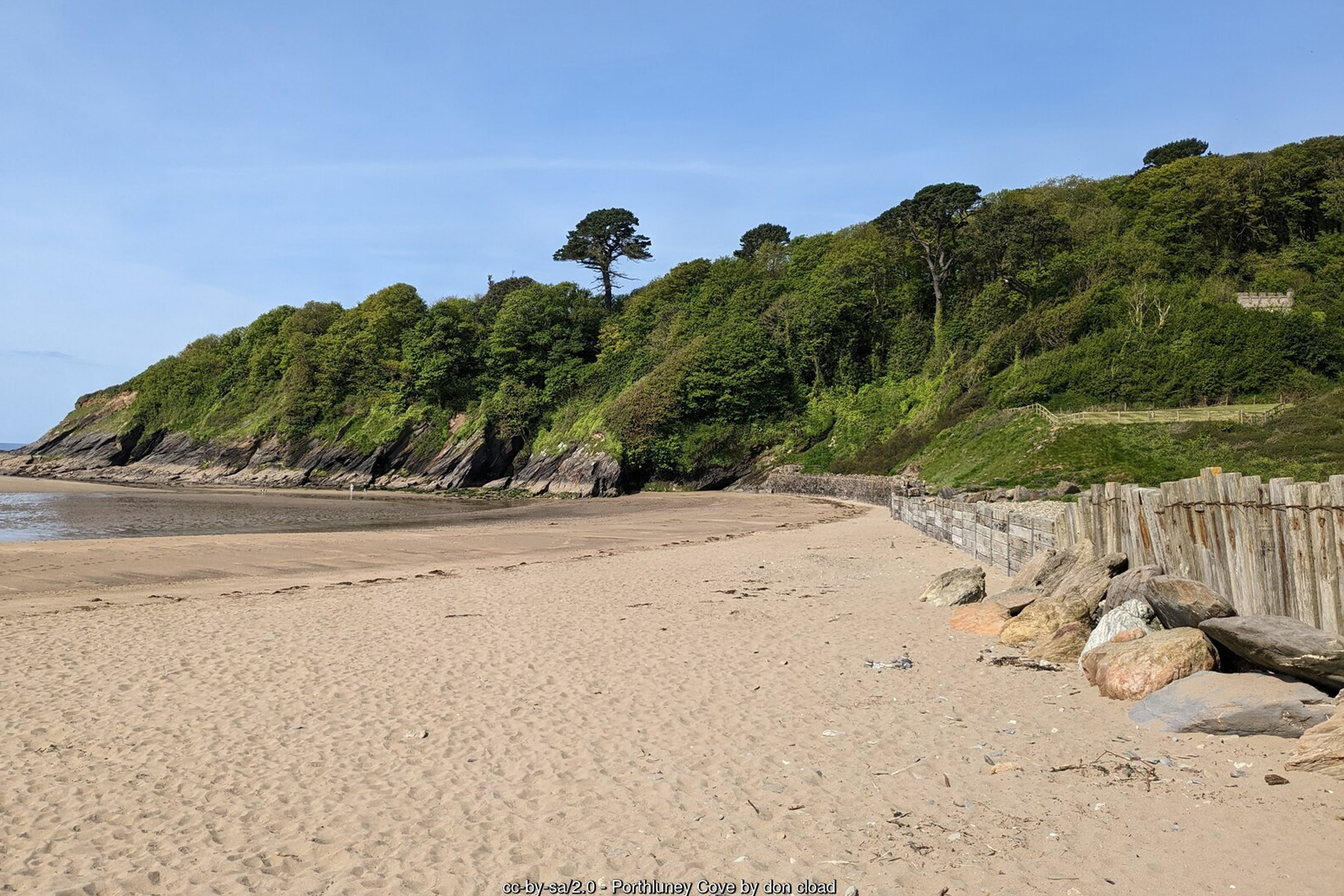
A mile or so east of Portholland, Caerhays Castle looks out over the wide sands of Porthluney Cove. The castle was designed by John Nash and built between 1807 and 1810 for John Bettesworth-Trevanion, whose debts forced him to flee to Paris in 1840. Michael Williams bought the estate in 1853, and his family have lived there ever since.
The castle is best known for its woodland garden, begun by J.C. Williams in the 1880s and filled with plants from Victorian and Edwardian plant-hunting expeditions to China. It holds the national collection of magnolias and is famous for its camellias and rhododendrons. The garden opens to visitors in spring, with tours of the castle on selected dates.
Porthluney Cove itself is a sandy, dog-friendly beach with a large car park, toilets and a café – a good alternative when parking at Portholland is full, and a lovely walk along the coast path.
- Caerhays Castle & Gardens – opening times
- Caerhays Castle & Gardens – Cornwall Online
- Porthluney Cove – beach guide
THINGS TO DO IN AND AROUND PORTHOLLAND
Portholland is a place for simple pleasures – rock pools and paddling, walks along the cliffs and quiet afternoons on the sand. For families, the sheltered coves and rock pools at low tide keep younger children happy. On rainy days, the Lost Gardens of Heligan, Mevagissey’s aquarium and museum, the Eden Project and the shops of St Austell and Truro are all within a drive.
- Walk the beach from East to West Portholland at low tide.
- Go rock pooling on the rocks at either side of the coves.
- Walk the coast path west to Portloe or east to Porthluney Cove.
- Visit Caerhays Castle gardens in spring for magnolias, camellias and rhododendrons.
- Spend a day on the beach at Porthluney Cove, Hemmick or Vault Beach.
- Explore Gorran Haven and the Dodman – see our Mevagissey & Gorran Haven guide.
- Visit the Lost Gardens of Heligan – Lost Gardens of Heligan.
- Discover the Roseland – Veryan’s round houses, St Mawes and St Just in Roseland – The Roseland Peninsula.
- See the Eden Project near St Austell – Eden Project.
- Find the Miss Peregrine locations at East Portholland – see the filming guide.
LOCAL EVENTS
- Caerhays spring garden season (spring) – the gardens open to visitors at the height of the magnolia, camellia and rhododendron season, with castle tours on selected dates.
- Mevagissey Feast Week (late June) – a week of music, processions and harbour events in Mevagissey, a short drive away.
- Fowey Royal Regatta (mid to late August) – one of Cornwall’s best-known regattas, further along the coast.
Dates change from year to year – check the Caerhays website and local noticeboards for this year’s events.
↑ Back to topPLACES NEAR PORTHOLLAND
- Portloe – a tiny working fishing cove, about two miles west along the coast path.
- Caerhays and Porthluney Cove – the castle, gardens and sandy beach, just over a mile to the east.
- Veryan – the village famous for its round houses, with Carne and Pendower beaches below.
- Gorran Haven and Mevagissey – the fishing villages on the far side of the Dodman.
- Tregony – the old market town on the River Fal, about three miles inland.
- St Austell and Truro – the nearest towns for shopping, around 9 and 12 miles away.
Roseland Beaches
From Gorran Haven and Vault Beach round to Portloe, Carne, Pendower and St Mawes – see all the beaches of the Roseland Peninsula in our Cornwall Beaches guide.
VISITOR INFORMATION
Parking & EV Charging
Portholland is reached by narrow, winding lanes from Tregony or St Austell via Caerhays – take care and use the passing places. There is a small car park at East Portholland and a handful of spaces at West Portholland, and both fill quickly on fine summer days. The large car park at Porthluney Cove (PL26 6LX), a mile along the coast path, is a good alternative.
Electric vehicle charging: there are no public chargers in Portholland. The nearest are in St Austell:
- Priory Car Park, St Austell – slow and rapid chargers (Evolt), PL25 5AA
- Tesco Superstore, Daniels Lane, St Austell – chargers (Pod Point), PL25 3HR
Bus & Train
There is no bus to Portholland itself. Go Cornwall Bus route 51 runs from St Austell to Veryan via Tregony, with some journeys calling at Portloe (Monday to Saturday) – from Portloe it is a two-mile walk along the coast path. The nearest railway station is St Austell, on the main line between Penzance and Plymouth. Check timetables before you travel.
Facilities & Supermarkets
There are public toilets and a seasonal café at East Portholland, but no shop – the old village store and post office have closed. Bring what you need, or stock up in St Austell:
- Tesco Superstore – Daniels Lane, St Austell PL25 3HR
- Other supermarkets in St Austell and Truro
Cafés & Restaurants
A small seasonal café at East Portholland serves drinks, snacks and ice creams by the beach. There is a café at Porthluney Cove below Caerhays, and pubs and cafés in Portloe, Veryan, Gorran Haven and Mevagissey. Opening hours vary out of season.
Health
The nearest GP surgeries and pharmacies are in the surrounding villages and in St Austell. The Minor Injury Unit at St Austell Community Hospital, Porthpean Road, St Austell PL26 6AA, is the nearest for minor injuries. Call NHS 111 for urgent advice and 999 in an emergency – ask for the Coastguard at the beach or on the cliffs. The nearest A&E is the Royal Cornwall Hospital, Truro.
Disabled Access
There is level access onto the beach at West Portholland and a short slipway down to the beach at East Portholland, with the car park close by. The beach is sand and shingle with rocky edges, and the lanes and coast path around Portholland are steep in places. Dedicated Blue Badge bays are not confirmed – check locally.
Vets & Dogs
Portholland has no seasonal dog ban – dogs are welcome on the beach all year round, as they are at Porthluney Cove. Keep them under control on the coast path, where there is often livestock in the fields. Vets nearby include Penmellyn Veterinary Group, 54A Holmbush, St Austell PL25 3LQ.
National Trust & English Heritage
The National Trust cares for much of the coast around Veryan Bay, including Dodman Point to the east and Nare Head to the west, and St Anthony Head at the tip of the Roseland. English Heritage cares for St Mawes Castle and, further east, Restormel Castle above Lostwithiel.
Attractions
Caerhays Castle gardens on the doorstep in spring, with the Lost Gardens of Heligan, the Eden Project and Mevagissey all within a short drive.
STAY & EXPLORE NEAR PORTHOLLAND
Official Information
FAMILY HOLIDAYS & SHORT BREAKS IN PORTHOLLAND
Family holidays in Portholland are about slowing down – rock pooling and paddling at low tide, picnics on the sand, walks along the coast path to Portloe and Caerhays, and evenings with nothing but the sound of the sea. With dogs welcome on the beach all year, it is a perfect spot for a peaceful holiday with the whole family.
Portholland has just a handful of cottages, so book early, or look further afield in Portloe, Veryan, Gorran Haven and the Roseland. Browse Portholland holiday cottages, or holidays and short breaks in Portholland for every type of accommodation.
Spring is a wonderful time for a short break, when the Caerhays gardens are in flower and the coast path is bright with primroses. Booking direct with the owner means no agency fees.
↑ Back to topFREQUENTLY ASKED QUESTIONS ABOUT PORTHOLLAND
Portholland is on Veryan Bay on the south coast of Cornwall, between Portloe and Caerhays, about nine miles south-west of St Austell. It is made up of two small hamlets, East Portholland in the parish of St Michael Caerhays and West Portholland in the parish of Veryan.
Yes, at low tide. At high tide the two coves are separated by rocks, but as the tide falls the sand joins up and you can walk along the beach from one hamlet to the other. Check the tide times and keep an eye on the rising tide.
Yes. Portholland has no seasonal dog ban, so dogs are welcome on the beach all year round. Please keep them under control and clear up after them, and keep them on a lead in fields with livestock on the coast path.
There is a small car park at East Portholland and a few spaces at West Portholland, reached by narrow lanes. They fill quickly on fine summer days, so arrive early. The larger car park at Porthluney Cove below Caerhays is about a mile away along the coast path.
Yes. There are public toilets and a small seasonal café at East Portholland. There is no shop – the old village store and post office have closed – so the nearest shops are in the surrounding villages and St Austell.
No. There is no lifeguard cover at Portholland. Much of the beach is covered at high tide, so take care when swimming, check the tide times and keep away from the foot of the cliffs.
Almost all of Portholland belongs to the Caerhays Estate, owned by the Williams family since Michael Williams bought it in 1853. The estate’s careful management has kept the hamlets largely unchanged since Victorian times.
Yes. East Portholland played the village on the Welsh island of Cairnholm in Tim Burton’s 2016 film. The Priest Hole pub seen in the film was a set built on the East Portholland car park and removed after filming.
Yes. The South West Coast Path runs east from East Portholland for about a mile and a quarter to Porthluney Cove and Caerhays Castle, and west from West Portholland for about two miles to Portloe, a strenuous but beautiful stretch of cliffs.