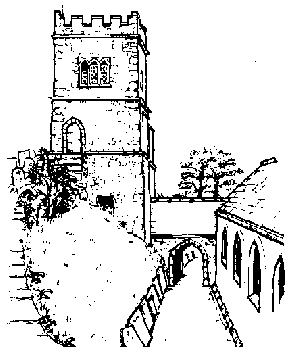
Discovering Cornish churches for the first time, visitors are often left with more questions than answers. Why are the buildings so solid and plain? Why are there so many names beginning with “Lan”? Who on earth were St Pinnock, St Veep and St Keyne? Why are so many parish churches on their own, often miles from the main villages? The answers lie in the simple truth that Cornwall is a land apart, with a history very different from the rest of England.
The unfamiliar saints to whom most of these churches are dedicated were Celtic missionaries from Ireland and Wales who, in the 5th, 6th and 7th centuries, brought to Cornwall a form of Christianity that had developed along different lines from the faith reintroduced to Saxon England by the Romans in 597 AD. These holy men and women established oratories, simple shelters of stone and wood, on the banks of tidal rivers or near springs on valley sides, not necessarily near centres of population.
The sites of many Cornish churches date back to these early days, and clues can often be found in old church and parish names. In Cornish, lann means a church site: originally an enclosed place containing a chapel and burial ground. Churches such as Lanreath, Talland and Lansallos preserve links with these early Christian foundations. At Lanteglos, it is “eglos” that means church; “Lan” in this name derives from “nans”, meaning valley.
The Normans rebuilt many Celtic chapels, but the great rebuilding of Cornish churches came in the 15th century, and much of what can be seen today dates from that period. In the words of Sir John Betjeman, they “are not so much architecture as building ... the best that a religious, remote people could do to make the House of God the most glorious building in the parish”.
The seventeen churches below form a cross-section of those found throughout Cornwall. Guidesheets and books may be available for further information at the churches. Parking is often available nearby, although access and parking can be restricted at some rural sites.
1. Braddock
There is an almost eerie loneliness in the situation of Braddock church, with nothing but the 19th-century Rectory (now a private house), the ruins of the gardener's cottage and the old glebe farm buildings for company. Originally a chapelry to St Winnow, Bradoc became a separate parish in the early 14th century. The original Norman church was cruciform and the font dates from this time. Nearby is the site of the Battle of Braddock Down, a famous Royalist victory in the Civil War.
2. Boconnoc
The little parish church of Boconnoc is set in the heart of a large and ancient private estate, part of which is also a deer park. The setting is almost perfect: the church, like a family chapel, perches on a terrace above the 18th-century house (not open to the public) and overlooks glorious rolling parkland and woods. There is absolute stillness here and a strong sense of another time, another century. The church, which has a bell turret rather than a tower, is largely 15th century and was restored in 1873.
3. Duloe
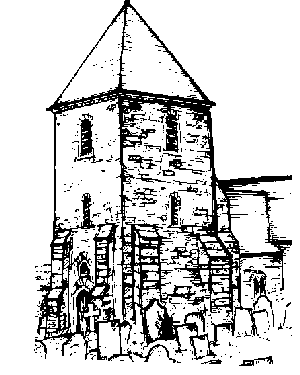
The two most interesting features of Duloe church are the tower and the Colshull chapel. The plan is unusual because the tower is attached to the south transept. This 13th-century tower is massive, like a keep, and appears to lean slightly. It is exceptionally well preserved and topped by a 19th-century pyramidal roof, said to approximate the original.
The north chapel, part of the 15th-century extensions provided by the wealthy Colshulls of Tremadart, is the glory of Duloe. Built as a chantry chapel where masses would be said for the souls of the departed, it is dominated by the tomb of Sir John Colshull, who in 1450 was the second richest man in Cornwall.
4. Lanreath
This is a remarkable church in a lovely village, with an unusually good restoration that allows visitors to experience clearly the atmosphere and fabric of a simple Cornish church in the 15th century. In its own time it would not have been outstanding; today it is.
Fragments remain of the earlier Norman church, including the squat goblet-shaped font with rich carving and a piece of an altar stone on the Lady Chapel windowsill, but the rest is wholly 15th century. Particularly wonderful is the wealth of old woodwork, some painted, in roofs, panels, bench ends, stalls, monuments and rood screen. There is a strong feeling of continuity of worship in this venerable building: ancient and glorious, yet still an unaffected village church.
5. Lansallos
Like a sentinel watching over the lonely sweep of Lantivet Bay, this now largely 15th-century church has an air of simplicity and solitude. This is an ancient holy place and the likely site of a Celtic monastic cell.
An old legend tells of the ghost of a monk who wanders down the church and across the graveyard. In this century the tower, a landmark for sailors and fishermen, has twice been struck by lightning.
6. Lanteglos
This beautiful church, crooked with age, nestles beside a farm in the folds of hills that dip steeply towards the Fowey estuary. A dubious legend relates how St Willow, the Irish missionary to whom the church is dedicated, was beheaded by a murderous kinsman at Lamellyon and then carried his severed head up the wooded path from Pont to the church site. The blood that fell along the way was said to have coloured the hedgerow flowers scarlet.
Daphne du Maurier walked up this same path from the little quay at Pont on the morning of her wedding in July 1932 to Major Browning. Inside, visitors can see the benefits of a sensitive restoration and enjoy a wonderful feeling of space.
7. Liskeard
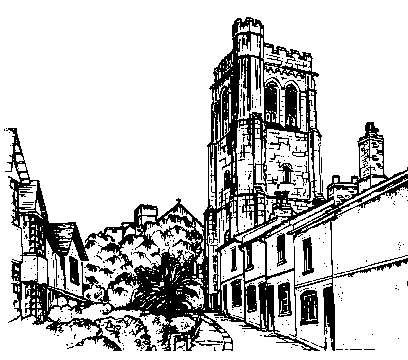
This powerful and impressive church towers over the huddle of streets and houses in the old heart of Liskeard. It is the second-largest parish church in Cornwall, after Bodmin.
Liskeard is one of Cornwall's oldest towns and, in the 15th century when much of the present church was built, it was also one of the wealthiest. The Norman church that stood here before may have resembled St Germans, with two towers flanking the west front. The sole tower standing today is modern but contains Norman remains, including a west doorway and upper windows. Other Norman work includes the font in the north porch and a deeply splayed opening in the west wall of the present north aisle, its apex only 7½ feet from the ground.
8. Lostwithiel
At first sight it is hard to believe you are in Cornwall, or even Britain. The distinctive octagonal spire of Lostwithiel church gives the ancient Cornish town a curiously foreign air. The church's peculiarity is not confined to its spire: inside, the nave is unexpectedly high, with clerestory windows above the lean-to aisles, rare in Cornwall. The piers of Pentewan stone are octagonal and smooth, and the line of the arches is unbroken by capitals, giving the interior the feel of a French monastery.
This is not entirely inexplicable: in the 13th and 14th centuries, when much of the church dates from, Lostwithiel was the capital of Cornwall, a busy port with overseas links, and the church belonged to the alien Priory of Tywardreath. During the Civil War, Roundhead soldiers are said to have baptised a horse in the font and blown up part of the church with gunpowder.
9. Morval
Morval Church has a strong sense of seclusion and privacy, due no doubt to its proximity to Morval House, a superb, largely Tudor building that is not open to the public. Although not far from Looe and a busy main road, here you are in another century, another world. Typically, the church is mainly 15th century and was harshly restored, but some old woodwork remains in the north aisle roof. A row of hat pegs, a lively Sunday School board and simple benches give it the air of a Victorian schoolroom.
10. Pelynt
This church, with its 14th-century tower, dominates the busy village of Pelynt, but was unhappily treated by Victorian restorers. The interior is dominated by a fine classical arcade of granite columns, erected around 1680 to replace the medieval pillars. Perhaps the chief attraction is the church's association with the renowned Trelawny family. The Trelawny chapel contains many relics, and an excellent brief history of the family is on sale in the church. The late poet Geoffrey Grigson, whose father was vicar here, gives an inspiring description of Pelynt church in his book Freedom of the Parish.
11. St Keyne
This small, crowded church, with a slender tower overlooking the village of St Keyne, is largely 15th century, although part of a Norman doorway remains to suggest an earlier building. The church suffered a severe restoration by J.P. St Aubyn between 1868 and 1877, and no old woodwork remains. The parish is chiefly famous for its holy well, signposted from the church.
12. St Martin by Looe
The old mother church of East Looe is tucked into the shelter of a hillside below the main road to Widegates. This is a fine church, largely 15th century, but with vestiges of the Norman cruciform building that once stood here.
Its wonderful Norman north doorway, dating from around 1140, is somewhat spoiled by an ugly Victorian porch. Inside there is a partly Norman font and much good woodwork, from the original wagon roofs to modern carving in the pews and rood screen.
13. St Nectan
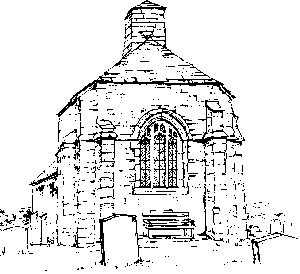
Dedicated to St Nectan, or Nighton, a Celtic hermit beheaded by pagan robbers in the 7th century, this tiny chapel has served the northern part of St Winnow parish since before 1284. The building has undergone many changes: extensions made in the last century were removed in the 1970s, and the present chapel was formed from the older structure. It is still in regular use during the summer.
14. St Pinnock
St Pinnock's fine, yellow-lichened tower can be seen from afar, nestling among the remote hills and plunging valleys that surround the West Looe River.
A tiny, peaceful church town gathers around this small church, which is now mostly 15th century and was heavily restored in 1882.
15. St Veep
Typically Cornish, this stout, strong church stands high above the Fowey River with just a few cottages for company. The Norman cruciform church was enlarged, like many others, in the 14th and 15th centuries and thoroughly restored in the 19th. Today the effect is one of rural simplicity, unadorned and light.
St Veep is renowned above all for its maiden bells: a complete ring of six bells that came from their moulds in perfect tune and have never had to be tuned, thought to be unique in England. They were cast in 1770 in the stillness of the night in a meadow opposite the church.
16. St Winnow
The glory of St Winnow is its position: ancient hallowed ground on the banks of the Fowey River, with little of the modern age intruding to spoil the peace of centuries.
Nothing but the holy site itself remains of the simple oratory perhaps founded by St Winnoc in the 7th century, and little remains of the Norman church that succeeded it. St Winnow is now largely 15th century and has been blessed with an unusually careful restoration.
The interior is made dark and warm by the wealth of old woodwork in roofs, benches and screen; there is an air of reverent grandeur here not often found in Cornish churches.
17. Talland
Huddled into a hillside to shelter from the sea on a lonely stretch of coastline, Talland is the mother church of West Looe and Polperro. Approach through the cramped churchyard along a path lined with slate headstones; the first sight of the detached tower is quite a shock. The lower storey of this tower is possibly 13th century, as are three lancet windows behind the organ in the west wall.
A late 15th-century wagon-roof porch links the tower to the church. The interior is light and simple, dominated by the marvellous 15th- and 16th-century benches. Pevsner writes that “the church is very completely pewed”.
Frequently Asked Questions
The Cornish word lann refers to an early church site, often an enclosed place containing a chapel and burial ground. Names such as Lanreath and Lansallos preserve a link with these early Christian sites.
Many early Christian oratories were established near tidal rivers, springs and valley sides rather than in the centres of later settlements. As villages developed over the centuries, the church could remain some distance from the main village.
Some church sites have early Celtic Christian origins. Many buildings were rebuilt or altered in the Norman period, and much of the fabric visible today dates from the 14th and 15th centuries, with later restoration.
Braddock Church stands near the site of the Battle of Braddock Down, a famous Royalist victory during the English Civil War.
Talland is the mother church of West Looe and Polperro. Its detached tower, late 15th-century porch and medieval benches are notable features.
Visiting rural churches
These are working places of worship as well as historic buildings. Opening arrangements, parking and access can vary; please respect church grounds and check locally before making a special journey.